

9 Chain Restaurants That Boomers Miss
There are few things that hit the big, red nostalgia button more than returning to the site of family meals long past. The very smell of a familiar restaurant can trigger memories that can bring us back to childhood days and, with any luck, give us a chance to pass similar memories onto the next generation.
For better or worse, though, the restaurant landscape is constantly evolving. Many of the familiar favorites of those who grew up in the Baby Boomer generation have been replaced due to intergenerational differences in food trends and dining styles, company mismanagement, or simply the difficulty of keeping a restaurant chain alive over several decades.
Some of these boomer favorite chains have gotten an investment shot in the arm and are trying to make comebacks, and some still operate far afield for those willing to make an international commute. Others are resigned to existing only in our memories, where we keep the torch burning and remember simpler days.
Kenny Rogers Roasters
There are celebrity endorsements, and then there's making your name synonymous with poultry. The latter is the path that country singer Kenny Rogers, of "The Gambler" fame, chose when he opened his franchise, Kenny Rogers Roasters.
This wood-grilled rotisserie chicken chain was conceptualized as an alternative to the fried chicken chains that were becoming so popular during the fast food boom of the 1980s. Co-created by the famous musician and John Brown Jr., the Kentucky governor who helped build KFC into the behemoth it is today, the restaurant quickly became a national favorite, expanding to 350 locations by 1995 and even making an appearance in an famous "Seinfeld" episode.
A $10 million lawsuit from Cluckers Wood Roasted Chicken in 1992, which alleged that Kenny Rogers Roasters had stolen its concept, was the first of several early 1990s speedbumps that eventually paved the way for the downfall of the tasty chain. Boston Market (then called Boston Chicken) established itself as a main competitor and grew rapidly in the mid-1990s. Meanwhile, fried chicken remained as popular as ever. In 1998, Kenny Rogers Roasters declared bankruptcy and was purchased first by Nathan's Famous, and eventually by Malaysian investors Berjaya Group. The chain technically still exists, just not in the U.S., where it deserves a comeback. For those who really can't live without The Gambler's chicken, a trip to one of the nearly 200 locations in Southeast Asia may be in store.
Casa Gallardo
Not every chain restaurant needs to make it around the world and back to be a familiar favorite. Some are beloved specifically because they remind us of home.
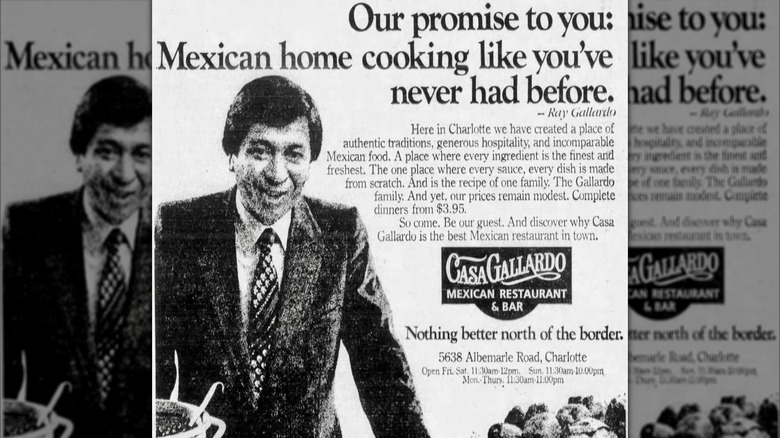
Enter Casa Gallardo, a St. Louis-based Mexican chain founded in 1975 by Mexico City-born Ramon Gallardo, with a vision of bringing family recipes from back home to the patronage of the Midwest. "Mexican home cooking like you've never had it before," the ads read. It was well received, with the restaurant's signature salsa becoming an institution, not just at the restaurant, but at grocery stores around the region. Gallardo was able to expand to a second location, and then expand again, and soon was made an offer by General Mills, who wanted to get into the growing and lucrative Mexican restaurant scene.
After branching out across the St. Louis area, it eventually spread to 34 locations nationwide with the help of its corporate backing. In 1981, Casa Gallardo reported $20.4 million in sales. Then came the downfall: General Mills decided to sell the chain in 1974, but rebuffed Gallardo's offer to regain ownership, instead selling to restaurant group W.R. Grace, owner of El Torito, one of Casa Gallardo's main competitors. That purchase didn't last long. The company changed hands again, and and then again. Locations closed, and by 2011 only four Casa Gallardo locations remained, all in the St. Louis area. By 2012, all traces were gone, except in the memories of those who loved it. In a 2025 Facebook poll conducted by St. Louis' FOX 2, it was voted the most missed restaurant for St. Louis diners.
Bennigan's
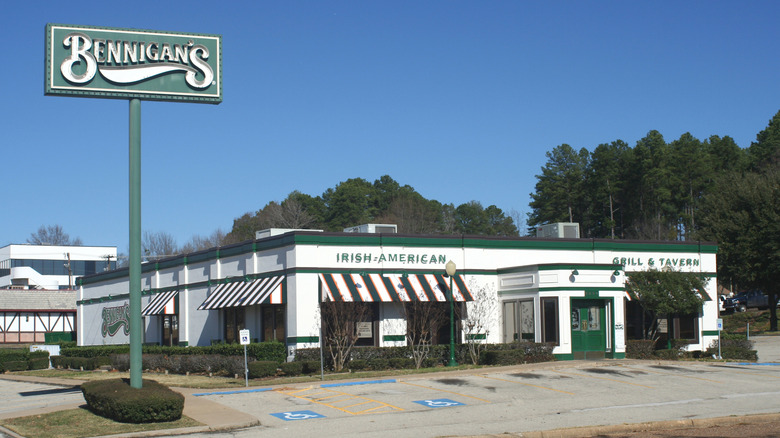
When you think of an Irish pub, there are a few staples your mind undoubtedly go to: quiche, chimichangas, Monte Cristo sandwiches covered in powdered sugar ... okay, maybe it's fair to say Bennigan's took a laissez-fair approach to its Irish inspiration. But one didn't go there for the authenticity of cuisine.
Bennigan's was, simply put, a good-vibes Irish-themed pub that promoted itself as family friendly and didn't take itself too seriously. It was created in 1976 under the Pillsbury corporate umbrella following the success of co-creator Norman E. Brinker's Steak and Ale chain. Brinker was more than just your typical corporate restauranteur — he is credited with inventing the concept of the salad bar for casual dining restaurants, and his chain also created the standard greeting many restaurants' waitstaffs still employ today.
As is the case with so many of these chains, the constant expansion to over 300 locations in the face of shifting landscapes and competition catching up ended up being difficult to keep up with. Food quality decline, a menu that didn't change as consumer tastes did, and poor location choices are cited as reasons that led to lower customer turnout and the company declaring bankruptcy in 2008. Casual dining was no longer a novel concept, and there were fewer reasons to choose Bennigan's. However, there is good news: Paul Mangiamele took over the company in 2015 and has been leading a comeback of the brand. Outside of international locations and Bennigan's On The Fly outposts, there are currently six Bennigan's locations still operating in Illinois, Iowa, Texas, and North Dakota.
Ponderosa Steakhouse
Sometimes the key to success is simply asking the right question. Ponderosa asked "what's better than a steakhouse?" and decided the answer was, "a steakhouse that's also a buffet," and America largely agreed.
The restaurant started from humble beginnings: A former McDonald's franchise manager and a car salesman with a piece of highway property in Indiana used the success of an up-and-coming chain called Bonanza Steak Pit, later known as Bonanza Steakhouse, to create their own buffet-style, low-price steakhouse, with dinners starting at $1.39 when they opened in 1965. In a bizarre business intrigue twist, the owners of Bonanza trademarked the name The Ponderosa Restaurant to slow the copycat's success, but forgot to trademark their own name, which the Ponderosa creators trademarked in return. Finally, they traded trademarks and continued forward. After all that drama, the star-crossed companies eventually merged into one in 1989. Maybe it was fate.
At its peak, the company boasted around 700 locations, despite being considered by some to be one of the worst steakhouse chains. After all, what you missed in quality, you got in quantity, a tradeoff that has paid off for American restaurants since time immemorial. Poor management is generally considered the primary reason for the Ponderosa chain shutting down, as it changed hands multiple times over the years. There are currently 20 domestic locations left, mostly in the Northeast and Midwest, as well as a handful of international locations.
Beefsteak Charlie's
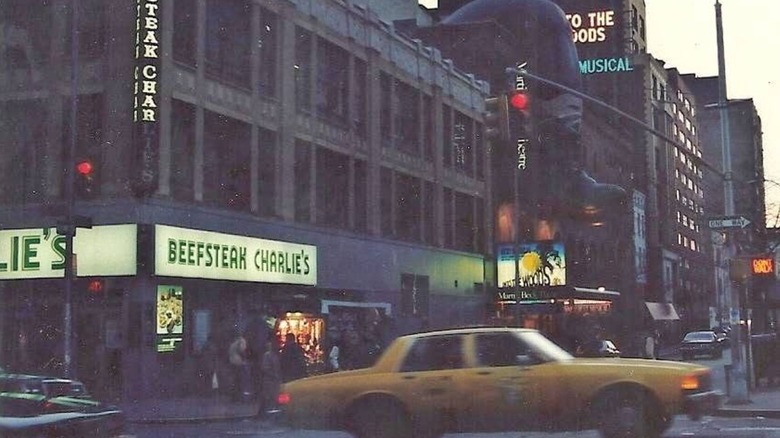
Beefsteak Charlie's rose to prominence serving steaks larger than the plates they came on and "offering a free beer for every two ordered" during the 1930s. By 1975, it had upped the ante, expanding into the ambitious (and dangerous) territory of all-you-can-drink beer, wine, and sangria. Truly, it was a different time.
It wasn't just the booze that was free-flowing though. Unlimited shrimp at the salad bar was a popular attraction and, perhaps, for those thrown by the concept of shrimp sitting out on a buffet line, gave new meaning to the slogan "I'm going to feed you like there's no tomorrow."
The chain was primarily located on the East Coast, especially in the New York area, and grew to more than 60 locations in the mid-1980s. But when the fall came, it came fast. In 1987, locations were starting to fold and the company sold to Bombay Palace Restaurants. By 1989, it was down to 35 locations, and three years later, only two franchises were left, both in Manhattan. Beefsteak Charlie's was out of business by 2001, leaving only the memories of bottomless beer washing down $7.99 filet mignon.
Chi-Chi's
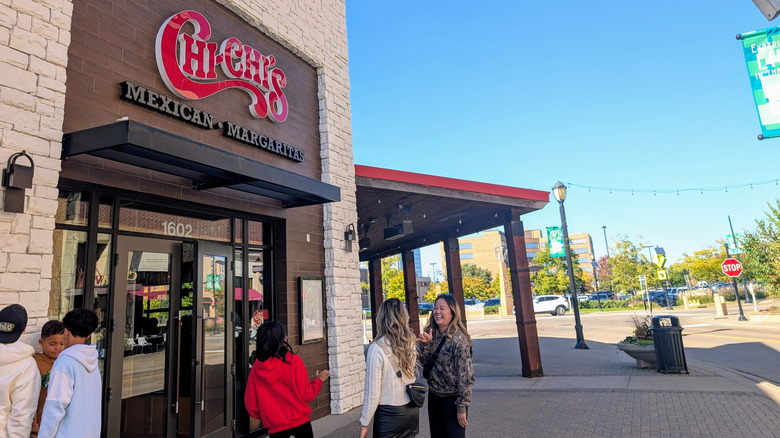
This may come as a surprise to those only familiar with the current food landscape, but there was a time when Mexican food was not ubiquitous or well-known. The rise of Taco Bell in 1962 as a beloved Mexican chain opened the door for the cuisine, and restaurants like Chi-Chi's (and its competitor, Casa Gallardo) took Taco Bell's fast food concept and ran with it, creating an industry of casual dining Mexican restaurants that would define the scene and introduce diners to Mexican food staples for years to come.
While Chi-Chi's wouldn't be mistaken for the food you'd find in Mexico City or Guadalajara, it became a family dining institution due to its bottomless chips and salsa, massive margaritas, fried ice cream, and, of course, the always-classic chimichangas. It was a place to feed the whole family on the cheap while providing a fun atmosphere, and, if it was your birthday, a lively song. In the 1980s, it was, simply, the place to be.
As is the case with so many other restaurants on this list, the company's impressive rise – growing to 210 locations in the 1990s — was followed by a precipitous fall. The common issues of miscalculated expansions and a feeling of staleness all played their part, but the true end came when a hepatitis A breakout tied to Chi-Chi's green onions led to multiple deaths. Unlike many of the others on this list, though, the story doesn't end there: 20 years after closing, the chain is making a comeback in Minnesota.
Burger Chef
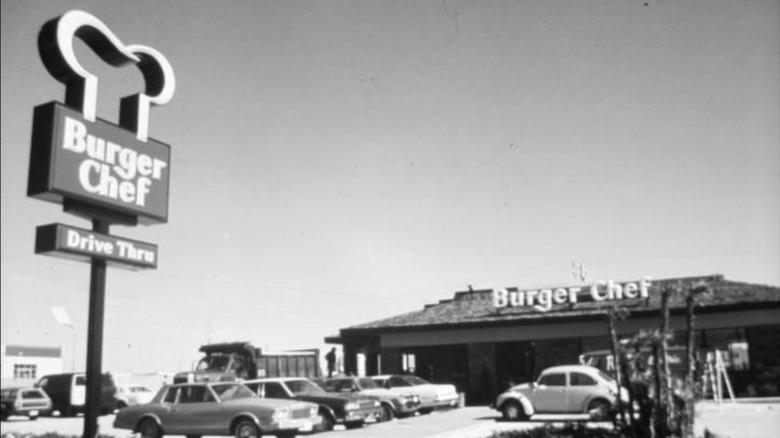
While Burger King boasts of its flame-broiled burgers, it was the chain's contemporary and competitor Burger Chef that is responsible for bringing the idea to the public conscience. Burger Chef was founded by three men — Robert Wildman and Frank and Donald Thomas — who helped design the broiling machines that would go on to give restaurants like Burger King their signature flavor. As a show of faith in their creation, they opened Burger Chef, which quickly exploded in popularity.
Opened in 1957, the chain was an instant hit, and by 1972 there were around 1,200 locations nationwide, with only McDonald's boasting more. Using its open-broil technique, Burger Chef could serve around 2,000 burgers an hour by the 1960s. It also pioneered many of the fast food staples we've become accustomed to, including a burger-fries-drink combo called the "Triple Threat," as well as the "Fun Meal," which featured dessert and a toy and preceded McDonald's Happy Meal by six years. Burger Chef even did themed Fun Meals, entering into a partnership with "Star Wars" in 1978 to create seven different offerings for the kids.
If you're wondering what happened to such an innovative chain and why it fell by the wayside as Burger King gained ground, it was bought by General Foods in 1968, which tried to expand into Australia, an effort that fell flat and cost the company tremendously. The final blow was a gruesome unsolved crime in which four employees were kidnapped and killed in Indiana in 1978. The company changed hands in 1982, with some locations being converted to Hardee's and the rest shutting down.
Pioneer Chicken
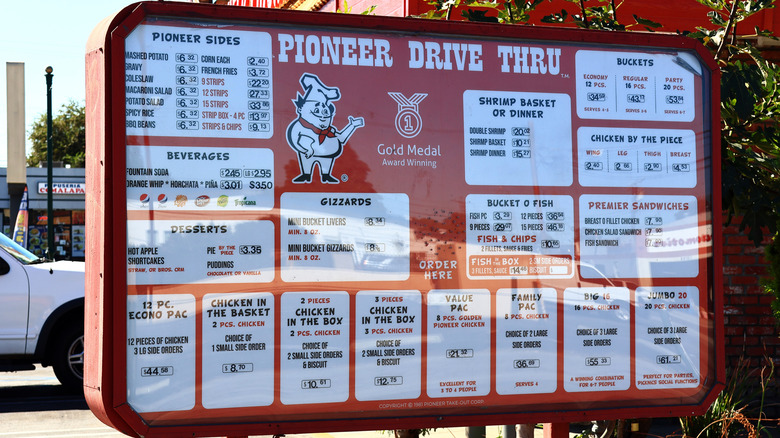
It would feel wrong to get through a whole list of beloved chain restaurants and not include a single fried chicken joint (apologies if that offends Kenny Rogers' wood-fired sensibilities). When it comes to fast food, California can at times be an ecosystem unto itself. While that claim may conjure images of In-N-Out and McDonald's, there was a moment in time — and that time was the 1970s and 1980s — when what it really meant was Pioneer Chicken.
An LA creation, Pioneer Chicken eventually grew to have 270 locations across the West Coast. It was crunchy, greasy, and delicious. More than that, it was iconic. It appeared in the lyrics for Warren Zevon's "Carmelita," ("Well I pawned my Smith Corona/And I went to meet my man/He hangs down on Alvarado Street/By the Pioneer Chicken Stand"), featured celebrities from Muhammad Ali and Kareem Abdul-Jabbar in its commercials, and had its own comic book.
Then, one day, it was gone. From 1988 to 1991, it faced multiple bankruptcy crises, and in 1993, it was bought by AFC Enterprises, with many locations being converted into Popeyes. While the glory days may be gone, there are still two locations in its home city of Los Angeles for those who want to see what it was about those chicken strips that made the band DeBarge consider it the perfect setting to feel the "Rhythm Of The Night."
Howard Johnson
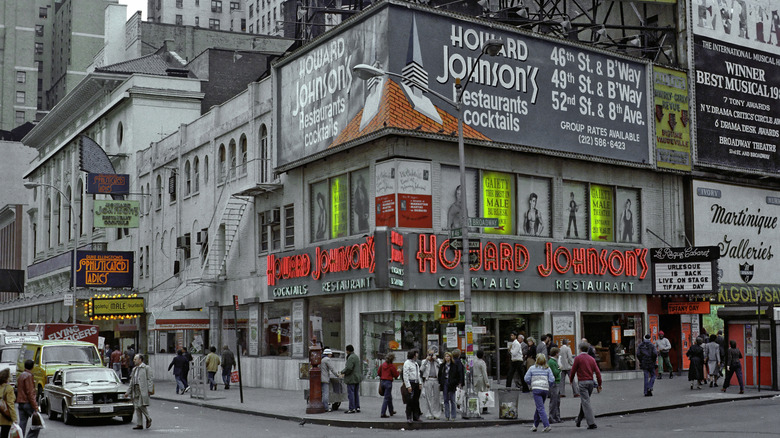
Howard Johnson was once a name ubiquitous with family trips, ice cream, and orange roofs. In 1925, the eponymous Johnson took a struggling family cigar business and made the unexpected switch to a combination drug store and soda fountain, quickly seeing that ice cream could be the way forward. From that decision, an empire was built.
In 1935, the first Howard Johnson's restaurant opened. By 1940, there were 132 locations, and Johnson's orange roofs had become iconic. But there was one final innovation left that would yield big results. Johnson realized he could attract more business if his customers also stayed the night, resulting in yet another unexpected pivot: the invention of the combination restaurant and motor lodge in 1953. By the 1960s, Howard Johnson's was not only the largest restaurant chains in the country, but also one of the largest roadside hotel brands.
Of course, by now readers will know what came next: while the hotels remain, the restaurant chain sadly went defunct. Attempts to cut costs led to a decline in quality at the same time that fast food competition began sprouting up everywhere. Until recently there was one Howard Johnson's restaurant location left, in Upstate New York, but in 2022 it shut its doors for good.