

14 French Desserts You Should Try Once In Your Life
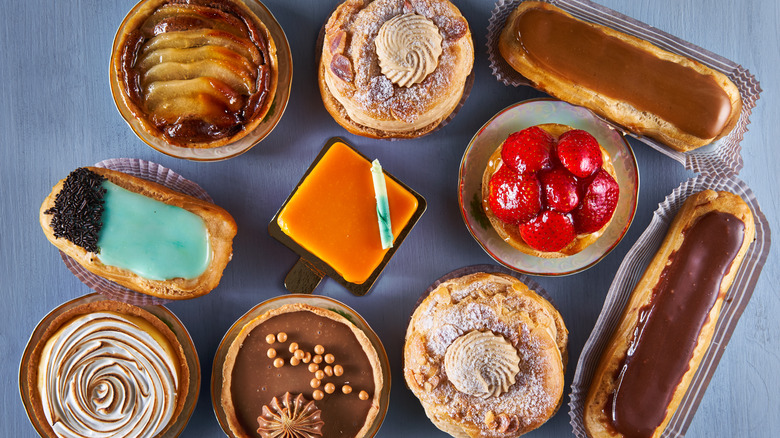
French cuisine is largely known for its decadent textures, flavors, and presentations, and this includes a long list of regional desserts. We all know about croissants, and, yes, when infused with the right sweet elements, they definitely count as a dessert, but that's just the tip of the iceberg when it comes to French desserts. In fact, there is a seemingly never-ending list of eye-catching sweet treats that hail from the country. The ones found below, though, are so mouthwateringly delicious that everyone should try them at least once in their lives.
If you aren't already familiar with French desserts, it doesn't matter if you are fluent in the language or not; the names of the country's culinary creations don't always alert you to what they actually are. With this in mind, if you're interested in sampling a few — why wouldn't you be? — but aren't sure where to start, we can help point you in the right direction. So, get your fork and spoon ready, because once you learn about the collection of French desserts below, you'll be dying to get your hands on them.
1. Tarte Tatin
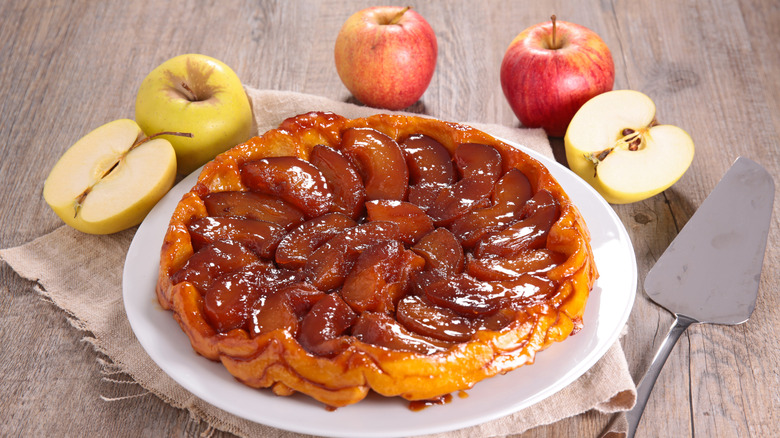
The tart Tatin may have a fancy name, but don't let that fool you. It is actually akin to an apple pie, just flipped upside down — and there's nothing extravagant about that. The French version of the dessert also has humble origins. As the story goes, in the late 1800s, Caroline (of Caroline and Stephanie Tatin's Inn, located south of Paris) forgot to put a crust on the bottom of her apple pie. Due to being exceptionally busy, she decided to put it on top instead and see what would happen. When she took it out of the oven and flipped it over, she saw that her misstep led to a happy result: The apples were beautifully caramelized. When she served it to the inn's guests, it was an immediate success, and the tarte Tatin was officially born.
Creating a tart Tatin is fairly accessible to novice home cooks. It only calls for five ingredients: apples, flour, butter, eggs, and sugar. The trickiest part is arranging the slices of fruit in a decorative way on the bottom of the pan. Actually, despite her massive culinary repertoire, Ina Garten admits it is the recipe she makes most because it is not only delicious, but easy to create, as well. If it's good enough for Garten to come back time and time again, you'd better believe it's a French dessert everyone should give a go at least once.
2. Crème brûlée
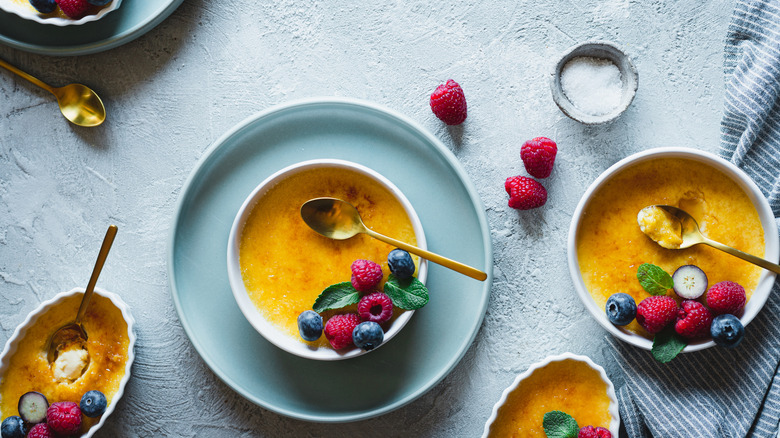
Crème brûlée is one of the most easily recognizable and widely popular French desserts in the United States, but, interestingly enough, its origins are somewhat disputed. France, England, and Spain all claim to be the birthplace of the dessert. Regardless, since its invention, wherever that happened to be, there's no doubt it has fully integrated itself into traditional French cuisine, and if you've never had the joy of eating one before, you are truly missing out.
In its most basic format, crème brûlée is made with just four ingredients: egg yolks, sugar, heavy cream, and vanilla bean. While simple, the elements come together to form a creamy, custardy delight. Then, the top is scorched to form a layer of burnt sugar that's to die for. Topping it with a couple of fresh berries is also customary, but either way, it is simplicity at its finest. In fact, this is one case where the sum is much greater than its parts. In addition to the sweet, rich flavor of the custard itself, part of the fun of eating one is using a spoon to crack the burnt layer on top. It not only adds a caramelized taste but contributes textural variation, and that is always a plus. Whether you decide to try your hand at making crème brûlée yourself or choose to seek it out from a restaurant, it's a French dessert that's worth your attention.
3. Éclairs
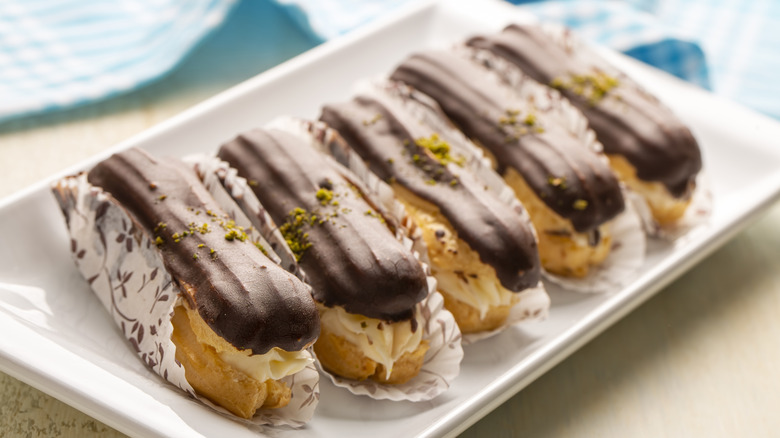
Éclairs have been around since the 1860s, and today, they are one of the more popular French desserts found in the United States. For good reason, too; they are tasty enough to go down in a flash. Speaking of which, the word directly translates to lightning.
Name and popularity aside, éclairs are made with choux pastry, which is similar to doughnut pastry, but devoid of baking soda, baking powder, and yeast, and relies on steam to rise. As a result, after being formed into long cylindrical pieces, the dough cooks up to be exceptionally light and airy. That's just the start of the legendary éclair, though. They are also filled with pastry cream or custard and then topped with either fondant or ganache icing — both of which are harder styles of icing, so you can still feel free to enjoy éclairs with your hands.
Arguably, the most popular flavor of éclair is chocolate, but thanks to the versatility of the choux pastry shell, they are welcoming to a world of other flavors as well. Everything from caramel to pistachio to Nutella to strawberry to matcha with chocolate and beyond can be found enhancing the delightful little pastry.
4. Yogurt cake
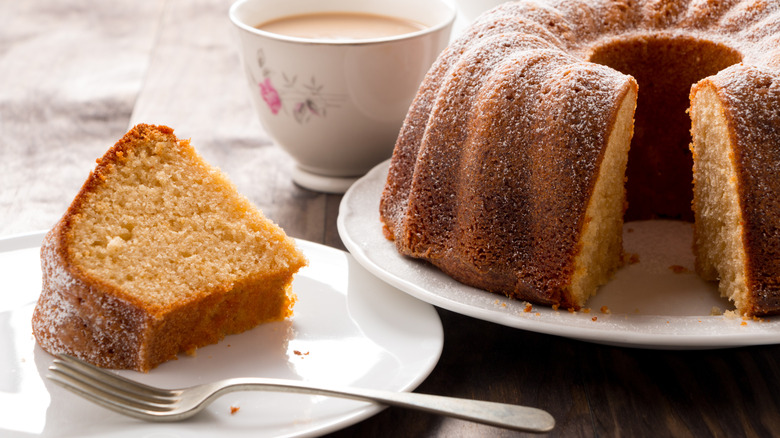
French yogurt cake, or gâteaux au yaourt in the native language, is another easy yet extremely satisfying dessert that deserves some time in the spotlight. In France, it is a popular recipe for kids to learn, likely because of the simple recipe, which calls for three eggs, one part oil, one part yogurt, two parts sugar, three parts flour, and leavening. Even so, when it comes out of the oven, you have a drool-worthy, slightly tangy cake that is moister than pound cake (if you can fathom that) while still presenting a delicate crumb.
Since French yogurt cake is not a common restaurant offering, if you want to give it a taste, you'll likely have to make one yourself. Or, at the very least, enlist a friend to do it — um, mom? Thankfully, though, it is one of the more straightforward must-try French desserts out there, so it should be attainable for even the most novice home cooks. The simplicity of the French yogurt cake also makes it prime for a plethora of flavor infusions. So, if you want to add citrus, or brandy, or fruit to the mix, go right ahead.
5. Crêpes Suzette
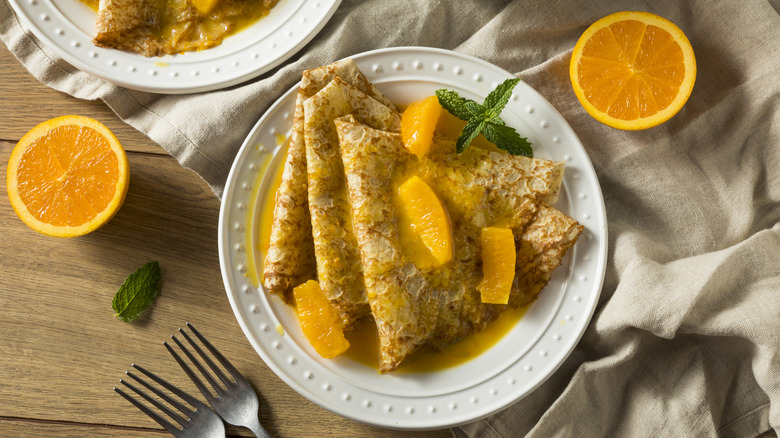
Crêpes are a delicately thin pancake-like creation that's ready and waiting for a world of flavor and ingredient infusions. Still, a Crêpes Suzette is quite possibly the most delicious and famous version of them all. It consists of classic crêpes in a sauce made of sugar, orange juice, and an orange liqueur, like Gran Marnier. The entire thing is also smothered in brandy and set on fire, which leads to a caramelized, citrusy, sweet flambé sauce that will draw just about anyone in. Heck, even watching a chef prepare one catches the eye, and that's why it's often done in full view when ordered in a restaurant.
Interestingly enough, crêpes Suzette is another iconic French dessert that was first created by accident — and this particular story is not disputed. In 1895, Henri Carpentier, a 14-year-old assistant waiter at the Maitre at Monte Carlo's Cafe Paris, was preparing dessert for the Prince of Wales (who'd later become King Edward VII of England). While doing so, he accidentally caught the cordials he was working with on fire, and instead of becoming flustered and starting over from scratch, he tasted the sauce and realized he'd come up with something extraordinary.
Don't let the flambé scare you too much if you want to try creating one at home; it truly does lead to exceptional flavor. However, you can still make a tasty rendition sans the potential fire hazard; it just won't be quite as authentic.
6. Mont Blanc
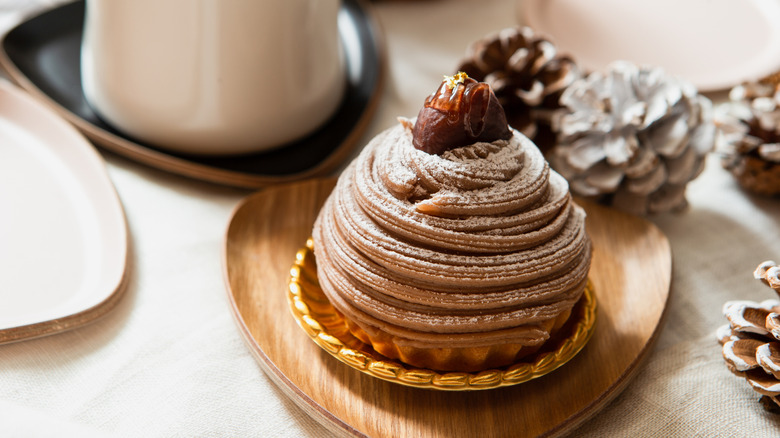
First and foremost, Mont Blanc is known for being the highest mountain in the Alps. However, for those in the know, it is also a delectable French sweet treat with Alpine-inspired appeal. In fact, when created, the Mont Blanc dessert resembles a snow-capped mountain peak, so the name is more than fitting. The exact origins of it is uncertain, but a reigning theory is that it was developed in Paris, France, in the 19th century. During that era, chestnuts started to grow in popularity in the region, and people began incorporating them into sweet dishes, instead of the customary savory ones.
The main components of a Mont Blanc dessert are as follows: It starts with a crisp meringue base, which is topped with thin strands of chestnut purée, and then finished off with a pile of whipped cream. Traditionally, a vermicelli tip is used to pipe the chestnut puree, but other shapes are also common. Either way, though, the yummy chestnut puree is the star of the show, offering a nutty, rich flavor that offsets the creamy whipped cream and meringue in a delightful way.
7. Macarons
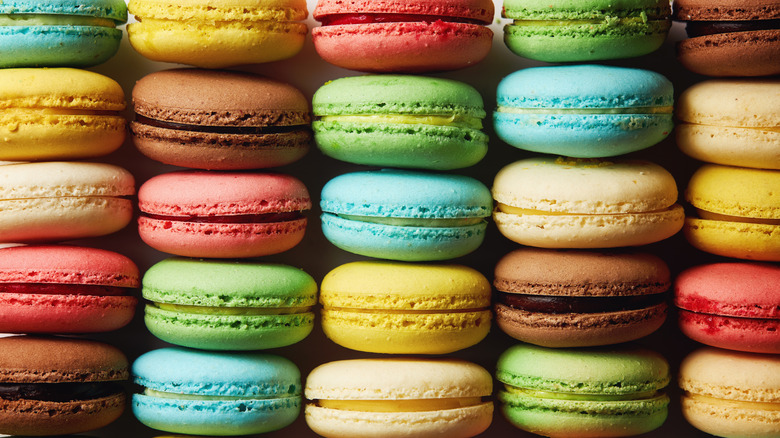
Macarons, not to be confused with macaroons (they are two entirely different desserts), are just about as French as it gets. Even if you have never tried one before, there is an extremely high chance that you have at least seen them. After all, it's hard not to spot them from across the room when present. Why? Well, they come in an assortment of rainbow colors, many of which are vividly bright. Hue aside, these tasty little cookie sandwiches are scrumptious, and since they come in a wide array of flavors, there's bound to be several for every type of preference.
Macarons consist of two airy yet chewy cookies made from almond flour, meringue, sugar, and food coloring. Between the two cookies, you find a sweet filling that not only adds textural variation, but even more flavor to the mix. The exact sandwich filling varies, but buttercream, marzipan, fruit (sometimes in jam form), and chocolate ganache are all common. No matter the exact ingredients, though, it is one treat that boasts lots of flavor and enough eye-catching appeal to serve as a centerpiece for a decorative table. Give them a try, and you'll see why they are the epitome of French baked goods.
8. Gâteau Basque
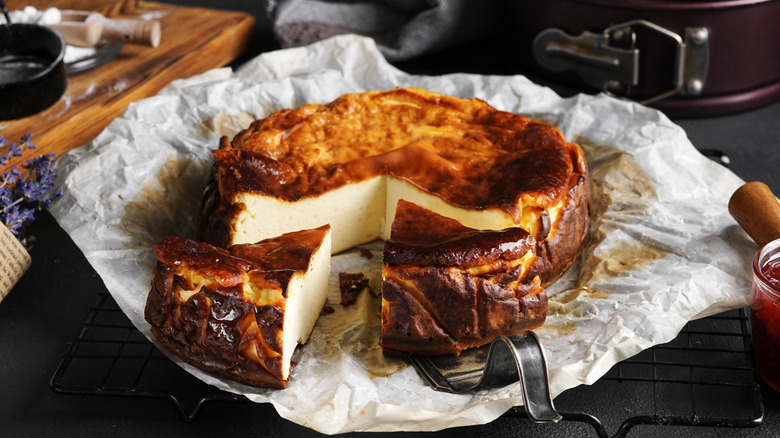
Gâteau Basque, aka Basque cake, has been described as being the adult version of Pop-Tarts. Considering the humble handheld snack's legendary status in the United States, you just have to give the elevated French recipe a try. It combines the best elements of a cookie, pie, and tart, and also features a pastry cream or cherry filling. Plus, it is a cake, so you get more of a mouthful than Pop-Tarts could ever provide. Um, yes, please.
Hailing from the Basque region in southwest France, the Gâteau Basque became widely popular in the 19th century. Its growth in the culinary scene is largely attributed to a particular baker, Marianne Hirigoyen, who first sold them in local markets before opening a brick-and-mortar bakery. Since then, the gâteau Basque's acceptance into French culinary tradition has been more than cemented. Actually, fast-forward to today, and there's now a museum and a two-day festival in October dedicated to the dessert. If that doesn't tell you exactly why it is a must-try French recipe, we don't know what would.
9. Canelé
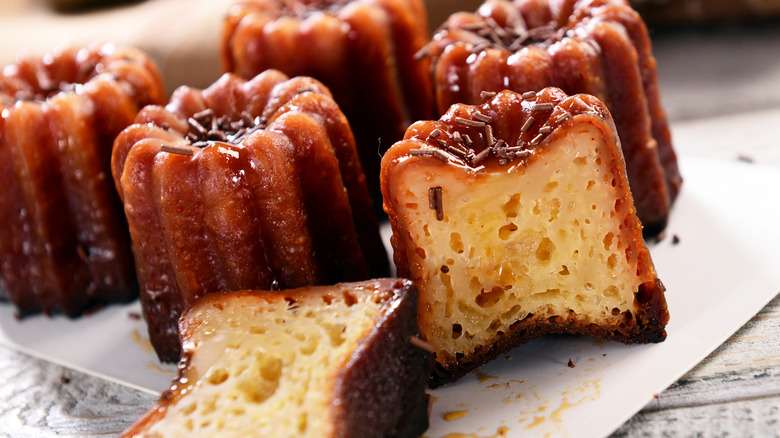
Whether you call them canelé, cannelé de Bordeaux, or canelé Bordelais, these yummy little French pastries are time-consuming to make — the dough needs to rest for up to 24 hours before baking. Even so, their delectable mix of textures and delicious buttery, custard-y flavors are worth the effort used to make them and then some.
Small and cylindrical with fluted edges, the center of canelés are made with flour, milk, sugar, butter, vanilla bean, eggs, salt, and rum. Once mixed with care, the dough rests for an extended time before baking in copper molds. After they're cooked, a delicious coating of edible beeswax and butter fills the molds and is also poured over the top before baking again. When that's done, you're left with delicious bite-sized (well, almost) custard-filled cakes featuring a caramelized crust on the exterior. Considering miniature copper fluted molds are not a customary tool in most homes, canelés aren't the first dessert we recommend trying to make at home. However, if you ever see them in a French bakery or restaurant, you'd be a fool not to give them a try.
10. Opera cake
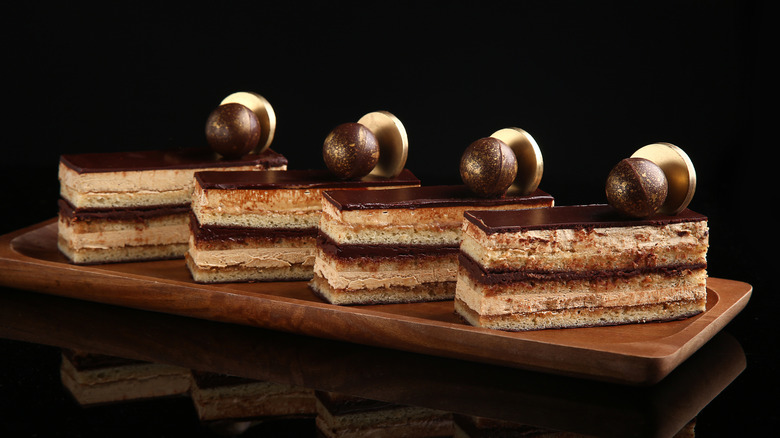
Opera cake is one of the coffee desserts that are always worth ordering, and guess what? It's also a French dessert everyone should try at least once. That is, of course, if you know what's good for you — and in this case, we truly hope you do.
Created by Cyrique Gavillon, the opera cake is just as much a thing of beauty as it is a delectable flavor wonderland. A rectangular-shaped cake at heart, it is made with alternating layers of coffee syrup-soaked almond cake, buttercream, and ganache, and then topped with a rich dark chocolate icing. Once completed, it not only looks stunning, but provides your palate with a mix of nutty, chocolatey, creamy, rich, coffee flavors that are hard to beat. Yes, it sounds a whole lot like tiramisu when the elements are taken at face value, but it is a delightful dessert all its own when it comes to how the ingredients come together. Plus, it's French, not Italian. Just saying.
11. Île flottante
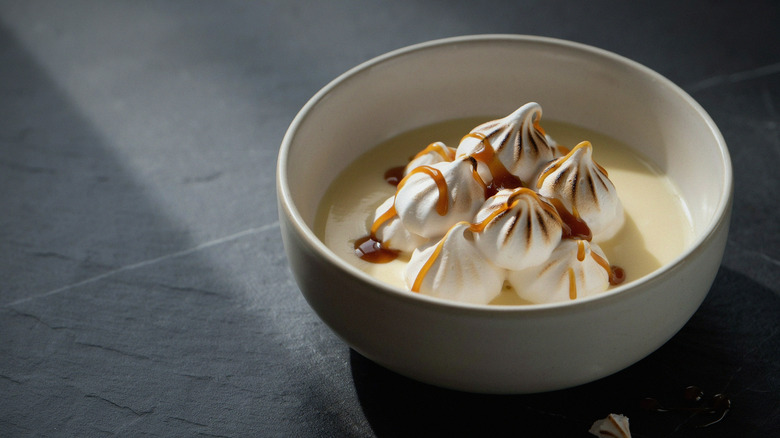
Île flottante, which translates to floating island, is the next French dessert we strongly urge you to give a try. It features large pieces of baked meringue floating in a pool of crème anglaise, hence the name. Traditionally, it is also topped with a caramel drizzle or spun caramel, but it is more than welcoming to other toppings, like crumbled cookies, nuts, fruit, and more. Think of it kind of like a melting ice cream sundae, but with a more decadent flavor and texture — the French would have it no other way.
While simple to make, the Île flottante presents itself as an elegant dish, and as such, is a mainstay in French cuisine. In fact, while it's said French people prefer to purchase dessert from a local bakery, it is one recipe many natives still have in their repertoire. It just so happened to be Julia Child's favorite old-school dessert, as well. Since she is credited with bringing French cuisine to the United States and helping it grow in popularity, following her lead regarding the greatest culinary hits of the country just makes sense.
12. Madeleines
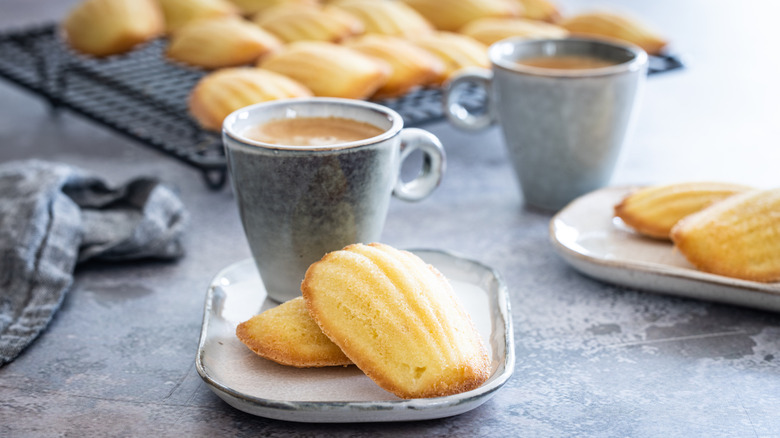
Not quite a cake and not quite a cookie, madeleines fall somewhere in the middle. Regardless of how you categorize them, though, they are another French dessert that's widely popular in its country of origin and beyond, so trying them is an absolute must.
Madeleines feature a unique shell-shaped structure, which makes them easily recognizable from other cake-like cookies. Still, the shape is just the first appealing thing they bring to the table. Traditionally made with flour, butter, sugar, eggs, and citrus zest (either lemon or orange), they offer up a mouth-watering aroma backed up by a soft texture that almost melts in your mouth. Straying from their original format, today you can also find creative renditions of the classic, like maple granola madeleines or dark chocolate espresso madeleines, and each is tastier than the last. Luckily, their widespread popularity means you can easily find them in French bakeries and even common grocery stores, so getting your hands on a batch shouldn't be challenging.
13. Profiteroles
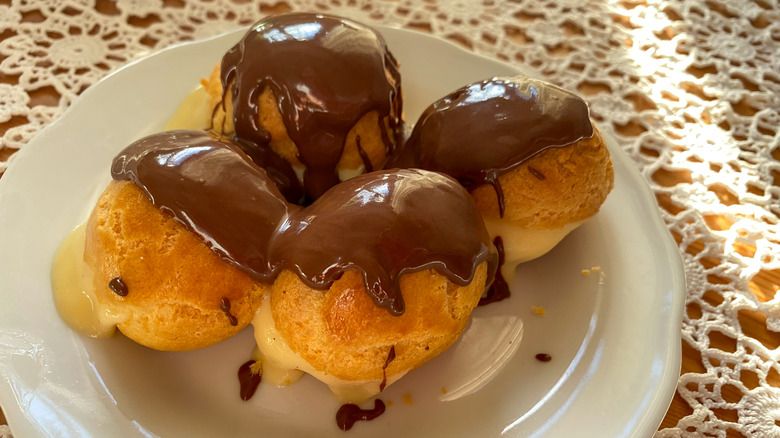
Similar to éclairs, which we've already discussed, profiteroles are made with hollowed-out choux pastry, filled with custard or cream, and topped with icing. What sets them apart is their shape. Instead of being long and cylindrical, profiteroles are formed into small bite-sized balls. As a result, they are the perfect sweet treat for bringing to a gathering or munching on if you simply want a few bites. However, once you get a taste of their scrumptious textures and flavors, trying to eat just one will be quite a complicated task.
Again, like éclairs, the most common icing flavor for profiteroles is chocolate. Still, they come in a myriad of other flavors, as well, so they have what it takes to pique the interest of many. For example, if chocolate is too one-dimensional for you — we are judging you — you can also make chocolate hazelnut profiteroles, vanilla ones, or just about any other flavor you can dream up.
14. Clafoutis
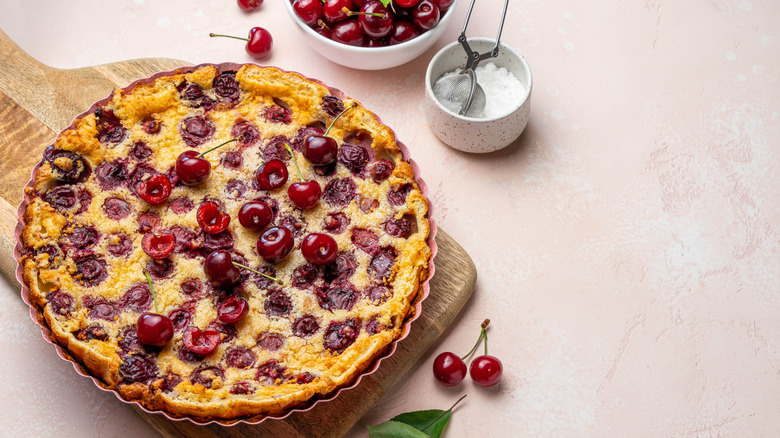
Last but certainly not least on our list of French desserts you need to try is clafoutis. The name may sound posh, but it's actually another sweet treat that's incredibly easy to make, so you don't have to be an established French baker to create one at home. Plus, it may be a dessert, but it is also acceptable to eat it for breakfast. Okay, now we are really listening.
Clafoutis consists of fruit smothered with a thick custard made from sugar, flour, milk, and eggs. The texture is akin to flan, but undeniably has all the French flair a Francophile could want. Most traditionally, cherries create the meaty fruit of clafoutis, but other berries and fruits, like raspberries, are also commonly used to pull off the recipe. While not necessarily a dessert, if you want to go in a savory direction, fruit can also be substituted for prosciutto, cheese, and tomatoes, so think of it like a choose-your-own-adventure type dish. No matter how you build it, though, clafoutis is one French creation that deserves more recognition, at least in the States.