

5 Changes McDonald's Filet-O-Fish Has Seen Over The Years
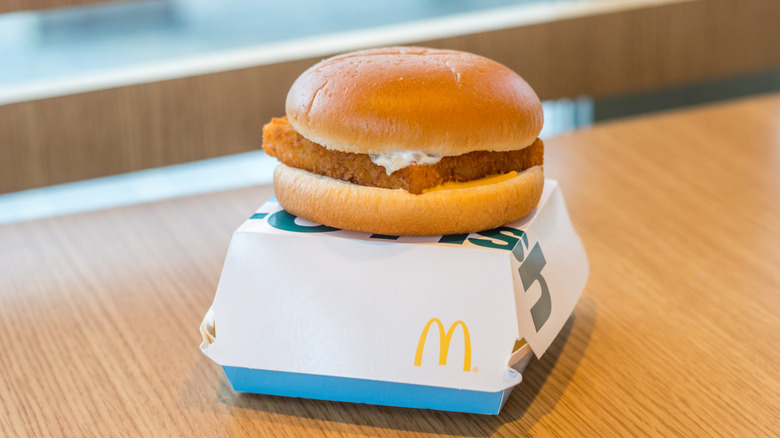
McDonald's Filet-O-Fish is nothing short of legendary. First introduced nationwide in 1965, the sandwich has gone on to become a cult classic and, as of 2026, remains the only seafood option on the U.S. menu. Naturally, like many of McDonald's oldest items, the Filet-O-Fish we know today is a little different from its original form. It's built with a breaded fish patty, a half-slice of American cheese, and tartar sauce, all sandwiched inside a steamed white bun. Going solely by the building blocks, it's essentially the same as the OG version. But pick apart the finer details, and several major differences begin to surface.
The original Filet-O-Fish was invented by Cincinnati McDonald's franchisee Lou Groen. In 1962, hoping to make up for dwindling sales from Catholic customers who abstained from meat on Fridays, he conjured up a fish-based alternative to burgers. The savvy concept proved promising but only made it onto the menu after a head-to-head sales showdown with then-CEO Ray Kroc's own pet project, the Hula Burger (a pineapple-and-cheese sandwich). The fish sandwich won by a landslide, and debuted with a breaded fish patty and tartar sauce on a steamed bun.
The formula was a recipe for perfection, which likely explains why the core ingredients haven't changed over the decades. But dig a little deeper, and you'll notice that the type of seafood used has gone through multiple iterations and international Filet-O-Fish variations abound. There have been plenty of unwelcome changes, too; price increases and alleged reports that the sandwich has shrunk in size have left fans irked. There was even a moment when McDonald's tried to replace the Filet-O-Fish outright, but the fact that it's still here spoils the ending of that story.
The Filet-O-Fish has featured several fish species over the years
The Filet-O-Fish is nothing without its crispy, breaded fish patty. But over the years, the chain has cycled through several different types of fish. The fish of choice in Lou Groen's original sandwich was halibut, prized for its thick, meaty white flesh and mild flavor. Yet despite its high quality, it simply wasn't feasible on a national scale. In an interview with USA Today, Groen explained the reasoning behind its eventual discontinuation: "I was paying $2 a pound for halibut. That sandwich cost me 30 cents apiece to make. They told me it had to sell for 25 cents. I had to fall back on Atlantic cod, a whitefish."
Although Groen wasn't thrilled with the swap, cod proved to be a reliable alternative. Simply put, it was the logical choice; it's exceptional for deep-frying, and its thick, sturdy flakes allow it to hold its shape while staying juicy inside. But its run eventually came to an unfortunate end.
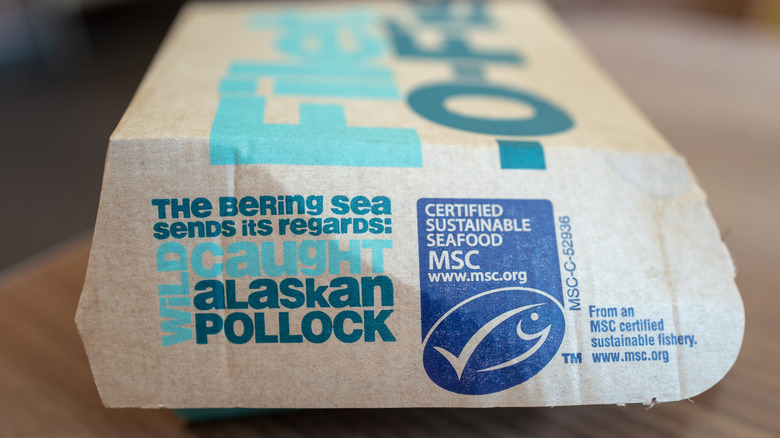
The decision to phase out cod wasn't based on quality but on sustainability. See, during the late 20th century, cod populations were nearly pushed to collapse by overfishing, creating an unsustainable situation for a chain operating on the scale of McDonald's. McDonald's ultimately transitioned to Alaska pollock, an abundant, more affordable species sourced from Marine Stewardship Council-certified sustainable fisheries. That's why every Filet-O-Fish box carries that familiar blue stamp.
Reports of a shrinking Filet-O-Fish have circulated for years
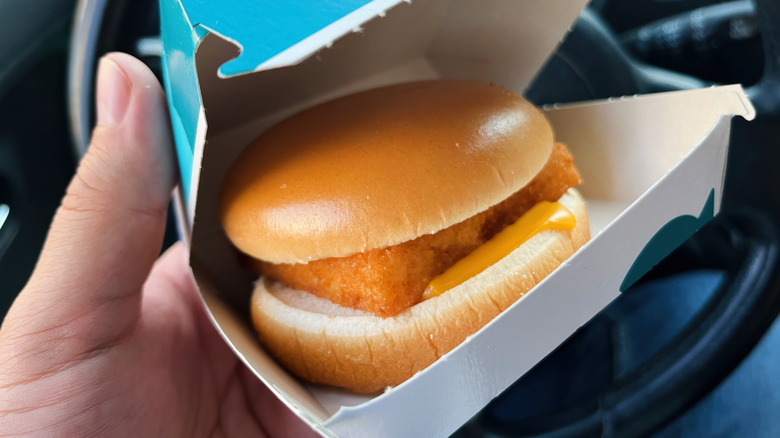
One thing all shoppers can unite over is a shared hatred of shrinkflation: a sneaky tactic in which companies make a product smaller while keeping the price the same. Several major brands have been caught doing this, and according to eagle-eyed customers, McDonald's Filet-O-Fish is also guilty. In a viral TikTok posted in 2023, one user claimed that "it was already small, but the Filet-O-Fish had shrunk by I'd say 20%."
This TikTok garnered significant backlash for McDonald's, and other content creators were quick to back up the original video's claim. The chain was left with no choice but to respond, asserting that "the size and build of the Filet-O-Fish, including a half slice of American cheese, has not changed in decades," in a statement to Business Insider. This was further corroborated by a former McDonald's corporate chef on TikTok.
Yet despite McDonald's vehemently denying claims that the sandwich has shrunk in size, it's still puzzling why so many fans are convinced of the opposite. Either it's a serious case of the Mandela effect, or there are other forces at work. One potential culprit behind the apparent shrinkage is the type of fish used. During high-heat cooking, fish naturally releases moisture, causing it to shrink. The formerly used cod is known to have a sturdier structure than Alaska pollock, meaning it may hold its shape better during frying. With that logic in mind, it's possible that more shrink-prone Alaska pollock could be behind the fillet's perceived smaller size — not shrinkflation.
The Filet-O-Fish boasts numerous international variations
We'd always encourage visitors to a new country to dive into the local cuisine, but international McDonald's locations have become something of a tourist attraction in their own right. According to McDonald's, "We try to adapt our menu to reflect different tastes and local traditions for every country in which we have restaurants. We're keen to respect cultural differences and so every country has its own policy of developing menu items." Few menu items represent this global approach more than the Filet-O-Fish. Sometimes, the gap isn't major — just look at the minor differences between the U.S. and U.K. Filet-O-Fish. Other times, though, the sandwich takes on a whole new form that's got fans wishing they could bring it home with them.
One region that does the Filet-O-Fish differently is Europe, where several countries offer the McFish alongside it. Forget about American cheese or tartar sauce; this simple version consists of just the classic Alaska pollock patty, a squeeze of ketchup, and, of course, the soft, steamed bun. In France, customers can also order the McFish Mayo, which — if the name hasn't already given it away — is the mayonnaise-based sister of the McFish.
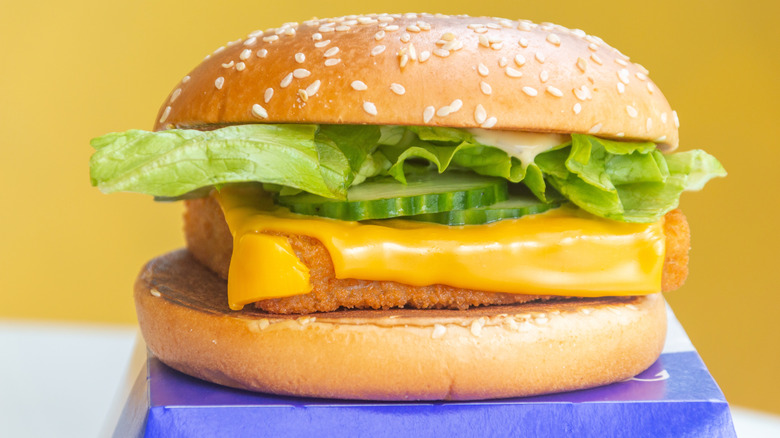
But if the McFish sounds too basic for your tastes, just hop on a flight to Sweden or Norway, where you can get your hands on the Fish McFeast. There's nothing minimalist about this one. It's essentially a Filet-O-Fish and a salad combined; it features the classic fish patty topped with cheese, tomato, iceberg lettuce, pickled cucumber, and chopped onion. It swaps tartar sauce for ketchup, mustard, and the mysteriously named McFeast sauce. Instead of a steamed white bun, it comes burger-style, served on a toasted sesame-seed bun.
The price of the Filet-O-Fish has risen over the years

When the Filet-O-Fish made its nationwide debut back in 1965, it would set customers back a mere $0.29, only slightly more than a hamburger or cheeseburger at the time. Decades later, however, the picture looks very different. Price is one of the biggest complaints customers have about the sandwich today. Look, price increases are expected over time, and no product is immune to them, but the Filet-O-Fish appears to have climbed at a significantly steeper rate than most other McDonald's menu items.
Prices vary from store to store, but customers should expect to pay around $5.59 for a Filet-O-Fish, and that's far from the high end. Some shoppers have reported paying upward of $7. Factor in a side and a drink, and the total can climb to $14 — not exactly a sum most people are looking to pay at a fast food counter. That price hasn't gone unnoticed, either, and it's only adding fuel to mounting criticism over the sandwich's size. On Reddit, one customer put it plainly: "I think [my McDonald's] charges something like [$7 to $8]. I like the fish burger, but it's not worth that price for the size."
These complaints are a major driving force behind the perception of shrinkflation. It's not just that the sandwich costs more; it's that customers are paying more for what feels like less. Even if McDonald's has stayed true to its word and never changed the size of the fillet, when the price climbs and the portion doesn't, it's only natural to feel like you're getting less bang for your buck.
The Filet-O-Fish was once nearly discontinued
Everybody knows McDonald's is no stranger to introducing new items and then swiftly pulling them from the menu. Some had short-lived tenures, like the questionable McLobster. Others sat at the opposite end of the spectrum, like Chicken Selects, a fan favorite that customers are still petitioning McDonald's to bring back. You might think that core, iconic items like the Filet-O-Fish are practically immune to discontinuation; think again. Back in 1996, McDonald's nearly ended its 30-year run.
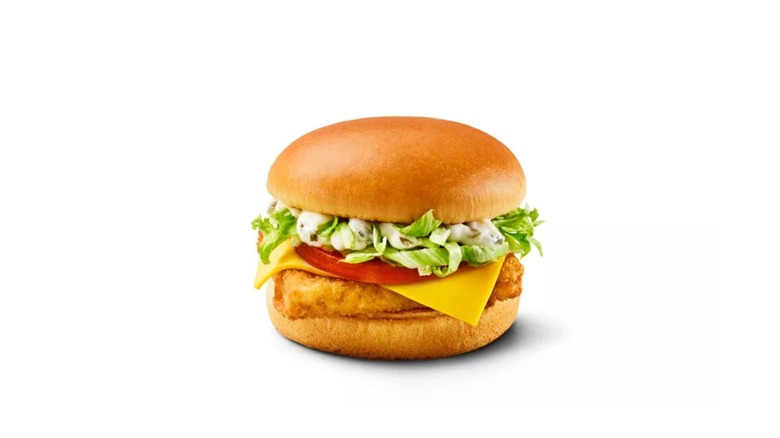
In September 1996, McDonald's pulled the classic Filet-O-Fish from U.S. menus and replaced it with the larger Fish Filet Deluxe, part of its new Deluxe line — a lineup of more sophisticated, adult-focused sandwiches designed to draw in a more discerning customer base. On paper, the Fish Filet Deluxe didn't sound half-bad. It kept the combination of tartar sauce and American cheese, added lettuce and a sesame-seed bun, and boosted the fillet's size by 50%. But fans simply weren't interested.
McDonald's realized its mistake too late. It hadn't anticipated the public's love for the Filet-O-Fish, and fans petitioned hard for the chain to bring the original fish sandwich back. McDonald's was quick to respond, and the Filet-O-Fish began making its comeback in 1997, temporarily keeping the bigger Deluxe patty. By 2000, the Fish Filet Deluxe had been phased out entirely. It wasn't just the fish sandwich that flopped, either; the entire Deluxe line was nothing short of a cataclysmic failure. McDonald's had budgeted a staggering $200 million to roll it out, and customers simply weren't buying into the new products.