

How A US And UK McDonald's Filet-O-Fish Are Different
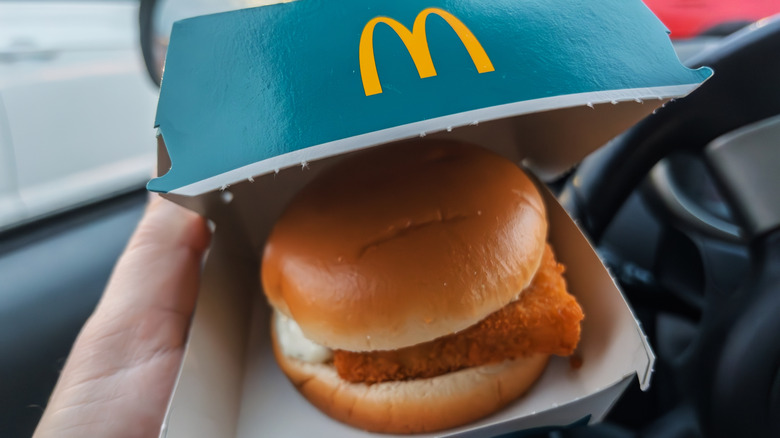
The Filet-O-Fish is one of McDonald's most iconic menu items, and has long been the go-to order for seafood lovers visiting the Golden Arches. But like many of McDonald's menu items, the Filet-O-Fish isn't exactly the same everywhere. With restaurants operating in more than 100 countries worldwide, the chain regularly tweaks ingredients and recipes to better align with local preferences and regional food standards. Some international Filet-O-Fish variations are dramatically different, while others feature only subtle (yet impactful) changes. The latter camp is exactly where the United Kingdom sits.
Unlike places like New Zealand, which swaps Alaskan pollock for white hoki, or some Asian locations that offer wasabi as an add-on, there aren't many obvious differences between the U.K. and U.S. Filet-O-Fish. The biggest giveaway is the type of cheese used, which is a prime example of a simple ingredient swap designed to better match local tastes. But beyond that, the two sandwiches seem much more alike than they are different.
While other Filet-O-Fish variations might sound more exciting, one thing that sets the United States' version apart is that it's the original version. The sandwich was created in 1962 by a Cincinnati McDonald's franchise owner seeking to develop a meat-free option customers could eat on Fridays during Lent. After proving to be popular, it was rolled out nationwide by McDonald's in 1965. The first international McDonald's only opened its doors in Canada in 1967, making the U.S. the only country that once had restaurants without it.
The United States Filet-O-Fish has a different nutritional profile
McDonald's was founded in the United States in 1940, but the Filet-O-Fish didn't become a permanent menu item until more than two decades later. Since then, the sandwich has developed a cult following and remains the chain's only long-standing seafood item at the Golden Arches.
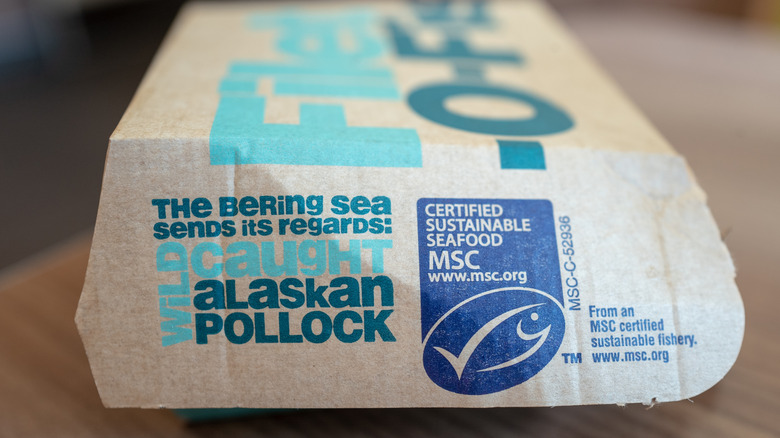
McDonald's in the United States proudly proclaims that its Filet-O-Fish uses wild-caught Alaskan pollock, while the sandwich in the United Kingdom is described more broadly as using white pollock. However, Atlantic pollock isn't native to British waters, but McDonald's U.K. has revealed that the fish it uses aren't from British waters, and on its website, McDonald's simply states: "Our famous Filet-o-Fish and Fish Bites use Pollock. All our fish comes from Marine Stewardship Council certified sustainable fisheries." While the British Filet-O-Fish claims to use white pollock, the Double Filet-O-Fish — a U.K. exclusive item — does claim to use Alaskan pollock. MSC-certified Alaskan pollock is still widely sold throughout Britain, particularly as frozen seafood products.
However, despite both sandwiches using Alaskan pollock, their nutritional profiles differ significantly. If protein is your priority, the McDonald's Filet-O-Fish in the United States comes out ahead with 16 grams of protein compared to the United Kingdom's 14 grams. But the most shocking difference is saturated fat. The U.K. Filet-O-Fish contains around 2.1 grams, while the U.S. version contains nearly double the amount at 4 grams. Interestingly, in the U.K., the tartare sauce uses rapeseed oil (a variety of canola oil) — whereas the U.S. uses soybean oil. Digging into the nutritional profiles of each sandwich, we discovered that soybean oil contains twice the amount of saturated fats as canola oil. This would likely explain the unusual disparity between the two countries' Filet-O-Fish despite their almost-identical base ingredients.
The Filet-O-Fish in the United Kingdom has subtle yet important differences
The Filet-O-Fish has been around since the start of the United Kingdom's McDonald's era. When the first branch opened in London in 1974, the Filet-O-Fish was already on the menu, featuring a cod filet that was sold for just 48 pence (roughly the equivalent of a mere 93 cents at the time). Beyond the (tragic) differences in price between then and now, this also means that British customers have come to know the Filet-O-Fish as an OG menu item.
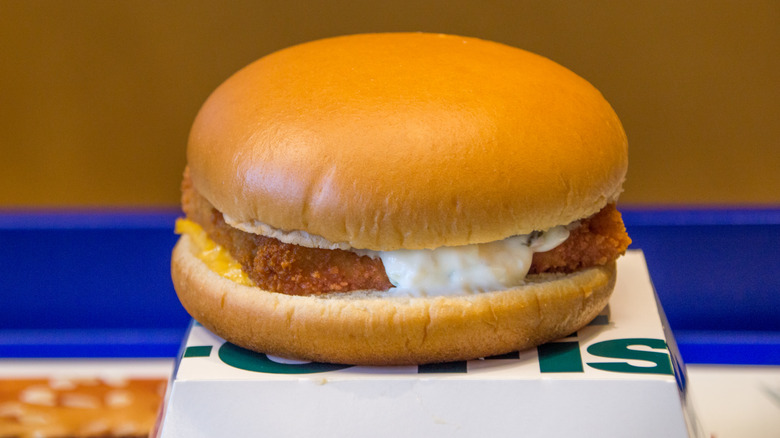
Compared to other international variations of the Filet-O-Fish, there aren't many obvious differences between the U.S. and U.K. versions at first glance. Both feature a breaded fish filet, steamed bun, tartar sauce, and the sandwich's signature cheese. But once you begin to look closer at the ingredient list, a few subtle yet impactful distinctions begin to emerge.
The U.K. version uses processed cheddar cheese slices rather than the American cheese found in the U.S. sandwich, which is a fitting choice given cheddars is, without a doubt, the U.K.'s most popular cheese. Like American cheese, processed cheddar melts easily and is commonly used across other McDonald's menu items in Britain. But compared to American cheese, which is usually a blend of multiple cheeses for a milder flavor, cheddar alone is known to have a sharper and richer taste. This difference is only made stronger by the fact that the U.S. sandwich uses only a half slice, whereas the British version opts for a whole one, giving the sandwich a noticeably cheesier profile.