

5 Dishes That Simply Taste Better In The Midwest

The Midwest is a region of the United States that can sometimes be difficult to define — although the federal government defines the region as comprising the Old Northwest and the Great Plains states. The former consists of states that were part of the western frontier before the United States expanded to the Pacific ocean and includes Ohio, Indiana, Illinois, Michigan, Wisconsin, and Minnesota. Missouri, Iowa, Nebraska, South Dakota, and North Dakota comprise the Great Plains.
Culturally, residents of each of the two components of the Midwest can often disagree on whether they're part of the same region, but to outsiders, all Midwestern states tend to have more in common with each other than they do with other regions of the United States — especially when it comes to food. And Midwesterners who leave the region often bond with each other, regardless of which state they're from, over cultural idiosyncrasies that may leave other Americans puzzled.
While popular stereotypes of Midwestern American food tend to revolve around bland casseroles and Jello-O salads, there is a lot more to this region's cuisine than most outsiders know about. Being an immigrant who married into a Midwestern family, I've experienced first hand what makes this region gastronomically unique and probably one of the most delicious parts of the country to live in and visit. Below are five dishes that simply taste better in the Midwest.
Cheese curds reign supreme here
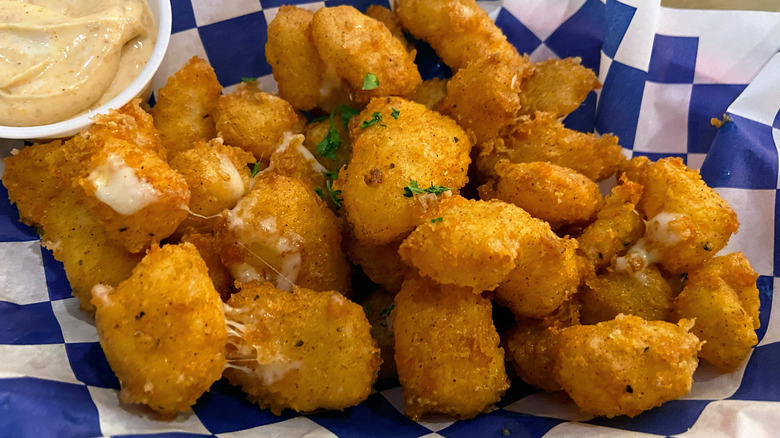
If you've had poutine made correctly, you've most likely had cheese curds. If you've had cheese curds outside of the Midwest (or Canada), there's a chance you haven't had real cheese curds — but rather cheddar cheese nuggets. Cheese curds were originally a byproduct of the commercial cheesemaking process, particularly cheddar cheese. After the milk has been coagulated and strained, the resulting curds are stacked, cut, stacked again, and pressed to remove moisture, which is called "cheddaring" and gives cheddar cheese its signature texture. Cheesemakers would then press these curds into molds, and any excess curds were sold as fresh cheese curds. Nowadays, they're so popular that Wisconsin cheesemakers make them intentionally.
Because the curds haven't aged, they have a mild, slightly tangy flavor and rubbery texture. The sign of a good cheese curd is if it squeaks softly when bitten. You can find this local delicacy almost everywhere in Wisconsin, and even gas stations and small farms will post signs advertising fresh cheese curds. After a few days, they start to mature, lose their squeakiness, and begin to resemble mild cheddar. Wisconsin cheesemakers can send cheese curds to other Midwestern states where they can still be enjoyed fresh, but by the time they reach more distant parts of the country, they've lost all of their signature characteristics.
Burgers are taken to a new juicy (Lucy) level
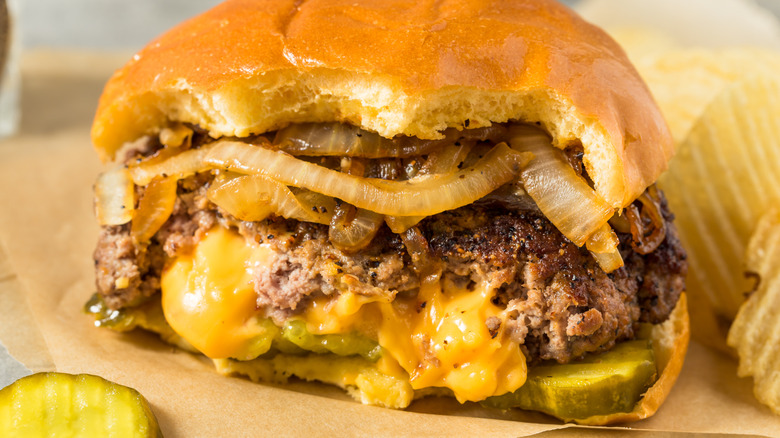
One of the best-ranked fast food burgers comes from Culver's, a chain that originated in Wisconsin and prides itself on using Wisconsin-sourced ingredients, making each burger fresh to order, and providing diners with customer service that rivals most chain restaurants. It serves a particular style of burger called a butter burger, which is a specialty of the Dairy State and distinguishes itself by its generously buttered and toasted buns. This chain is only present in 26 states, and most locations are in the Midwest.
White Castle, known for its palm-sized sliders, got its start in Wichita, Kansas in the 1920s, though it's now headquartered in Columbus, Ohio. Oddly enough, there are no longer any White Castle locations in the Sunflower State, and despite the brand's national recognition, the vast majority of its locations are in the Midwest. While the Southeastern United States has its version of miniature burgers via Krystal, in my personal experience, they pale in comparison, and the buns aren't as soft and fluffy as White Castle's.
No discussion of hamburgers is complete without mentioning Minnesota's contribution: the Juicy Lucy. This burger is stuffed with molten cheese that combines with the beef juices creating a creamy, meaty eruption the moment you bite into it. There are few traditional styles of hamburger in the U.S. that are as deliciously cheesy as this Midwest invention.
The Midwest has a love affair with sausage
The Midwest is a sausage lover's happy place, and there are so many varieties to choose from. Perhaps the most famous iteration is the Chicago hotdog made with Vienna Beef franks, a local brand with a really snappy casing. For the uninitiated, Chicago dogs are "dragged through the garden," meaning they come with a plethora of vegetable toppings, including a pickle spear, tomatoes, onions, relish, and spicy sport peppers.
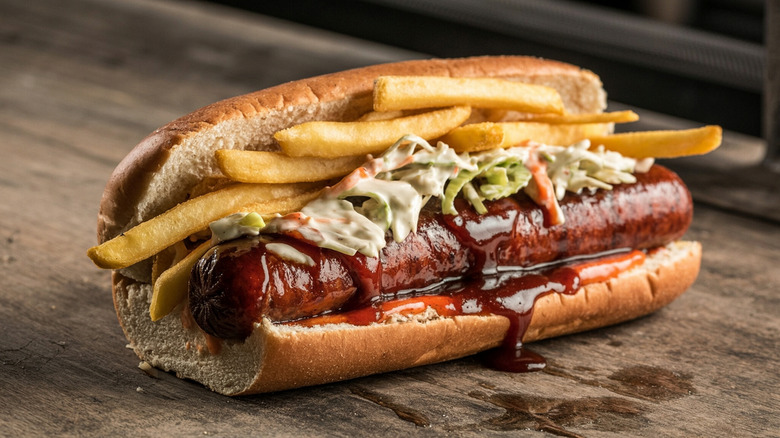
Further south in Cleveland, Ohio, a large Polish-American community made kielbasa almost synonymous with the city's culinary identity. You can find it in a Polish boy sandwich, which features kielbasa sausage on a bun topped with fries, coleslaw, and barbecue sauce. In Wisconsin, sausage has a more germanic flavor in the form of brats, short for bratwurst. Johnsonville is a popular local brand available at many retailers throughout the country, but there are many other local varieties that are nearly impossible to find outside the state. Just don't steam your brats in water (use beer instead), which is popular in Wisconsin.
The Midwest's sausages aren't all European, though. The Hmong community is a Southeast Asian minority that helped the U.S. during the Vietnam War and were later granted refugee status after the war ended. While most live in California, many of them relocated to Minnesota and neighboring Wisconsin. If there is one sausage I must eat every time I visit either state, it's Hmong sausage. It's porky, garlicky, very umami, and makes a filling meal with a side of sticky rice.
Wild rice grows freely in the Midwest
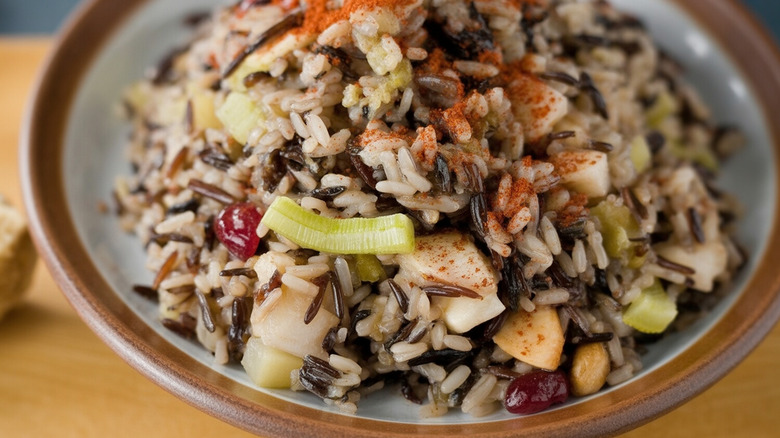
There is a chance that the wild rice you think you're eating isn't really wild; you may ask whether wild rice is actually rice (it isn't). It is one of North America's only native grains and grows wild in fresh bodies of water in the Upper Midwest, especially in Minnesota. It is a traditional staple of the Ojibwe Nation, one of the largest Native American groups north of Mexico, and they still harvest the wild grains by hand in canoes. In the 1960s, the University of Minnesota domesticated the grain and started planting it in paddies, and other states, like California, also began to cultivate it. But it's nothing like the real thing.
The jet-black sticks in your pilaf next to the chicken marsala at your coworker's retirement banquet bear little resemblance to the real thing, which has a creamy brown color and is much more tender when cooked. The bodies of water where wild rice naturally grows are protected in states like Minnesota and Wisconsin, and only Native American peoples are legally allowed to harvest it. It is pricier than the cultivated imposter, but is worth seeking out. Most locals, regardless of their ancestry, will always prefer the Native-harvested real variety, but it can often be difficult to find even where it's grown. Fortunately, it regularly makes an appearance at farmers markets and is often available to purchase online directly from local tribes.
Chili has an unexpected (but delicious) pairing
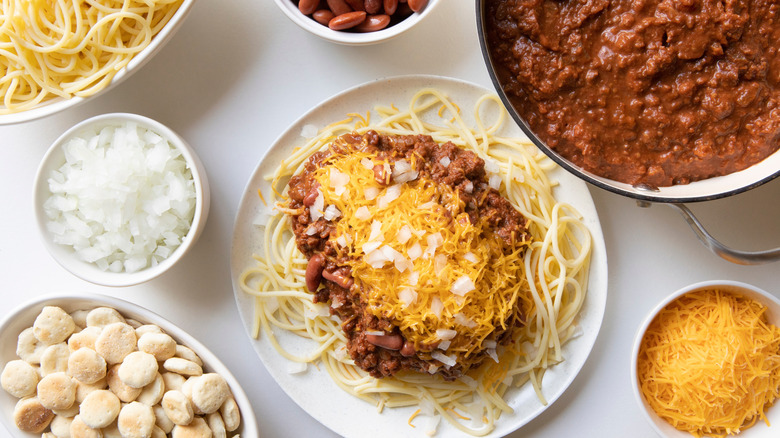
This one is going to be controversial unless you're from Cincinnati, Ohio. This city is home to the best style of chili — after my mom's, of course. My spouse introduced it to me when we were first dating 15 years ago, and it's now become a yearly Valentine's Day tradition. The reason I love it so much is because of its bouquet of spices that reminds me of moussaka or pastitsio. It's smothered onto fully cooked spaghetti (I'm not a fan of al dente) and topped with a mountain of cheese. It was actually invented by Macedonian immigrants who moved to Porkopolis, the city's nickname, after trying to sell hot dogs in New York; Greek immigrants also contributed to the recipe.
The reason why it has a mixed reaction outside of the city is that it's unlike any type of chili in the USA. The consistency is soupier than most other styles, and the sweet spices, like cinnamon, are unexpected. Even other Ohioans can have strong opinions about this chili. But just as Chicago doesn't have to apologize to New York for its deep dish, Cincinnati makes no apologies for its local delicacy. Skyline Chili is the most emblematic purveyor of this style, not only in Cincinnati but even where I live in Florida. If you venture to try it, follow Anthony Bourdain's tip to make it more enjoyable: tons of cheddar cheese atop the noodles and sauce.