

Forget Salmon: The Buttery Fish With Fewer Calories

Affordable salmon alternatives usually require you to give something up, whether that's availability, flavor, or texture. But if you're looking for something a bit lower in calories that offers a similarly appealing taste, look no further than barramundi, an Indo-Pacific white fish that most folks sleep on.
When it comes to calories, salmon's high fat content usually puts it pretty high compared to other seafood, typically between 130 and 200 calories per 100-gram serving. Barramundi, however, generally has about 100 calories per 100-gram serving but doesn't sacrifice flavor. Most leaner alternatives, like cod and tilapia, have a neutral taste, but barramundi comes loaded with an oceany butteriness that's hard to beat, similar to sablefish or flounder. While it's considered a "medium-fat" fish, it can actually have a higher ratio of omega-3 fatty acids to total fat than salmon, along with similar protein levels, so you won't be sacrificing much in terms of nutrition.
Still, much like the differences between wild and farmed salmon, you can see quite a bit of variety in barramundi. While both types should have a delicately sweet and buttery flavor, ocean-caught varieties tend to be a bit more complex thanks to a varied diet. However, farm-raised fish can be renowned for not only their high quality but also their sustainable aquaculture practices. Provided you avoid the standard seafood counter red flags to ensure freshness, you should have great results no matter what type of barramundi you buy.
Tips for substituting barramundi in salmon recipes
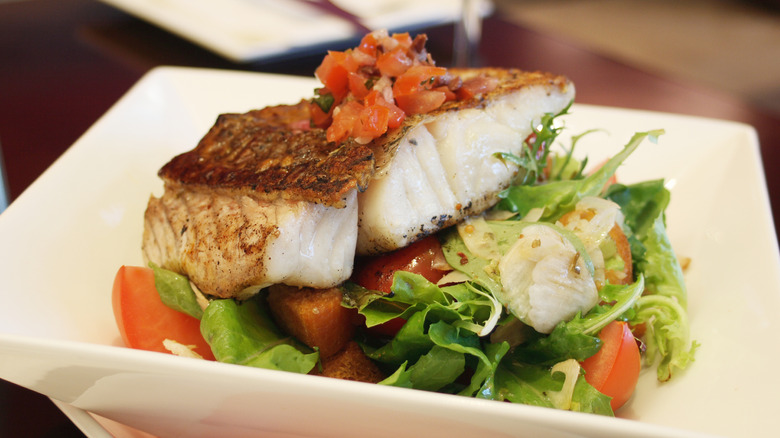
Since barramundi is pretty middle of the ground when it comes to fat, firmness, and flavor, it's one of the more versatile proteins you'll come across. Still, if you're trying to use it in your favorite salmon recipes, you may need to accommodate its lower fat content and milder flavor to achieve a high-quality result.
A particularly well-marbled salmon may need little to no oil when pan-frying, but the same can't be said of barramundi. This is especially important to keep in mind when using a stainless steel or cast-iron pan, or if you just want extra-crispy skin. You can compound its natural taste quite easily with a pat of butter, but a neutral-tasting oil might be best with an ocean-caught fillet to preserve its natural flavors. Just like with salmon, you'll want to cook your fish skin-side down for most of the cooking time to help prevent sticking and achieve crispy skin.
If you lean more toward soups or chowders, barramundi is a solid salmon substitute that produces large flakes when cooked and won't break down easily in broths. While neither fish is typically used to produce a traditional fish stock, barramundi has enough flavor to shine through a flavorful broth without overshadowing ingredients the way salmon might. While it's not the best choice if you're trying to impart a ton of fishiness to your other ingredients, it's ideal as a lean, nutritious protein that bulks up a recipe.