

Not New York Strip: The Budget-Friendly Steak Alton Brown Cooks Instead

There are countless different types of steak cuts out there, each with their own strengths and weaknesses, so choosing the right one can make or break a meal. One of the best and most classic ways to cook a steak is on the grill, but not all cuts are created equal for this method. If you're planning on grilling up a delicious, flavorful steak, who better to draw inspiration from than Food Network royalty Alton Brown? In an interview with Salon, Brown revealed he'd always choose to grill top sirloin over New York strip.
Both top sirloin and New York strip are excellent options for the grill, but each brings something different to the table. Top sirloin — a subsection of the larger sirloin — is cut from the rear hip area near the rear of the cow, specifically the top portion, which is a moderately hardworking muscle. Because of this, it's exceptionally lean, packed with protein, and has very little intramuscular fat, factors which also contribute to its lower price tag than the more tender New York strip. That's not to say it's lacking in quality, though. This cut brings a bolder, more robust, beefy flavor, which, in Brown's very own words, delivers "a traditional 'steak' steak" experience.
In contrast, New York strip comes from the short loin region higher up on the cow. This muscle does far less work than the hip area, so it carries far more marbling alongside a distinct strip of external fat, hence the name. That marbling gives it a richer, buttery flavor and softer bite, but with a comparatively less beef-forward taste. So if you're looking for unapologetically bold, beefy flavors, skip New York strip and put a top sirloin in your basket instead.
The best way to cook top sirloin on the grill
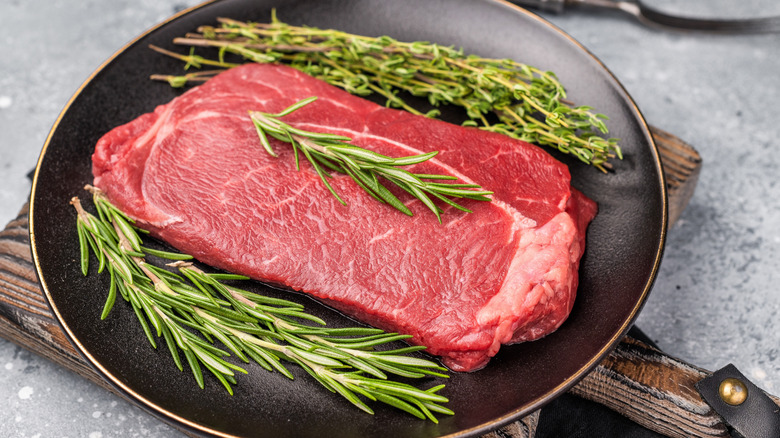
One of the best parts about grilling a New York strip is how forgiving it is. Exposed to high heat, its fat renders out, basting the meat in delicious flavor while keeping it juicy and moist, too. Top sirloin lacks that same fatty buffer, making it far more prone to drying out on the grill — which is one way it's different from grilling, say, a ribeye. Fortunately, there are a few things you can do to prevent drying out from occurring.
Retaining moisture starts before the steak even hits the grill. One of the best ways to do this is with a dry brine. At least an hour before cooking, or better yet, the night before, coat the steak in a layer of coarse, crystal salt. At first, the salt pulls moisture out of the meat, dissolving into a brine that sits on the surface. But hear us out: Given enough time, that brine gets reabsorbed back into the meat, carrying the salt deep into the muscle fibers and loosening them up along the way. This matters because those same fibers tighten and squeeze out moisture the second they hit high heat. By loosening them ahead of time, the steak holds onto far more of its natural juices on the grill — plus that dry brine will help make a delicious crust.
Once you're ready to grill, the best method, in our opinion, is the two-zone approach. Simply divide your grill into a hot side with direct flame and a cooler side with none. Using indirect heat, cook the steak on the cooler side with the lid closed until it's nearly at temperature, then finish it with a quick sear on each side over the hot zone to build a golden, beautiful crust. This method lets the steak cook through gently without drying out, without sacrificing the crust only intense heat can achieve — like a reverse sear for your grill.