

How Much Chicken Cost In The '70s Vs 2026
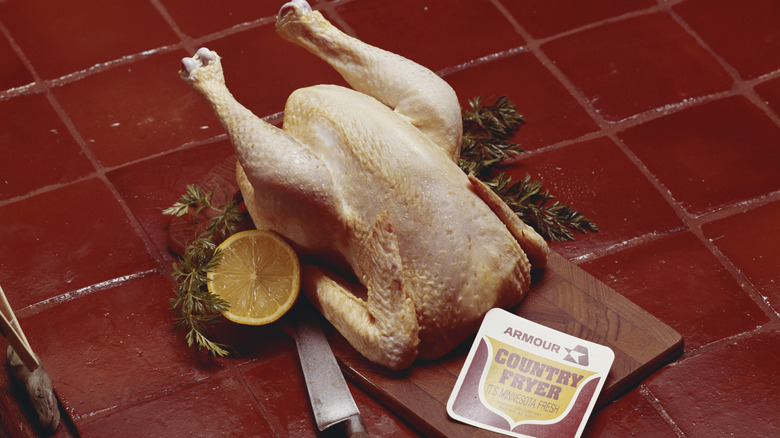
Ah, chicken — if you're American, odds are it's what's for dinner. After all, we each eat roughly 103 pounds per year, compared to fewer than 60 pounds of beef. Ever since the '70s, beef consumption has been declining, while we've more than doubled our obsession with the most popular fowl. Speaking of the 1970s, how do prices compare then and now? We're not talking about the perpetually underpriced Costco rotisserie chicken, but rather the average cost per bird. These days, it costs a pretty penny to indulge in our favorite light and simple summer chicken recipes, but what about in 1970? Or 1975?
The National Chicken Council states that the retail price for the average broiler was 40.8 cents per pound in 1970 (26.4 cents wholesale). Then, five years later, it spiked to 63.3 cents per pound retail (or 45.1 cents wholesale). Now, to really make ourselves sad, let's look at the 2025 price of the bog-standard broiler: 244.7 cents per pound (that's $2.45 in standard money) at the grocery store. If you can get your hands on one wholesale, you'd pay a measly 103.5 cents (again, that's $1.04 per pound). From 1970 to 2025, that's a 499% increase.
The figures for 2026 haven't been released yet, so we did the legwork and calculated a national average by looking at some of the most expensive states (California, Washington, Alaska, and Nevada), some middle-of-the-pack states (Nebraska, Wisconsin, and Michigan), and some of the least expensive (Mississippi, Iowa, and West Virginia). Then, we looked at a few of the top grocery stores: Walmart, Costco, Amazon, Kroger, and Albertsons. We calculated a national average for each store, combined them, and arrived at an overall national average of $1.71 per pound as of July 2026.
How inflation has impacted the cost of chicken
Now, we know inflation has been ravaging our wallets because people are starting to eat old-school (inexpensive) groceries from years past. The initial shock of seeing an increase of nearly 300% is definitely a blow to the gut, but to understand the real cost difference, we need to factor in inflation. After all, a penny today is not worth what a penny yesterday (or 50 years ago — no, don't think about that) was.
Fortunately, we don't need to do any heavy computations: The U.S. Bureau of Labor Statistics does the work for us. According to its inflation calculator, 40.8 cents in 1970 would be $3.49 in 2025 and $3.62 in 2026. That roughly 63 cents in 1975? That would be $3.89 in 2025 and $4.05 in 2026. Despite the eye-watering price jump, chicken today is, somehow, cheaper than it was in the '70s.
If you think about the changes humans have made in chicken farming, it sort of makes sense: Today, chickens are bigger than they ever were before, so one chicken feeds more people, but farmers also lose less poultry to disease and other issues thanks to major improvements in feed, living conditions, and even medicine. Losing fewer birds means cheaper prices for us at the market. Plus, in the past, poultry was seasonal and mostly eaten in the spring, so off-season birds were pricier. So, yes, the dollar was stronger in the 1970s than it is today, but that doesn't mean we should covet the apparent cheapness of the past — it wasn't all it was cracked up to be.