

Why Champagne Chicken Is No Longer Popular In Restaurants
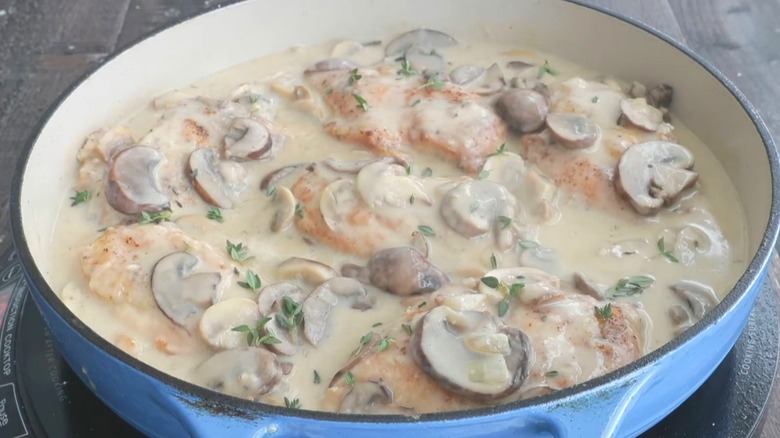
Some dishes are timeless; they've been around forever and aren't going away anytime soon, like the beloved New England lobster roll. Others are more of a flash in the pan (we're looking at you, Dubai chocolate). But then there are those dishes that we perhaps thought would be around forever, but didn't stand the test of time. For example, one of the several chicken dishes we don't see in restaurants anymore is Champagne chicken, a French-style preparation in which chicken breast is braised in Champagne and finished with mushrooms and cream for an air of luxurious decadence. To understand why this classic no longer graces the menus of upscale eateries, Food Republic spoke with Ben Tannenbaum, alcohol industry analyst. "What made [Champagne chicken] special was never the complexity; it was the theater of cooking with bubbly at the table, the sense that you were splurging just by ordering it."
According to Tannenbaum, one of the factors for the decline of Champagne chicken was economics. "In the 1960s and 70s, pouring a $15 bottle of sparkling wine into a dish that sold for $25 felt indulgent but doable for a white-tablecloth restaurant," he explained. "Today, to keep the same margin with decent bubbles, that same plate needs to land in the $45 to $50 range." This shift in attitude is also influenced by how we view chicken today. Before intensive commercial farming made it inexpensive and widely available, chicken was considered a luxury or special-occasion dish, comparable to pork or prime cuts of beef. In the modern era, its ubiquity has diminished some of its allure. While high-quality chicken certainly still exists, high-end restaurants are far more likely to showcase premium cuts of beef or pork rather than center a dish around chicken.
Can Champagne chicken ever make a comeback?
Champagne chicken's time in the spotlight was largely tied to the mid-century era. In particular, many New York eateries featured the dish on their menus, including beloved renditions at La Caravelle, a French restaurant that opened its doors in 1960. According to Ben Tannenbaum, however, Champagne chicken is best left behind in the 1960s.
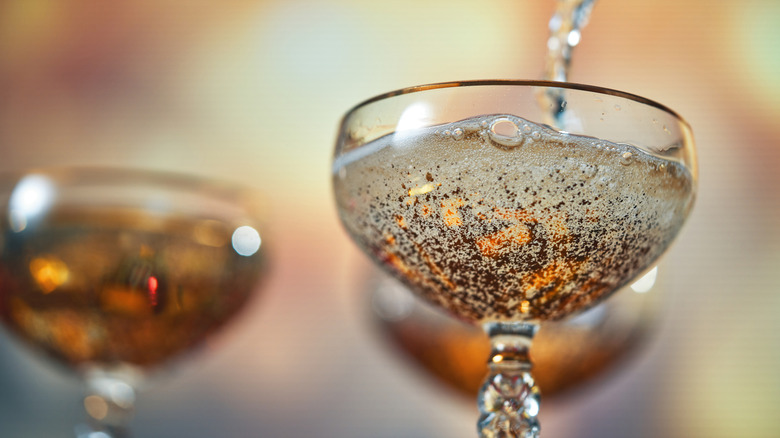
Tannenbaum explained to us that another reason for the decline in Champagne chicken was how attitudes shifted regarding how we appreciate Champagne. "As wine education and the craft cocktail movement took off, people started to understand that good sparkling wine is meant to be drunk, not boiled into oblivion," he told us. Made through a secondary fermentation and aging, Champagne can command enormous prices for its complex flavor and aroma. Traditionally enjoyed chilled and sipped, boiling and reducing it for Champagne chicken, as Tannenbaum noted, quickly destroys its subtle nuances. So for those looking to make a Champagne chicken at home, there's no need to splurge on an expensive bottle of bubbly. A Brut Prosecco or Cava will get the job done just as well, without breaking the bank.
To enjoy a modern take on Champagne chicken today, Tannenbaum recommended restructuring the dish. Instead of braising the chicken in the Champagne, he suggested enjoying a glass on the side, where its aroma and complexity can better complement the flavors of the dish. In this spirit, another trend that has gained traction in recent years is high-and-low cooking – the practice of pairing "high-end" ingredients with more familiar, everyday elements. One unconventional yet beloved combination is a glass of Champagne paired with fried chicken, which may be the modern incarnation of Champagne chicken done correctly.