

10 Mistakes You Keep Making With Parchment Paper
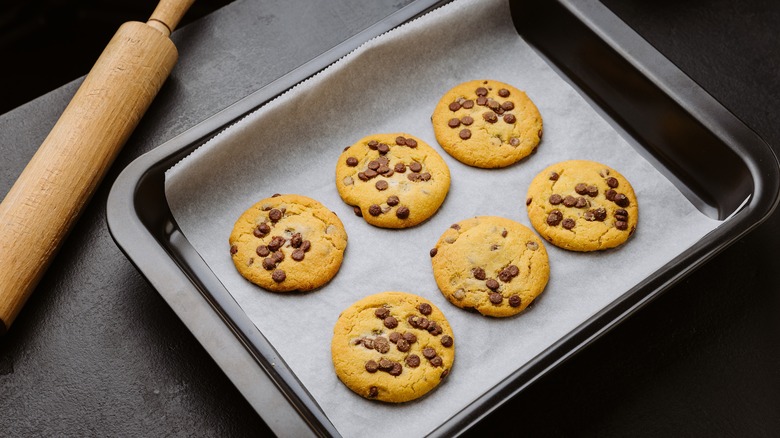
You may think there isn't much to parchment paper, and we wouldn't blame you. It's barely more than a roll of regular paper. Yes, there's a shiny side, but still, it's nothing fancy or elaborate, and you can use it for just about everything in the kitchen, right? Well, kind of. As it turns out, there are quite a few common mistakes people commit with the humble baking accessory. We are going to put an end to that in your kitchen, though.
From forgetting all the ways parchment paper can be helpful in the kitchen to using it to roast veggies to putting it under the broiler — it's heat resistant, but c'mon — you'd be surprised at how many common misuses people unwittingly commit. That is, of course, people who aren't in the know. Not us, though. We searched online and tapped into personal experiences using the handy kitchen accessory to compile a list of frequent mistakes so we can avoid them moving forward. They might just expand your ideas about what the handy kitchen accessory is actually capable of, too. Let's go.
Not knowing when to use parchment paper vs aluminum foil

Both parchment paper and aluminum foil are used to line baking trays and more. As such, it's easy to think they are 100% interchangeable. While this is true in many circumstances, the difference lies in the details, and there are times when one works better than the other. With this in mind, thinking it doesn't matter which one you use, or thinking they will perform the same in every scenario, is a mistake you want to avoid.
Performance-wise, the main difference between parchment paper and aluminum foil — obviously, they are made from different materials — is that parchment paper features a non-stick side. No surprises here, but it ensures your carefully curated baked goods don't stick to your pans or trays. With aluminum foil, you don't get the same non-stick characteristics, although it does promote more even cooking across a surface. It might even eliminate the need to rotate pans in the oven. Regardless, if you're looking for a no-stick option, parchment paper is the way to go, particularly with fragile baked goods. Will reaching for the wrong roll completely ruin your edible creations? Probably not, but it isn't off the table entirely, and it sure won't do you any favors. So, remembering which one works best for your specific cooking task is always the way to go.
Not crumpling or wetting your parchment paper to get a better fit and prevent curling

Typically, parchment paper comes in a roll. You can purchase different sizes and shapes, but a roll is standard. While this is great and all for convenient storage and use, it results in the edges curling, particularly if you pull out a large section of it. If you've ever tried laying parchment paper on a baking tray only to have the edges curl in an unruly way, you know what I'm talking about. Also, isn't it frustrating? Yeah, well, there's a quick fix that's ready to save the day: Crumple your section of parchment paper up and then flatten it out again. Obviously, it won't get perfectly smooth again, but the small ridges will ensure curling issues are a thing of the past.
When it comes to baking trays and pans with taller walls, like a lasagna pan, you can also take this crumpling tip a step further to get the best fit possible. All you have to do is wet the parchment paper, as well. As you might expect, though, you don't want to get it so wet that the paper starts to deteriorate. It won't happen as quickly as with a regular piece of paper, thanks to the non-stick coating on one side, but still, less is more in this scenario. Pair a little water with crumpling, and your parchment paper will fit into a pan like a pro.
Thinking it doesn't matter whether or not you use the shiny side of parchment paper
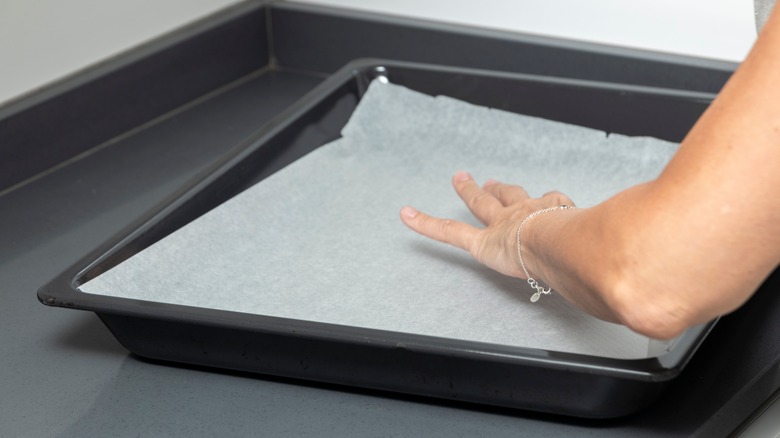
Parchment paper has a shiny side and a matte side. Well, for the most part. Some are glossy on both sides, but that's not the norm. Anyway, the glossy or shiny side of parchment paper isn't there by accident. The shiny side serves a very distinct purpose — it is a non-stick coating, of course. Since one of the main reasons people reach for a roll of parchment paper, thinking it doesn't matter which side of the parchment paper they position to come in contact with their food, would be a big mistake.
I'll be the first to admit: I have thrown parchment paper down on a baking tray many times without thinking about which side should face up. I've also spent some time wondering if it truly matters, and guess what? It does. So, moving forward, you and I are both going to commit to placing the glossy side of our parchment paper face up, so it comes in contact with our food. That way, we can take advantage of the handy kitchen accessory's true non-stick potential and all the other good stuff that comes along with it. Consider it done.
Not using parchment paper to help remove hard water stains
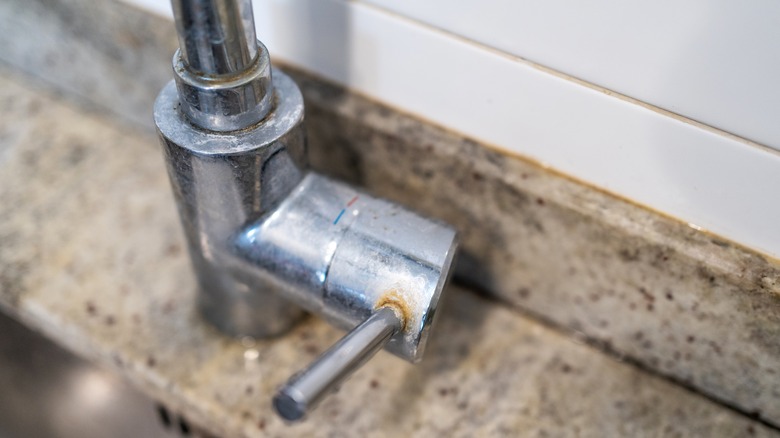
Hard water stains are not only unsightly, but they are a pain in the butt to remove. So much so that many of us let them build up for months before attempting to tackle the task — that ends today, though, because I'll let you in on a secret: Parchment paper is the key to quickly removing hard water stains on your kitchen sink and faucet.
There's no hidden secret to using parchment paper to remove hard water stains. All you have to do is crumble up a piece, start rubbing the stains in question, and watch in awe as they "magically" start coming off (a quick rinse never hurts, either). We say magically because, considering how tricky it can be to even find the right cleaner and how much physical effort the process usually takes, parchment paper seems like a real miracle worker. Finally, you can kiss those unsightly marks on your faucet and sink goodbye in a matter of moments. Sounds like a dream, huh? It basically is, so forgetting this would be a mistake. Even if you don't see it as a huge blunder, there's no denying it's a cool hack.
Thinking parchment paper is tricky to use with round pans
It's easy to think a regular roll of parchment paper won't work very well when it comes to lining round pans. It's square, or rectangular, after all. Sure, you can buy pre-cut round pieces of parchment paper, but really, thinking you need to do so is a mistake. You can easily make round sections of parchment paper out of your typical roll, no problem.
For round baking trays (for things like cakes and pies), precision isn't required, so you have a few options. For the easiest use of parchment paper in a round pan, just cut a portion large enough to cover the bottom and push it in. Then, fold the excess edges over the sides. Easy peasy. You can also cut the excess off. Or, for a more finished look, you can set your round pan on a piece of parchment paper, trace around the base, and cut out your perfectly sized circle. Best of all, each of these options works exceptionally well.
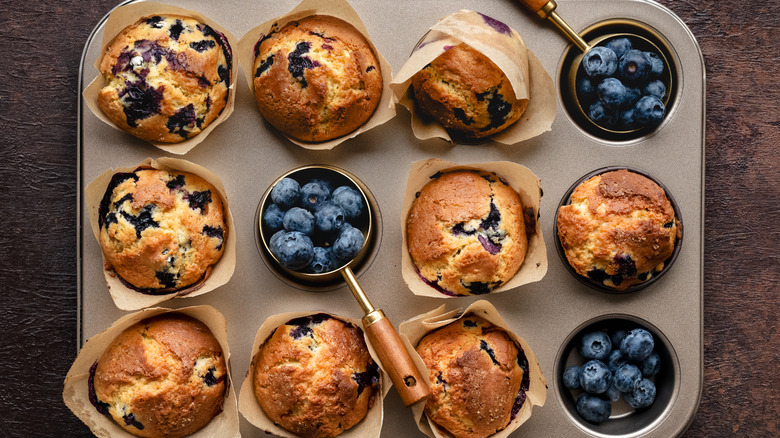
The same technique of pushing square-shaped pieces of parchment paper into round pans can be applied to muffin trays. In fact, creating muffin liners this way is called the tulip method, and it's eye-catching to say the least. If you track down some colored parchment paper, it only gets better.
Choosing not to cover your cutting board with parchment paper when working with raw proteins
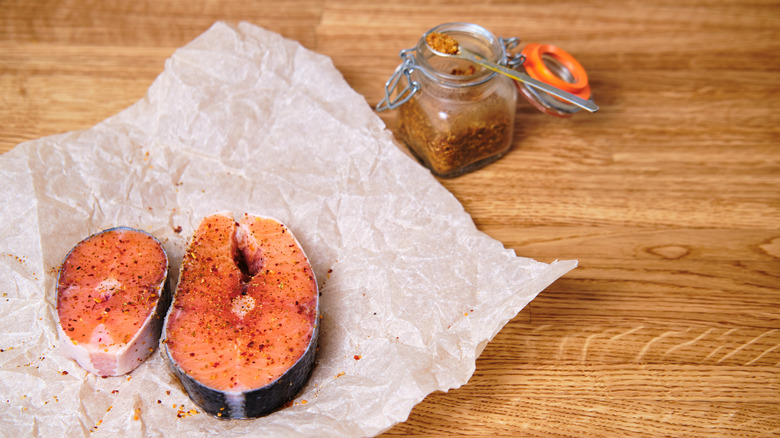
When you think about it, cutting boards take a lot of brunt in the kitchen. Obviously, you use them to slice and dice, so they take repeated hits. However, they are also somewhat of a catch-all for contamination. Hence, a need to clean them so meticulously, particularly after the surface has been exposed to a type of protein. The last thing we want is salmonella or something worse, right? Right. So, forgetting that parchment paper makes a fantastic barrier between your favorite proteins and your beloved cutting board is a mistake you should say goodbye to forever, starting today.
Placing a layer of parchment paper between poultry, beef, or seafood and your cutting board not only helps prevent cross-contamination, but it also makes clean up incredibly quick and easy. In many cases, you'll simply be able to toss out the sullied parchment when you're done. Depending on how messy your meat of choice is, cleaning your cutting board after use may still be a wise idea. Just use your best judgment, and you should be good.
Another perk to pairing protein, parchment paper, and your cutting board is that it makes it easy to handle without dirtying your hands. Just lift an edge of the paper and flip. When it's time for seasoning, this is a huge perk. After all, who wants blood and other meat residue all over their spice jars? Not us.
Putting parchment paper under the broiler
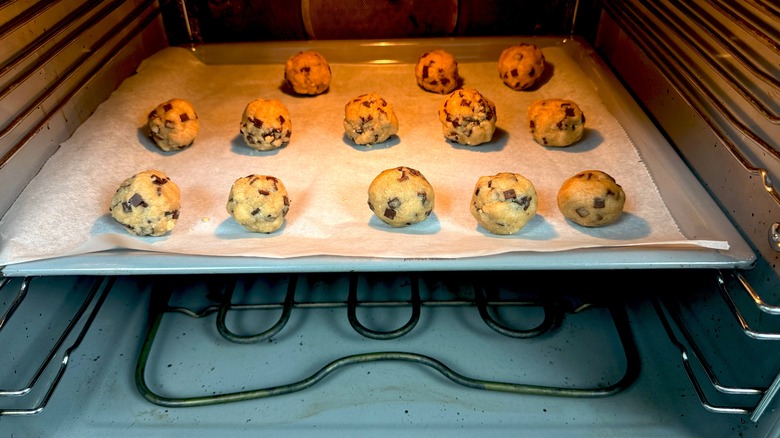
Parchment paper and baking are a no-brainer. It may look like regular paper, but it's actually quite heat-resistant. However, assuming it can withstand the high temperatures of your oven's broiler is a mistake you don't want to make. After all, if the shiny stuff starts to melt, it will leach into your food, and that can't be good for you. Of course, it certainly won't do whatever you're making any favors in the flavor department, either.
The temperature of an oven's broiler varies from one appliance to the next, no surprises there. However, in general, you can expect an oven's broiler to reach temperatures between 400 and 450 F on the low setting. On high, anywhere from 500 to 550 F is standard. As for your parchment paper, the level of heat resistance also varies from one brand to the next, but they typically max out between 420 and 450 F. These ranges provide a little bit of wiggle room, but it's not worth risking it. Instead, aluminum foil may be your safest bet. Or, if you really see some benefits in using parchment paper under your broiler (based on your cooking habits), it's best to seek out parchment paper that boasts an extra high heat resistance (it's a thing). Just check the packaging. Otherwise, you run the risk of ruining your creation before you ever even get a taste. Bummer.
Overlooking parchment paper when you need a piping bag
It isn't often we need a piping bag in the kitchen. We're not super fancy with my frosting, and while we admire celebrity T.V. chefs' love for piping mashed potatoes — or pommes purée, as they like to call it — that's not a task we'll willingly undertake on a regular basis. Still, when we do need one, we never seem to have one. Sound familiar? If so, you're in luck because parchment paper is ready to step in and fill in the gaps, at least temporarily.
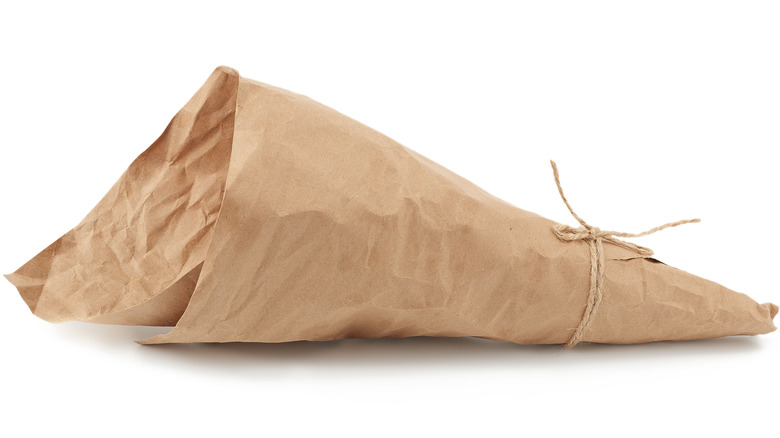
Making a piping bag out of parchment paper is pretty straightforward. Actually, the trick is not overthinking it. Simply roll a section of parchment paper into a cone shape, cut a small hole at the bottom, and you're all set. You could also tie a little string around it to help it stay together, but it isn't 100% necessary. Either way, you have a ready-made, albeit temporary piping bag ready to go in a matter of moments. Just remember that since it is made with paper and not plastic, like your typical piping bag, it won't last for long. So, if you put a particularly moist ingredient inside, work quickly.
All that being said, whether you're a frequent user of piping bags or not, remember that parchment paper can easily fill in if you find yourself in need of one. Forgetting this would be a mistake.
Forgetting parchment paper can also be used to line a skillet or an air fryer
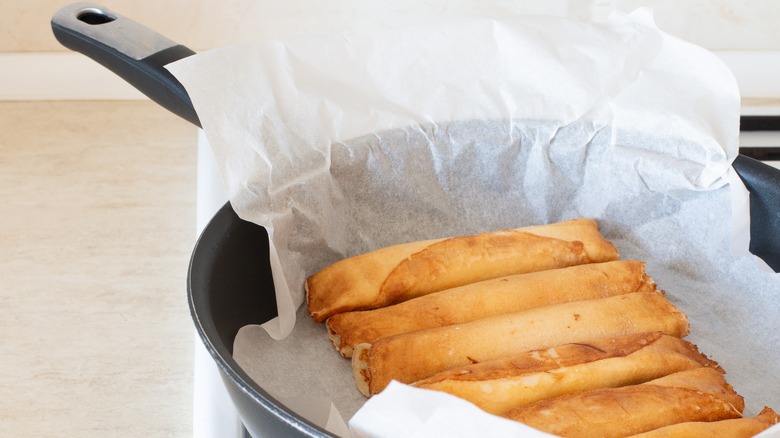
Parchment paper is a baker's best friend; everyone knows that. As you know, though, it's handy for a whole lot more than your average baking tasks. We've covered a few of these extracurriculars thus far, but here's another to add to the list: Parchment paper makes a fantastic liner for skillets and air fryer baskets as well — forgetting that is a mistake. What? Really? Yup, and we are die-hard fans of using it in the air fryer. We hate cleaning the basket and bin every time. Can you blame me? Regardless, parchment paper makes cleaning the mighty appliance after use practically effortless.
As for your frying pans, parchment paper works as a liner in them, as well. However, you'll want to check the heat temperature resistance listed on the packaging before diving right in. Additionally, it's best to use it when cooking on low to medium heat. As we discussed before, most parchment papers are only heat-resistant up to 420 or 450 F, so you don't want to exceed that, or it will become unsafe. Since cast iron skillets are known for getting exceptionally hot — that's how they provide an excellent sear, after all — it's probably safest to keep parchment paper out of them, as well.
Using parchment paper when roasting veggies
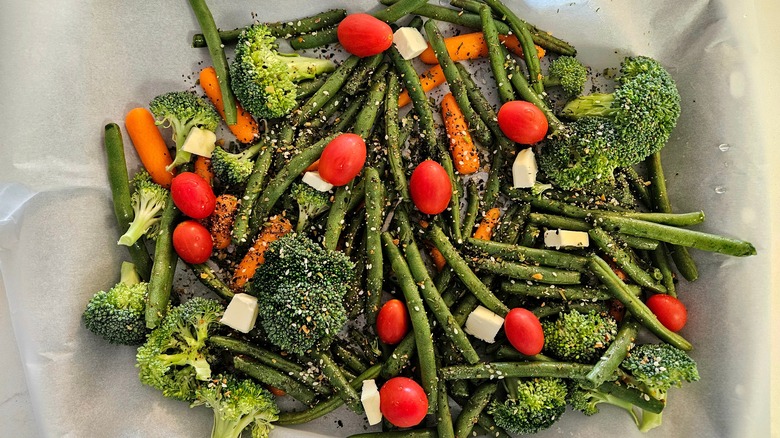
For the most part, lining your baking sheets with parchment paper is a win-win. Not only does it prevent food from sticking, but it also makes cleanup a breeze. Just toss the paper in the trash, and you're good to go (well, mostly, but you get the point). However, when it comes to roasting vegetables in the oven, putting them on a parchment-lined tray is one mistake you want to avoid.
Perfectly roasted veggies have crispy edges and soft centers. They may even have the tiniest bit of char, something that adds lots of yummy flavor. Sounds delicious, right? It is, but parchment paper puts a big roadblock between properly roasted veggies and the pan required to crisp them up just right. In fact, if you line your baking tray with parchment paper before spreading your vegetables out on top, you can basically forget about browning. In addition, parchment paper makes it tricky to achieve even cooking across the entire pan, at least when it comes to veggies. Ask us how we know.
Will your veggies still cook with parchment paper beneath them? Absolutely, and they will still be edible, as well. They won't be roasted, though. Baked, yes, but they'll lack all the signature texture and flavor roasting provides. Unfortunately, what this means is that if you want actual roasted veggies, you'll just have to bite the bullet and wash the pan after. Worth it.