

Not Ribeye: Bobby Flay Recommends This Steak Cut For The Best Tacos

When taco night rolls around, you'll want to head to the butcher and grab some good meat. If you're making carne asada, your instinct might be to pick the ribeye. While it might be the gold standard of steak, tacos and ribeye are an inherent mismatch. Tacos are one of the most democratic foods out there, while ribeye is made for deep pockets and expensive tastes. Even Food Network's Bobby Flay recommends skipping it. Instead, he swaps the pricey cut for the seriously underrated skirt steak.
Ribeye is America's favorite steak thanks to its rich marbling and tender texture, but you'll rarely find it in taquerias. Beyond being pricey, ribeye's assets are its downfall in tacos. In an interview with Food and Wine, Flay revealed the reason why he often chooses to skip ribeye altogether: "[Ribeye] can be inconsistent because the fat doesn't always melt even when cooked properly." This is a real problem in tacos. Encased in a taco, you don't have the option to trim around a rubbery pocket of fat or leave it on the plate. Even if you trim the fat before adding the steak to your tacos, it's so unevenly distributed that you risk ending up with wildly inconsistent slices.
Unlike ribeye, skirt is cut from the plate primal, a hard-working area near the diaphragm. Rather than being streaked with generous ribbons of fat, it's comprised of long, coarse muscle fibers, which give it a chewier, more fibrous bite along with a bold, beef-forward flavor. Its thin profile may not win it fans at white tablecloth restaurants, but it's exactly why taquerias can't get enough of it. All that surface area compared to its thickness means skirt steak cooks quickly, soaks up marinades fast, and slices evenly, which is everything you want from taco meat.
The best way to cook skirt steak for life-changing tacos
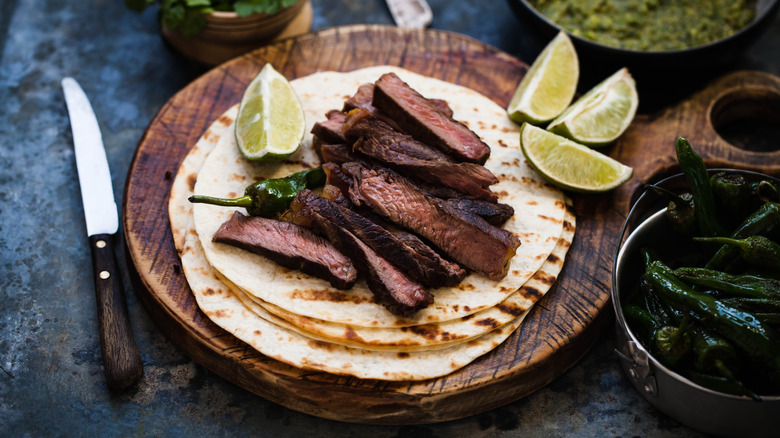
There's no cut of beef more well-suited to carne asada than skirt. Literally translating to "grilled meat," the beef is usually marinated in a citrus and garlic blend, with the acidic ingredients helping to tenderize the surface of the meat. After being left to soak up the flavor for a couple of hours, it's then seared or grilled over an open flame or charcoal to impart a smoky, charred flavor (an air fryer also works if you can't grill). Because skirt is such a thin cut, it doesn't enjoy spending too much time over high heat; it only needs around two to four minutes per side. Skirt can be prone to drying out, so it would be wise to avoid cooking past a medium doneness.
How you cut skirt is just as important as how you cook it. Compared to other cuts, skirt has particularly long, dense muscle fibers, and if you slice them with the grain, you'll leave them intact, resulting in chewy, rubbery bites. Slicing against the grain shortens these fibers, turning them into more satisfying, bite-sized strands. To identify the grain, look closely at the surface of the meat to spot the direction of the muscle fibers running through the beef.
Although skirt is beloved by taquerias, that doesn't make it suited to all beef tacos. One popular style where we would skip skirt is birria, the slow-cooked, tender beef marinated in a chili-and-spice adobo served with a flavorful broth for dipping. The whole concept of birria revolves around slow-braising, requiring tough, collagen-rich cuts like chuck or beef cheek, which break down into tender, shreddable meat over several hours. While skirt does have some connective tissue, it's simply too thin and lean to survive hours of prolonged heat.