

This Chain Was Dunkin's Bitter Rival In The '50s — Now It's The Most Popular Donut Spot In Japan
Dunkin' is one of America's favorite spots to grab a quick donut and one of its famous syrup-infused iced coffees — which we ranked from worst to best. Today, the chain boasts more than 10,000 stores in the U.S. alone and sits comfortably at the top of the country's donut hierarchy. However, it wasn't always the undisputed heavyweight. In a rivalry that gives McDonald's and Burger King a run for their money, Dunkin' spent decades going head-to-head with Mister Donut. Ultimately, Dunkin' came out on top — at least, if we're talking strictly about the USA. Over in Japan, Mister Donut reigns supreme.
What makes this feud particularly fascinating is that it was a family affair. Dunkin', originally known as Dunkin' Donuts, was founded in 1950 by William Rosenberg. The simple combination of donuts and coffee proved to be a huge success. Naturally, Rosenberg wanted to expand the business through franchising. So far, so good, right? Well, not everyone was happy with the idea, including Harry Winokur, Rosenberg's brother-in-law. In a move that would spark a decades-long rivalry, Winokur left the business and opened Mister Donut just a few miles from Dunkin's original location. He even embraced franchising, with Mister Donut employees reportedly being prohibited from saying the word "dunk" in their stores.
As is often the case, feuds rarely end with a clear winner. In 1990, Dunkin' acquired Mister Donut and rebranded nearly all of its American locations as Dunkin' stores (ouch). Today, just one Mister Donut location remains in the U.S. That must have been a hit on Winokur's pride, but while Dunkin' was busy making cereal in the '80s, Mister Donut was thriving on the other side of the world. Today, Mister Donut is Japan's leading donut chain, with more than 900 locations in operation.
How Mister Donut took Japan by storm
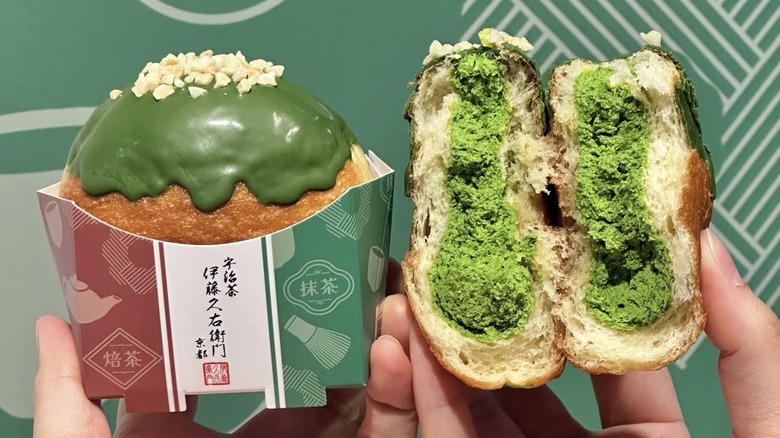
Japan has embraced plenty of Western-style foods with open arms. Think of the juicy, hamburger-inspired hambāgu, or comforting pizza toast with its wide array of toppings. Mister Donut also happens to fit comfortably into this category. However, one thing worth knowing about Japan's take on Western staples is that they're rarely direct copies. Instead, the country has a knack for putting its own spin on imported dishes. That's exactly how Mister Donut managed to carve out a place for itself in the market.
The first Mister Donut opened its doors in Japan in 1971, after business executive Seiichi Suzuki acquired the exclusive rights to operate the brand in the country. The original menu featured familiar American favorites, but Suzuki also introduced items and adjustments designed to appeal to local tastes. These included reducing the sugar content of certain products, serving more modest portions, and creating a cozy, sit-down atmosphere. The approach proved successful, and Mister Donut quickly expanded across Japan. Dunkin', meanwhile, had also tried its luck in the Japanese market, opening its first location in 1970. While Mister Donut continued to grow, Dunkin' struggled to gain a foothold and eventually left Japan altogether in 1998.
In 1989, Suzuki's company Duskin acquired full ownership of Mister Donut's Japanese operations, giving it greater freedom to develop the brand's distinctly Japanese identity. From there, the chain continued to expand, eventually bringing its donuts to markets including Thailand, Australia, Taiwan, and Singapore. Today, Mister Donut is best known for its playful, distinctly Japanese creations, particularly the Pon De Ring, a chewy, ring-shaped donut made up of small dough balls, and Mocchurin, its mochi-inspired donut line that is so soft, they require paper trays to keep each donut from losing its shape.