

Not Ribeye, Not Filet Mignon: The Tender Meat Cut That's Cheaper
High meat prices might have you skipping traditionally high-end cuts, but you don't have to sacrifice flavor or texture on a budget. While pork steaks may not have the same reputation as their beef counterparts, they can be sublime. Take coppa, or pork collar, which costs a fraction of the price of prized ribeye or filet mignon.
Pork steaks are affordable not because they lack quality, but because of supply and demand. Pork collar, in particular, holds a prominent place on dining tables the world over, from American Southern-style marinated steaks to Chinese char siu. It's an interesting cut that blends intense meatiness with rich marbling. While prices vary by region and pig breed, you can expect to find commodity coppa steaks for close to $4.29 a pound, compared to around $20.99 a pound for ribeye and $26.99 a pound for filet mignon. Regardless of the exact prices, you're unlikely to find pork collar of similar quality for anywhere near the same price as these two cuts of beef.
While pork collar is technically part of the pork shoulder, specifically the Boston butt, it doesn't require low-and-slow cooking to break down its connective tissue. Instead, it's one of the more tender parts of the shoulder and goes by many names, like pork neck filet or center-cut Boston butt. On a cow, the comparable area falls within the chuck primal cut and can cost you at least $8.50 a pound, even when bought in bulk at Costco — still almost twice as much as you can expect to spend on standard pork collar steaks.
Tips for cooking tender, flavorful pork collar steaks
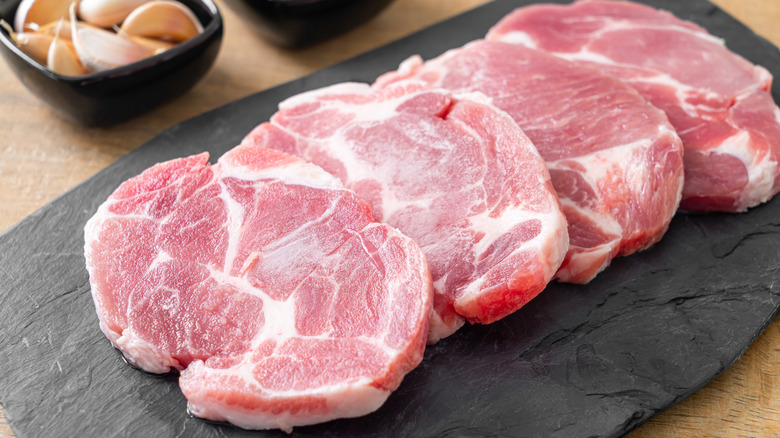
In terms of preparation, pork collar steaks cook more similarly to ribeye than filet mignon. While filets cook quickly and may dry out if left even slightly too long, solid heat control and a good blend of seasonings are all you need to render some of the fat and get a beautiful crust.
Cooking a juicy pork steak with a crispy sear is fairly simple on either the grill or stovetop. Depending on the thickness of your meat, you'll likely want to keep the heat around medium. This should be high enough to trigger the Maillard reaction but not so high that the outside burns before the middle cooks through. On the grill, a two-zone strategy (heating just one side) can help, since you can finish your meat with indirect heat on the cooler side if the crust develops too quickly. In the pan, don't be afraid to add a bit of butter and baste your steak thoroughly, infusing it with more richness so it'll come out extra tender and delicious.
Underseasoning is a major mistake with pork chops, and that applies just as much to pork collar steaks. Dried spices don't just add layers of flavor — they can also help build a better crust that amplifies the meat's natural taste. Pork collar steaks are meaty and bold and can easily overshadow subtle seasonings, so opt for a blend that's equally bold and rich in spices like chile powder or dried herbs.