

12 Old-School Breakfast Orders You Rarely See On Menus Anymore
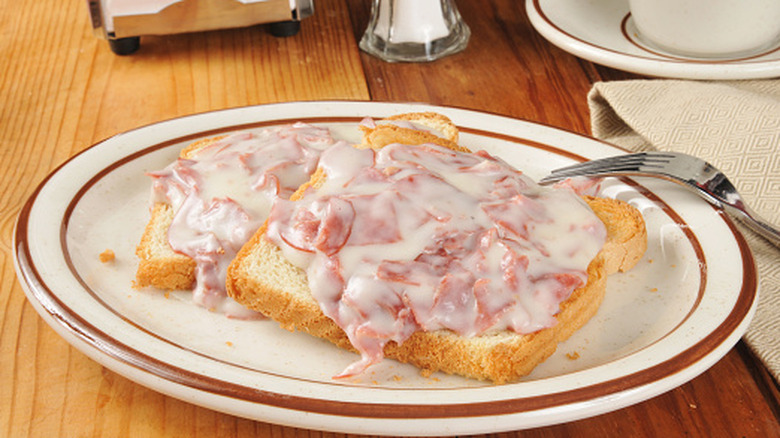
We may receive a commission on purchases made from links.
Breakfast is subjective. Depending on where you're eating it, the first meal of your day could be a platter of tacos, pickled fish on toast, or an espresso. In the United States, our idea of breakfast has evolved with the culture. When the country was largely agrarian, the meal fueled hours of grueling physical labor. As economics, politics, and demographics changed, so did the food. Quick and efficient replaced hearty and rich; diet trends, immigration, war — each historical milestone and subsequent nostalgic echo shaped the eating of its era.
So what is considered an "old-school" breakfast? For this article, I focused on edible Americana, dishes that were popular and culturally significant at a particular place and time. Whether we're talking about the codfish croquettes of the early New England colonies or the fried cornmeal mush of the South, breakfast foods — their rise, fall, and rebirth — tell a story. Some dishes on this list emerged out of necessity. Others appeared through migration and cross-cultural fusion. But all of them — at one time or another — had a place on the breakfast table. Here are old-school breakfast orders you rarely see on menus anymore.
1. Fried cornmeal mush
Corn has always been one of America's most important crops, serving as an essential food source for indigenous peoples and early European settlers. Since ears weren't convenient to transport and cook, Native Americans would pulverize the kernels into a coarse powder, which could then be used to make flat breads, porridge, and a starchy base for soups and stews. Today, you can still find cornmeal on most breakfast menus in forms like porridge or buttery shrimp and cheese grits.
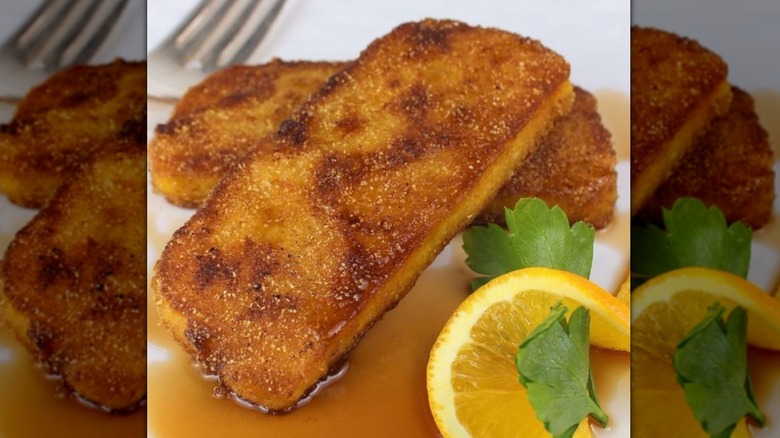
But the dish you don't see as often is fried cornmeal mush, a hearty — albeit oddly-named dish that has all but disappeared from American food vernacular. Ironically, fried cornmeal mush isn't all that mushy. The cornmeal starts out as a thick porridge, but after cooking, it's poured into a loaf pan to set until firm, giving it a consistency more reminiscent of stiff polenta than a porridge. Then, the cornmeal loaf is sliced, griddled, and served with butter and syrup. However, home cooks note that to achieve a crispy coating and soft, gooey center, the cornmeal slices need to be deep-fried or, at the very least, submerged in hot oil. Otherwise, the texture just isn't the same.
2. Scrambled brains and eggs
Nose-to-tail cooking is a new(ish) food movement dedicated to utilizing every part of a recently butchered animal. Its purpose is threefold: Respect the animal, celebrate sustainable practices, and preserve historic food traditions. Although educational and interesting, today, nose-to-tail cooking in America is far from a necessity. But this wasn't the case a century ago, when nutritious calories weren't as easy to come by. In the late 19th and early 20th century, you'd find menus filled with snoots, chitterlings, tongues, and gizzards. But even back then, brains were harder to come by.
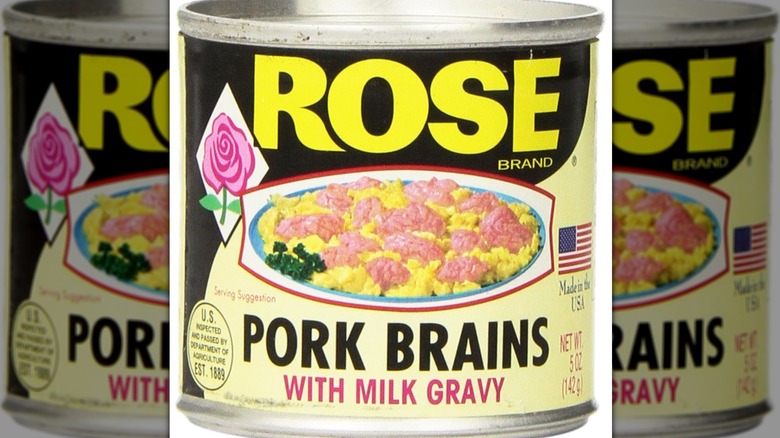
Except in the Southern United States, where brains — canned brains in particular — were relatively common. The tradition likely began in rural farm communities, when the pig was slaughtered at the crack of dawn so its more prized cuts could be tended to and the sausages prepped. Brains don't stay good for very long. Unlike skin or meat, which can be dried or salted, brains have to be consumed shortly after they're harvested. Families would scramble the brains with eggs and season them with salt, pepper, and butter. A flaky biscuit would be served alongside the plate to add some texture to the otherwise mushy mixture.
3. Chipped beef on toast (AKA S.O.S.)
Before a day of hard physical labor, a hearty breakfast was expected — if not mandatory. And few professions were as physically taxing as being a soldier. To feed thousands of troops, you needed food that could nourish and comfort. Chipped beef (also called creamed chipped beef) accomplished both.
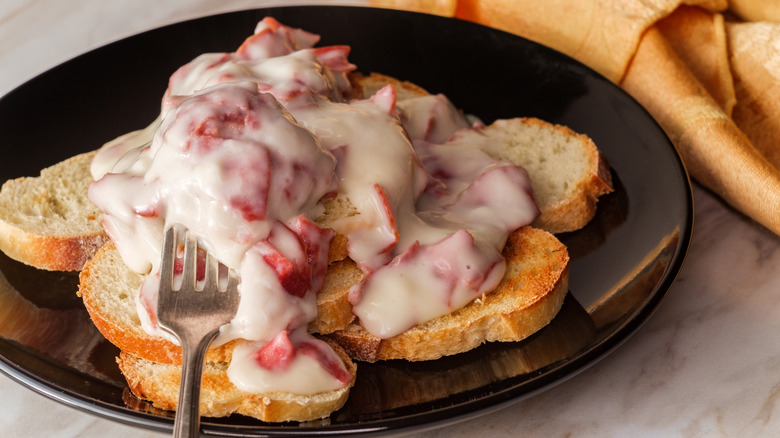
With its first recorded appearance in the 1910 "Manual of Army Cooks," chipped beef became an instant hit with the soon-to-be soldiers of World War I. Recipes varied based on available ingredients, but the general formula remained consistent, essentially a flour-thickened white gravy made with evaporated milk and beef stock. Slices of thinly-shaved beef were then added to the gravy to give it more heft and protein.
The S.O.S moniker could stand for "Save Our Soul," but it more likely means, "S**t on a Shingle," referring to how the warm mixture would be poured atop a stale slice — or shingle — of toast to soften the bread. The dish stayed popular amongst troops through subsequent American military conflicts, like the Korean and Vietnam Wars. As soldiers developed a nostalgia for the dish, it began to appear more frequently on breakfast menus, especially in the South.
4. Johnnycakes
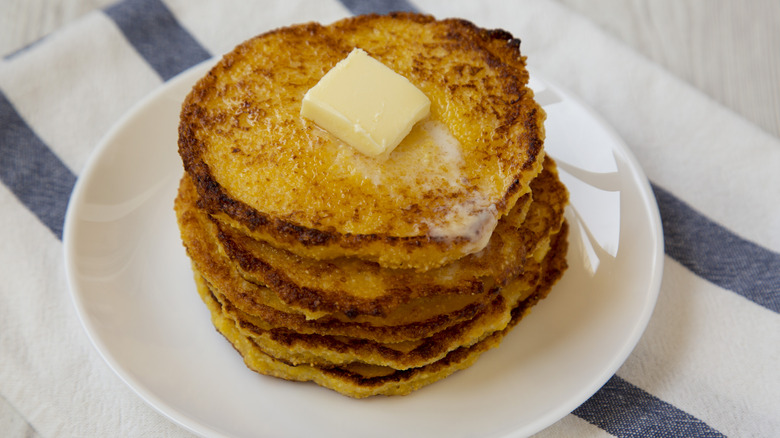
In early colonial America, the johnnycake, also known as a hoe cake or ash cake depending on where you'd order them, was a true breakfast staple. Cornmeal was cheap and easy to carry, and with just water— milk if you had it — salt, and a hot cooking surface, you could whip up a short stack of johnnycakes to eat alongside your eggs, gravy, and salted ham.
You'd think the dish was named after John Adams, or John Quincy Adams, or some other patriot named John, but historians believe the food's etymology is from "Shawnee cake" (say it fast, and you'll get it), a prevalent Native American tribe. Other theories are that the word "johnny" evolved from "journey," a reference to the cake's portability. And johnnycakes did move around, quickly making their way down to the southern half of the United States, where it would likely become the precursor to Southern cornbread. But over the decades, the softer heirloom corn was replaced by grittier, more commercially viable varieties, resulting in johnnycakes with a more toothsome bite. While they still exist on Southern breakfast menus, the johnnycake has dipped in popularity, replaced in most part by the softer, flour-based pancake.
5. Red-eye gravy
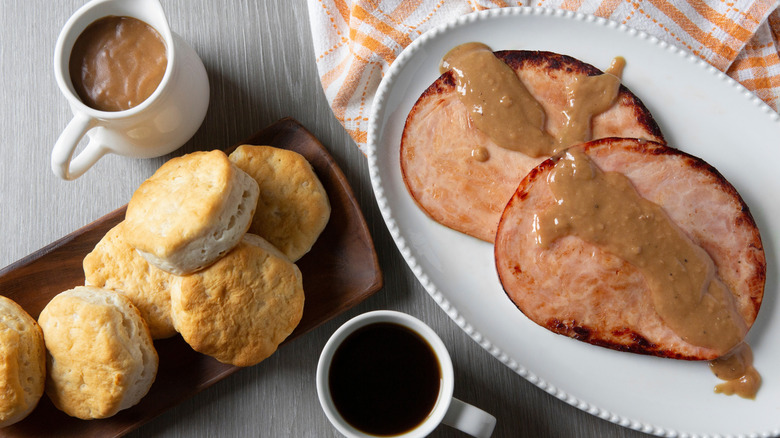
Just like your favorite single-origin pour-over, red-eye gravy is steeped in mystery and lore. Like most early American breakfasts, the dish was created out of necessity. Today, we may chill our leftover coffee and sip it over ice the next morning. Not so much in the early 19th century. Red eye gravy is a thin pan sauce made from stale coffee and pan drippings. After pan-frying a slab (more likely a slice) of country ham, thrifty cooks would deglaze the pan with a few splashes of leftover coffee, and serve the resulting "gravy" over biscuits, grits, or any other dry carbohydrate. But this is the bare-bones version.
Over time, the dish evolved, with the most significant addition being a roux to thicken the thin sauce into something satiny and smooth with more coating potential. Some modern variations bypass the coffee and opt for other common Southern beverages, like iced tea or cola. Today, the phrase "red-eye" is closely linked to coffee, but the name "red-eye gravy" was more likely a reference to its appearance. When combined, the rendered pork fat and watery coffee left a reddish ring at the bottom of the pan that resembled, yep, a red eye.
6. Milk toast
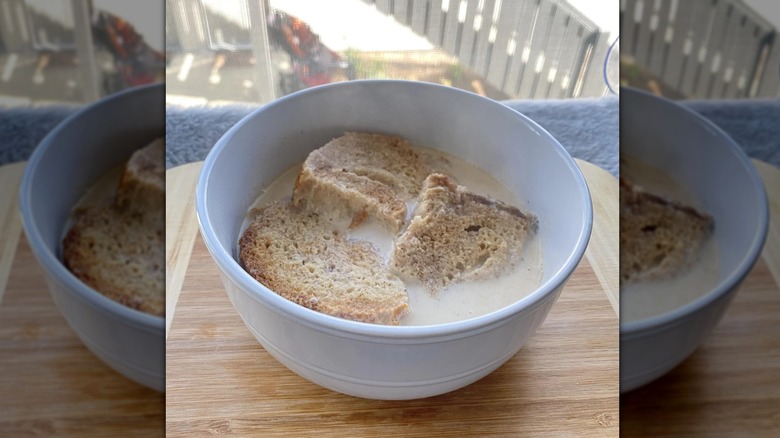
You won't find milk toast on many breakfast menus. Not because it's particularly daring, odd, or unusual; it's actually quite the opposite. Milk toast is ordinary. Or at least, it sounds ordinary, so much so that the word milquetoast, meaning timid or unassertive, is thought to have come from the dish — essentially a bowl of sweetened, warm milk garnished with pieces of toast. The recipe is simple. Cube stale bread, add it to warm milk, then sprinkle with cinnamon, sugar, and a few dashes of vanilla extract.
But people who grew up with the dish may argue that milk toast is more than just the sum of its parts. Think of it as the 19th-century version of breakfast cereal. It was popular amongst kids, and many parents believed its soothing, gentle nature could benefit children with digestive or gastrointestinal issues. But adults ate it, too, viewing it as a cozy comfort food that can relieve the ailments of the mind as well as the stomach. If you want to know what all the hype was about, try making it in your own kitchen by adding a slice of toasted white bread to a bowl of sweetened, warm milk. What could be bad?
7. Kippers and onions
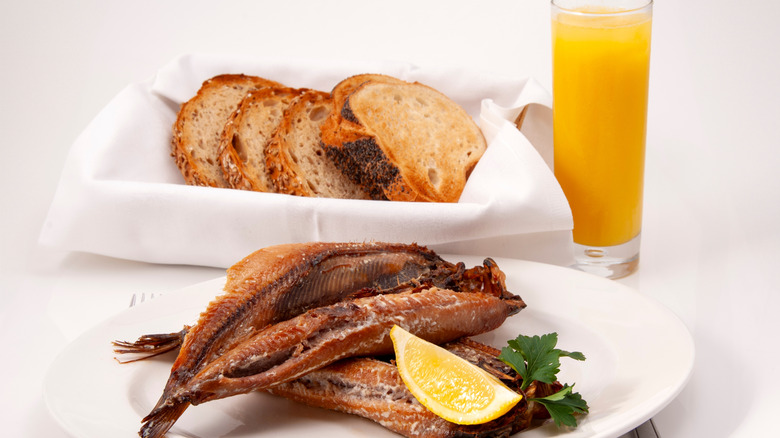
Unlike some of the colonial-era foods on this list, kippers and onions hit the American breakfast scene a little later. Kippering is a preparation style — not a fish variety — very popular in England and Eastern Europe that involves butterflying the fillets of herring, sardines, or other small fish, salting them, and finishing them with a cold smoke. Kippers most likely landed in America during the wave of European immigration in the mid 19th-century.
Despite their small size, kippers are incredibly nutritious, with a pleasant oiliness, meaty bite, and mild smoky flavor. But do they have a place alongside your coffee and pancakes? Think of kippers like you would lox, canned sardines, or a smoked whitefish spread. These fish are commonly served as part of a traditional Eastern European appetizing platter, served with thick rye bread, a smear of butter and cream cheese, and thin rings of white onions. The flavors don't seem like they'd work together, but the combination is light, balanced, and oddly satisfying. During World War II, a thankful family member could send a care package that included kippers to a soldier overseas. Today, you'll more likely find slices of smoked salmon draped nestled beneath a globe of poached eggs, but just know that kippers walked so that a bagel and lox could run.
8. Grilled lamb kidneys
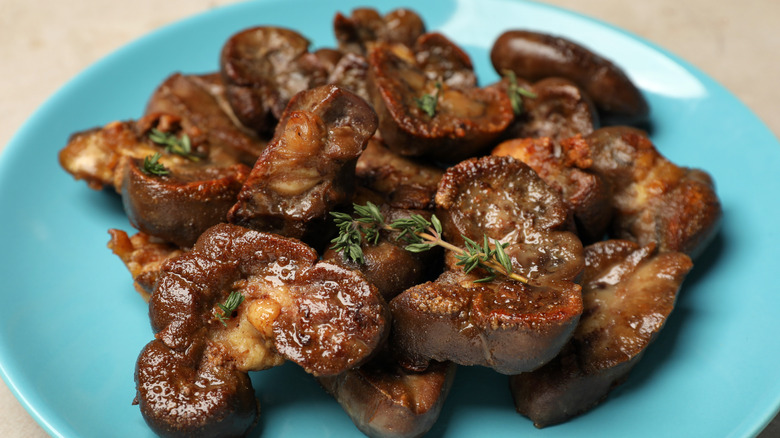
Offal is no longer a mainstay of the American diet, but there was a time just a generation or two ago when an animal's odd bits — the kidneys, the tongue, the liver — were just as common as the roast or the loin. In many instances, organ meats were not considered the choice cuts, but some specific animal parts, like the sweetbreads or, in this case, lamb kidneys, were thought to be delicacies.
Looking through a 1920s breakfast menu from the ultra-luxurious Fairmont San Francisco, you find grilled kidneys featured prominently towards the top, followed by calf's liver, pig's feet, and broiled honeycomb tripe. You can also find lamb kidneys on the plate of a full English breakfast. The world's favorite fictitious secret agent, Mr. James Bond, even dined on them in Ian Fleming's 1958 novel, "Dr. No."
Offal has a reputation for being intensely funky, but not lamb kidneys. They're actually pretty tame, especially relative to other larger animals, like pigs or cows, with a nice bite that's not quite chewy, yet not quite succulent, either. They have a slight mineral funk that's not unpleasant but still assertive, which is why these are best "deviled" — cooked in a generous amount of butter, then tossed in a sauce of mustard, Worcestershire sauce, and cayenne pepper.
9. Shirred eggs
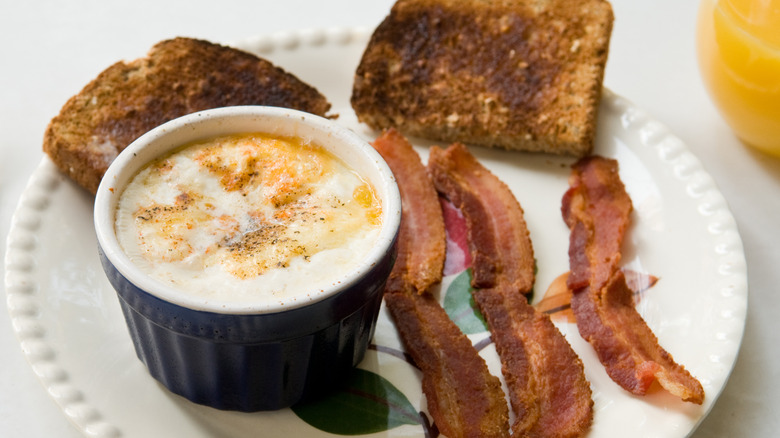
Go to a diner and you can get your eggs prepared a half a dozen ways — scrambled, fried, over-easy, hard boiled, poached, but have you ever ordered your eggs baked? That's the idea behind shirred eggs. Shirred eggs get their name from the vessel they're cooked in; a wide, low-bottomed baking dish resembling a ramekin. While most eggs are cooked with speed in mind, shirred eggs are prepared more leisurely, baked slowly with a touch of cream until the whites have just barely set.
This elegant presentation elevated the egg from provincial farm food to a Victorian-era breakfast staple. To get an idea of its status, one only has to look at the menu on the Titanic, which featured shirred eggs as part of its first-class breakfast. Shirred eggs returned to fashion in the homemaker-era of the 1960s as a fun, refined brunch option that provided the host ample time to prep and greet guests while the eggs baked slowly in the oven. Today, you'd get some strange looks if you ordered shirred eggs at your local diner, but you can easily recreate these at home with a gratin dish or muffin pan. Just carefully crack the eggs into the dish, drizzle with cream, bake for around 15 minutes or until the white is set, and serve with a slice of toast.
10. SPAM and eggs
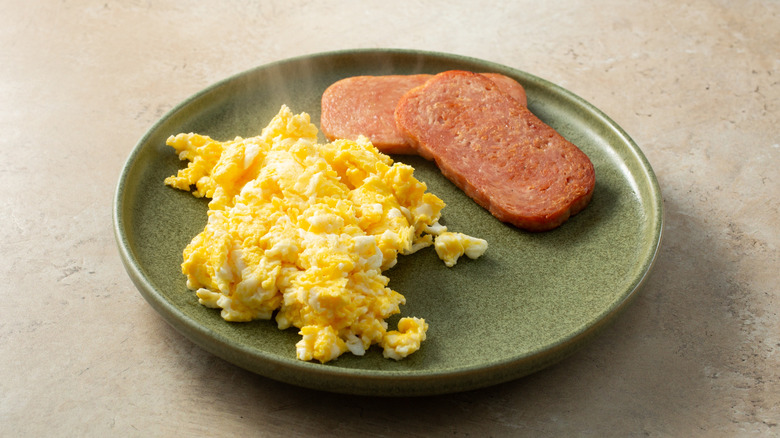
Food, like fashion, comes in and out of style. What was once viewed as pedestrian or ordinary can quickly evolve into something bold and trendy. SPAM is one of those foods. Hormel launched its iconic canned meat in 1937, just a couple of years prior to the start of the Second World War. It was cheap, tasty, portable, and shelf-stable, making it the perfect food for a country still feeling the effects of the Great Depression.
But after World War II, everything changed. Similar to chipped beef, SPAM was popular with the American GIs overseas, who ate it with another shelf-stable protein: powdered eggs. When the troops returned home from overseas, they brought their appetite for SPAM and eggs with them. Breakfast meats, whether ham, bacon, or sausage, pair naturally with the mild savoriness of eggs, so SPAM was a natural fit. In the following decades, as American influence continued to grow, SPAM traveled to all corners of the globe, where it still plays a major role in Korean, Hawaiian, and Filipino diets. Today, it has achieved cult status, which is why you can still find this homey comfort food on modern breakfast and brunch menus.
11. Dutch baby
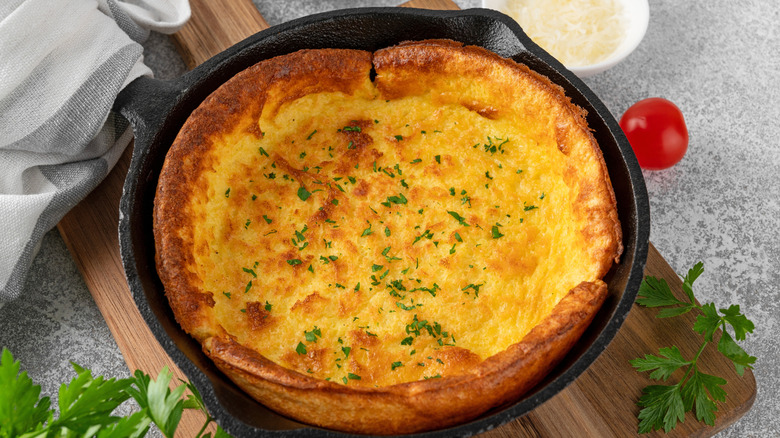
The Dutch are often credited with inventing the microscope, the CD, and orange carrots; however, the Dutch baby is decidedly of German origin. So how did it end up on American breakfast tables? Well, like most imported traditions, it started with a mistranslation. The story goes that in the early 20th century, Seattle's Maca Cafe introduced a thin German-style pancake to its menu, but when the owner's daughter tried to pronounce the name of the dish, she accidentally mistook the word Deutsch (which means German) for Dutch.
Many cultures have their own version of a pancake, from French crepes to Russian blini to Chinese bing, but the Dutch baby stands apart from the rest because it's baked, not griddled. It's a little like a popover, with a thin, eggy batter absent of any leavening agent. The result is a sweet breakfast food that's crisp around the edges yet pliable closer to the center. They're best prepared in a cast-iron skillet, where the batter can climb the walls of the pan and develop that signature lip that's just begging to be filled with whipped cream, ice cream, stewed berries, or fresh fruit.
12. Codfish croquettes
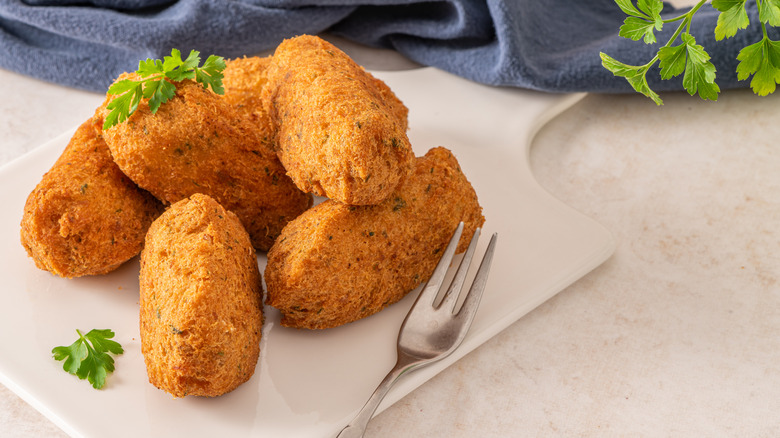
Cod and cod fishing were central to the early Northeast American settler economies. Europeans loved cod, so much so that they nearly depleted their native supply by overfishing it. America was positioned to fill the void. Cod was such an important fixture that the Cape of St. James was renamed "Cape Cod" in the fish's honor.
But what's so special about cod? Unlike other fish, cod's flesh takes especially well to curing, lasting years if properly dried and salted. In an era without refrigeration, this quality allowed cod, a cheap protein source at the time, to travel around the world. When rinsed of its salty shell, the cod could be used in any number of dishes, from croquettes to fritters to stews. New Englanders mix the cod with mashed potatoes and spices, roll it into a ball or torpedo, fry it, and eat it for breakfast. In the Caribbean, it's sautéed with ackee — a starchy fruit — onions, tomatoes, and Scotch bonnet peppers. Today, salt cod is no longer the budget-friendly staple it once was; it also takes a day or two to eliminate its salty bite, which is part of the reason you don't see it on many modern breakfast menus.