

What Happens If You Add Salt To Wine?

Depending on whom you ask, adding an ingredient to your wine is either genius or straight-up blasphemy. Although purists may beg to differ, there's no shortage of excellent wine mixers out there. Who doesn't love a mimosa, Aperol spritz, or a Spanish-style kalimotxo, to name just a few? But while some wine-based concoctions are perfectly accepted, even celebrated, other additions are bound to raise eyebrows: enter salt. On paper, it might not sound like the most conventional tip, but there's actually some merit to it.
A little salt might just be the difference between a mediocre glass of wine and a standout one. This largely comes down to the way sodium can influence our perception of certain flavors. Ever sipped a red and noticed that your mouth feels slightly dry afterward? That's the work of tannins, naturally occurring compounds found in grape skins, seeds, and stems, as well as in oak barrels. Rather than simply making wine taste astringent, tannins bind to proteins in your saliva, creating that drying effect. Here, salt comes in handy as it can suppress our perception of bitterness.
Softening the effect of tannins is nothing new. See, when tannins are especially pronounced, they can overpower the more subtle flavors hiding in the glass. To soften their effect, several techniques have been developed; it's one reason why steaks are often paired with high-tannic wines. A small pinch of salt can have a similar effect. By dialing down the bitterness, it'll round out the wine's harsh edge, allowing its intended character to flourish. This is an especially useful tip if you're drinking certain reds, which can be particularly tannic as they're fermented with the grape skins still in contact with the juice, extracting more tannins than you'd usually get from white or rosé blends.
The practice of adding salt to wine goes way back
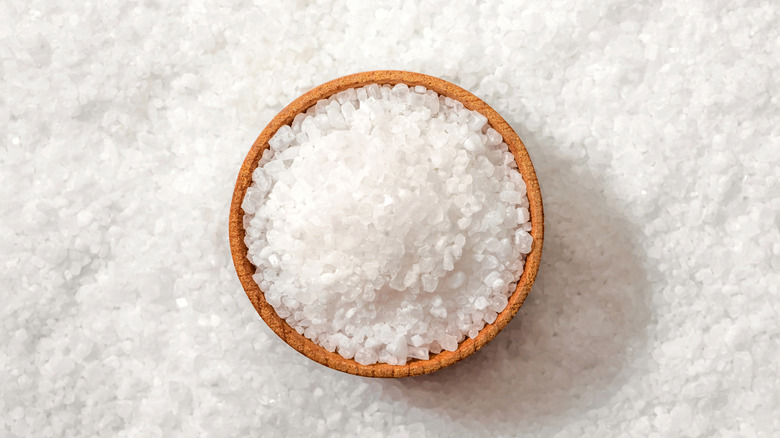
The ancient practice of winemaking goes back long before written history. The earliest archaeological evidence of wine production dates back roughly 8,000 years to what is now Georgia (the country, not the state). Interestingly, while adding salt to wine might seem like a modern, science-backed trend, there's evidence that salt has played a role in winemaking since at least classical Greece.
Back then, wine and salt weren't necessarily paired directly, but saltwater still played a major role in wine production. Winemakers on the Greek island of Kos are recorded to have mixed seawater into grape must. According to legend, this practice was inspired by Dionysus, the Greek god of vegetation and spiritual ecstasy, who was associated with wine and the sea. The resulting aroma was known then as "ανθόσμιος οίνος," which translates to "wine that smells like flowers." Beyond influencing the wine's aroma, the addition of seawater also acted as a preservative. Over on the island of Chios, ancient winemakers were famed for submerging grapes directly into the ocean to infuse them with salinity. This method was later borrowed by the Romans, and is presently undergoing a major resurgence.
Salt has also found its way into wine more indirectly, particularly in vineyards located close to the sea. Take the Italian island of Ischia, for example. Beyond its beautiful beaches and idyllic sun-drenched landscape, the island has a winemaking history spanning nearly three millennia, dating back to Greek settlers who planted vines on its fertile volcanic slopes. Today, its steep, terraced vineyards are exposed to maritime winds and coastal mists, creating a unique growing environment known as "terroir." Some producers believe these salt-tinted grape skins contribute to the distinctively savory, briny, and mineral character associated with many celebrated Ischian wines.