

McDonald's Vs Burger King: The Fast Food Chain With The Healthier Hash Browns
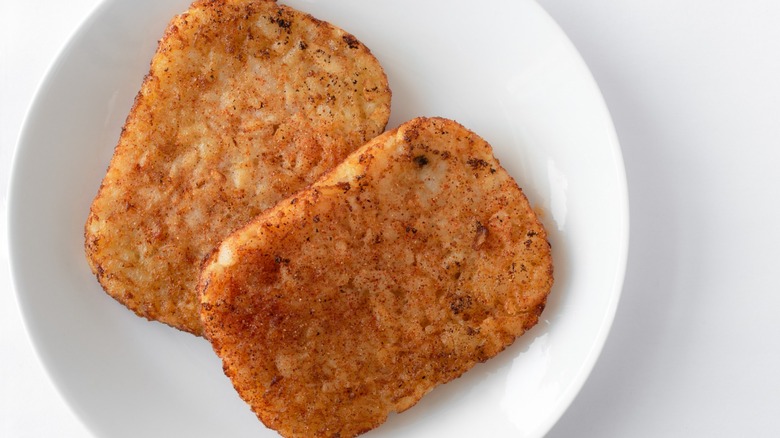
For many, a breakfast isn't complete without a side dish, and there are few side dishes that are as quintessential for the first meal of the day as hash browns. These shredded or finely sliced potatoes are a fixture at home and at many restaurants, and they're no stranger to fast food restaurant menus, either. Perhaps the most iconic iteration of this dish — outside your family recipe, of course — is the one from McDonald's, which is one of the best fast food breakfast items for under $5. But other competing chains also have their own version, including Burger King. While many diners argue over which one is the tastiest, that's all a matter of opinion. When it comes to which chain offers the most nutritious one, that answer is a little more objective, and the winner in that battle is McDonald's.
We arrived at this conclusion by analyzing the nutritional values of each restaurant's hash brown options, focusing on certain aspects of each. We looked at three key figures: the overall calories per portion, the carbohydrates, and the fat. We also looked at some additional aspects of each menu item's nutrition, and in almost every category, McDonald's offered the healthier option of the two, which we'll break down below. But there are some additional details about each restaurant, including ingredients and transparency, that may help you decide which one's hash browns are a better fit for your nutritional needs and your lifestyle.
McDonald's lets customers know more about what goes into its food
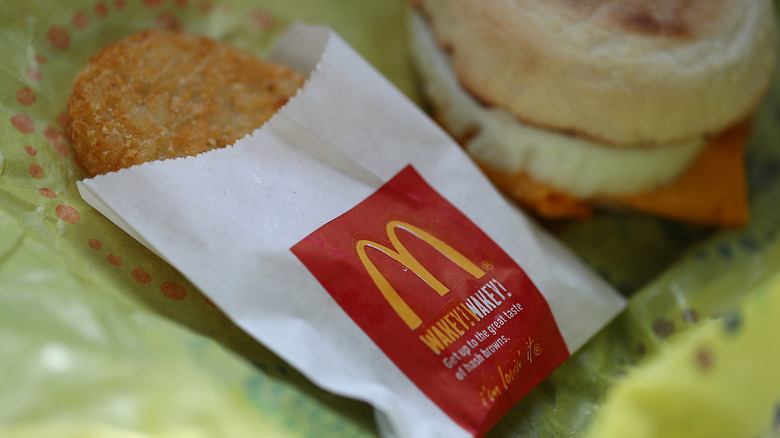
In 2014, McDonald's launched its "Our Food. Your Questions" campaign, answering many customers' queries about what goes into its food. As such, you can find more information on its website about how its menu items are made, including its hash browns, which are not seasoned in restaurants but rather salted in the facility in which they're made. These potato patties are made from shredded spuds that are seasoned and mixed with corn and potato flour before getting partially fried, frozen, and sent to restaurants.
Potatoes are the first item on the ingredients list, followed by a vegetable oil blend that includes canola and soybean oil, and it's the same oil that McDonald's uses to fry the potatoes at its many locations. However, it does also include hydrogenated soybean oil, which some diners may take objection to, as this includes trans fats that may not be good for your heart (per the WHO), as well as beef flavoring to mimic the beef tallow it used to use until 1990. The flavoring is also made with wheat, which means that they're not entirely gluten-free (unless you're abroad — in many other countries, the wheat is omitted). Other than that, most of the ingredients are things you'll find in many processed foods.
McDonald's only offers one size for its hash browns, and it has 140 calories. Each one has 18 grams of carbs and 8 grams of fat per serving, along with 2 grams of protein and 2 grams of fiber. There are 310 milligrams of sodium per serving, which is about 14% of one's daily recommended intake, which is less than Burger King's equivalent.
Burger King's hash browns include include some things you may not want in your food
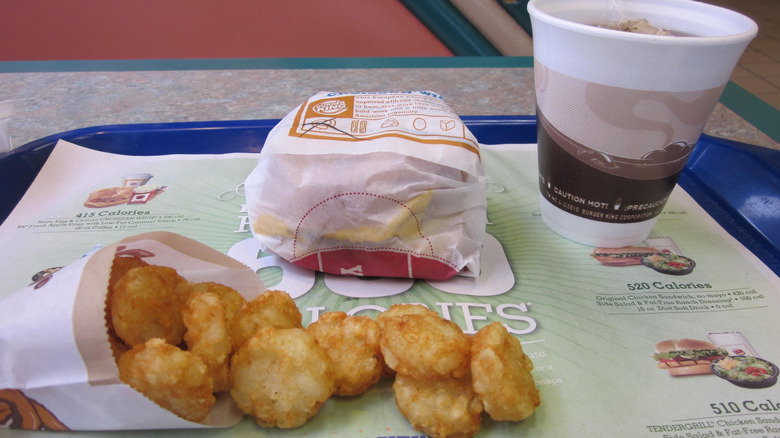
Like McDonald's, Burger King serves breakfast until 10:30 AM. However, unlike McDonald's, Burger King hasn't launched any public relations campaign to demonstrate how its menu items are made. As such, it can sometimes be a little more difficult to figure out what's in breakfast here as opposed to McD's. Nevertheless, it does publish its ingredients on its website, including those for its hash browns. Perhaps the biggest difference between the hash browns here versus the competition is the format. Burger King's version is shaped into small bite-sized coins. Additionally, you can get several sizes of them, though we looked at the small to compare nutritional values with the competition.
Just four little nuggets have 270 calories, or nearly twice as much as what you can get at the Golden Arches. There is also twice the amount of fat and four times the amount of saturated fat. While they have just a tiny bit more fiber at 3 grams, they have 260 milligrams more of sodium, which can be a huge deterrent for people with high blood pressure. Burger King's hash browns also have slightly more additives than its competitor's, including in the dehydrated potatoes. It also contains wheat flour instead of just a wheat-derived flavoring, making it just as unsuitable for people with gluten intolerances.
But perhaps one aspect that will give you pause has to do with the oil. For starters, BK uses two different types of oil blends in its hash browns — one that is included in its uncooked form and another used for frying, and even the frying oil can vary between two different blends. The hash browns also contain palm oil, whose production may be contributing to deforestation (per the WWF).