

Diners From This State Tip The Least On Restaurant Bills In 2026
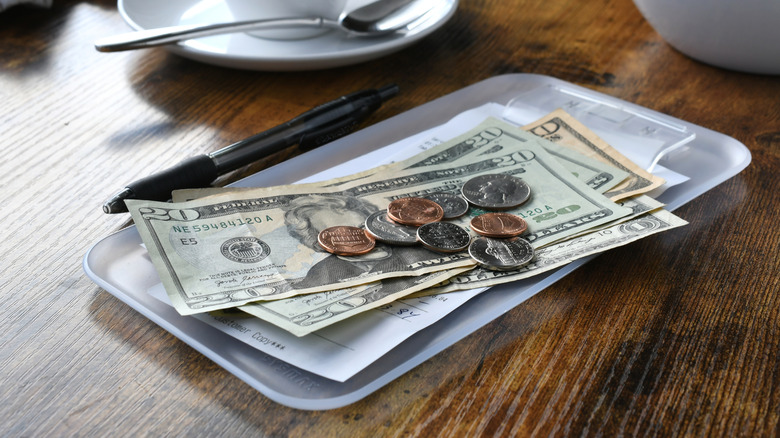
Tipping has a dark and problematic history, but the practice isn't going anywhere anytime soon, especially in the restaurant business. And while the demand for tipping appears to have increased dramatically across the board thanks to the COVID-19 pandemic, it seems that people in some states happen to be more generous with their gratuities than those in others. In fact, according to the restaurant management software company Toast, California has the lowest average percentage across all 50 states, with Californians tipping a mere 17.1%. But the Golden State's low tipping average may have less to do with frugal customers and more to do with California laws.
After all, California has one of the largest economies in the world, and it has far and away the highest number of billionaires in the country. While it could be that the sample is skewing the data, it's much more likely because of California's minimum wage laws. Unlike federal minimum wage laws for tipped employees, which allow employers to pay their employees as little as $2.13 per hour, with the rest made up in tips (called a tip credit), California requires tipped employees to be paid the full state minimum wage, which is one of the highest in the country at $16.90 per hour (and it's even higher in some cities). Because tipped employees in California are already making so much more than those in, say, Pennsylvania, customers might not feel the need to tip as generously.
Higher base wages in California likely influence smaller tips

If you live in or visit California and you dine out (maybe you treat yourself to a visit at Fior d'Italia, the oldest Italian restaurant in the U.S.), it might interest you to know that the tipping laws that apply to every restaurant owner and employee are some of the strongest and most comprehensive in the country. As mentioned, the vast majority of states allow tipped employees to receive a subminimum wage, with the rest made up in tips. However, the Golden State has long held to the notion that tipped staff should receive the full minimum wage before tips, having enacted this into law starting in the mid-1970s.
And in 2025, California legislators passed a bill expanding the state labor commissioner's reach in enforcing tipping laws, allowing the office to directly mete out punishments for tip theft. The bill, signed into law by Governor Gavin Newsom, also strengthened enforcement of existing rules that prohibit deductions from tips for any associated credit card processing fees that might accrue as a result of that method of payment.
These examples of strong tipping laws could influence Californians' propensity for paying less in tips, as a 2022 study discovered that where there is a higher tip credit (and thus a lower minimum cash wage), customers are more likely to tip greater amounts as acts of kindness. Therefore, it could be deduced that the greater the minimum wage (California's is among the highest), the less altruistic customers might feel they need to be.