

Nutella Is Only 13% Hazelnuts - So What's The Other 87%?
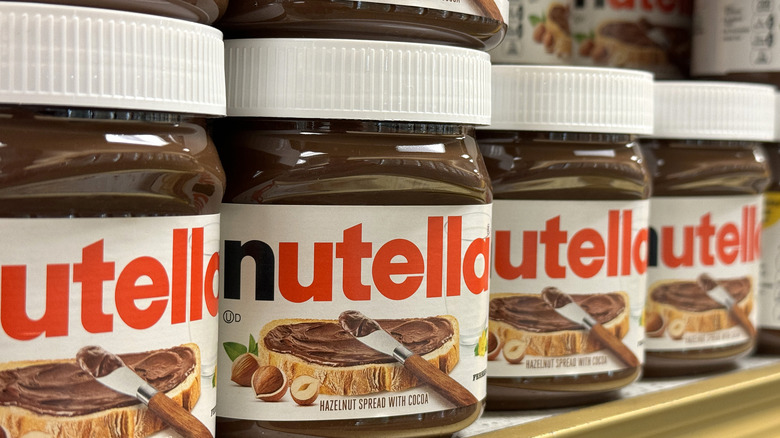
Rich, indulgent, and deliciously chocolaty, Nutella has been a pantry staple for decades, whether you're making éclairs, spreading it on toast, or adding a dollop to your hot chocolate. But it's the hazelnuts, lending that deep, earthy undertone, that have turned it into a certified global icon. Officially marketed as a hazelnut spread with cocoa (sometimes called "hazelnut cream"), a quick look at the ingredient list reveals something surprising: Hazelnuts make up a mere 13% of the jar, with sugar and palm oil doing most of the heavy lifting.
Sugar takes the top spot on the label, making it the most dominant ingredient in the jar by weight. Palm oil comes next, a fat responsible for that smooth, spreadable texture and Nutella's ability to hold its consistency at room temperature. Neither is particularly shocking; plenty of comparable spreads lean just as hard on both to boost flavor and keep the product shelf-stable for months.
Rounding out the rest of the label are skim milk powder, fat-reduced cocoa, lecithin, and vanillin, each playing a much smaller role than the big three. But perhaps even more surprising than the proportion of hazelnuts is the fact that cocoa powder accounts for just 7.4% of the jar. That imbalance sparked controversy in 2017, when consumer watchdogs accused Ferrero (Nutella's parent company) of quietly cutting costs by reducing the cocoa content, pointing to skim milk powder climbing from 7.5% to 8.7%. Among the label's less contentious players, lecithin works as an emulsifier, keeping the ingredients from separating, while vanillin is an artificial flavoring added for a hit of vanilla-like aroma.
Hazelnuts were once the main event of Nutella
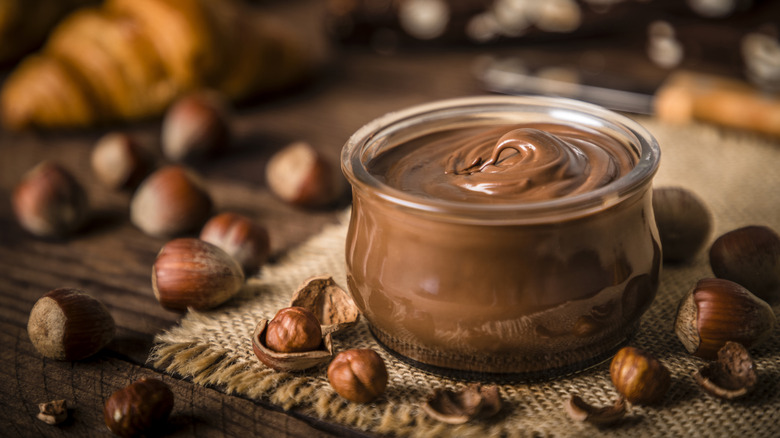
The tradition of stretching chocolate with hazelnuts may date back to Napoleon's era. One popular account holds that Napoleon's Continental Blockade in the early 1800s disrupted cocoa imports, pushing Turin's chocolatiers to bulk out their limited supply with the region's abundant hazelnuts, giving rise to a chocolate-hazelnut confection called Gianduja, a name patriotically associated with a local puppet character. Over a century later, that same approach would inspire Nutella's creation.
Conceived in the aftermath of World War II, the spread was, once again, a clever solution to a severe cocoa shortage. Pietro Ferrero created its predecessor in Alba, in the Piedmont region of Italy, in 1946, taking advantage of the region's plentiful supply of hazelnuts. His version contained mostly hazelnuts and just a little cocoa. This early iteration, named Giandujot after the region's existing chocolate-hazelnut tradition, was more like a paste than a creamy spread. It only became spreadable in 1951 with the introduction of Supercrema, and the recipe was further reformulated in 1964, when Nutella was officially born. If you fancy reviving an old-school version without all the extra fuss, you only need three ingredients for a homemade rendition.