
Who Makes Costco Kirkland Signature Côtes Du Rhône Wine?
There's truly no other grocery store quite like Costco. Where else can you pick up a giant 60-pound bucket of honey alongside your weekly fruit and veggie haul, then finish off your shopping spree by chowing down on its iconic $1.50 hot dog and soda combo? Holding it all together is Kirkland Signature, Costco's expansive range of private-label goods. Usually, Costco keeps the identities of its suppliers closely guarded secrets, and product recalls are often the only way people manage to deduce the famous brands behind certain items. In a rare break from precedent, however, there's no secret that Romain Leroy is the name behind the bulk-buy chain's Kirkland Signature Côtes du Rhône Villages wine — it's literally on the bottle!
As of 2022, Romain Leroy is the current director of the Rhône Valley winemaking and négociant house Grandes Serres. For those unfamiliar, a négociant is essentially the middleman between Costco and the vineyards, purchasing grapes and wines from growers to produce and bottle under its own name. Previously, Patrick Lesec, another well-regarded négociant, supplied Costco with the bottles, before things changed hands to Leroy for the 2024 vintage. So any bottle labelled as 2023 or earlier will carry Lesec's name, while anything from 2024 onward will be Leroy's.
Specifically, Romaine Leroy sources its Côtes du Rhône Villages wine exclusively from the Southern Rhône Valley, a major wine-producing subregion of the larger Rhône Valley in southeastern France. This makes perfect sense, as the Côtes du Rhône Villages is a grenache-dominated blend, and the Southern Rhône Valley is most famous for its GSM blends, which are made primarily from grenache, syrah, and mourvèdre grapes.
What sets Costco's Kirkland Signature Côtes du Rhône Villages apart?
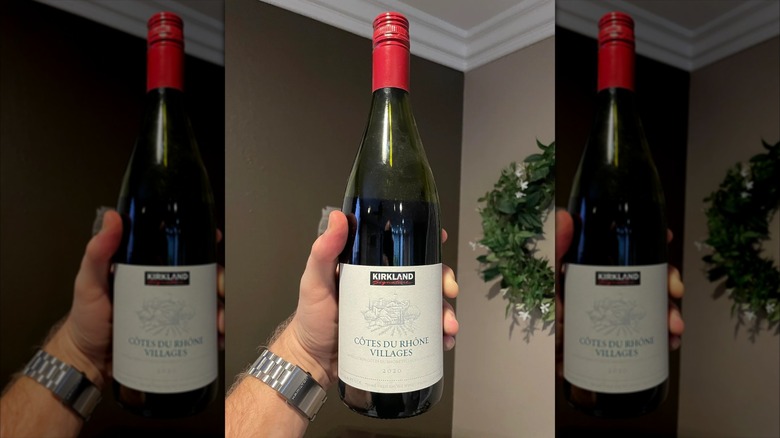
Costco's Kirkland Signature Côtes du Rhône Villages wine isn't built around a single grape. Instead, it's defined by its appellation, a legally protected geographical area where wine grapes are grown and where strict local laws govern how the wine can be produced. Côtes du Rhône Villages sits a tier above standard Côtes du Rhône AOC, the baseline of the Côtes du Rhône classification system, with stricter production rules and lower yields. Production is limited to 95 designated communes across four departments, and red wines, which make up the vast majority of what is produced, must contain at least 50% grenache, alongside a combined minimum of 20% syrah and mourvèdre each.
The maximum yield — the amount of wine that can legally be produced from a given plot of land — is also lower than the generic AOC limit. Standard Côtes du Rhône AOC vineyards are capped at 50 hectoliters per hectare, whereas Côtes du Rhône Villages tightens that cap to 45 hectoliters per hectare and drops it to 42 for wines from individually named villages. The general idea is that lower yields encourage each vine to put its energy into fewer, more concentrated grape clusters instead of spreading it across a larger crop, potentially resulting in more intense flavor and character. However, we recommend taking this reasoning with a grain of salt. The relationship between yield and wine quality is complex and remains the subject of considerable debate within the wine community.