

Does Costco Grind Kirkland Signature Meat Fresh In The Store?
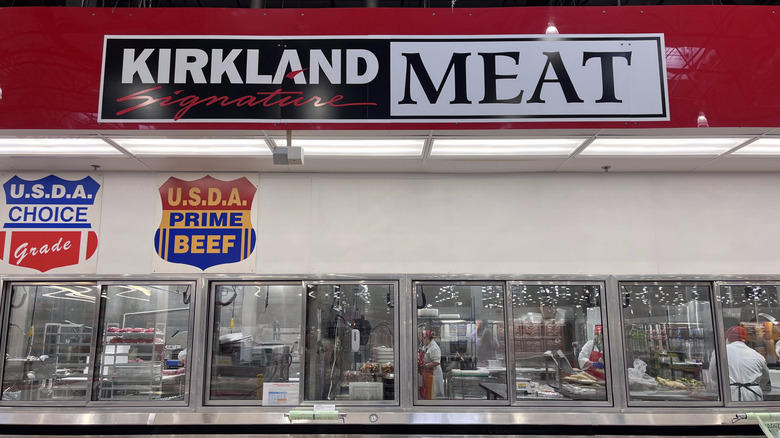
Even if ground beef isn't on your weekly shopping list, we'd always advocate tossing it in your cart anyway. It's truly an all-rounder, delivering delicious, lazy weeknight meals that stretch across countless recipes and cuisines. Better yet, if you've got a Costco membership, one of the many perks is access to large batches of meat at lower prices. Just one pack of Kirkland Signature Ground Beef is enough to feed a small army, or last you months if properly stored in the freezer. Despite the low price, Costco doesn't skimp on quality either. According to self-identified employees on Reddit, it's ground in-store every morning – though that's not to say every batch is freshly cut that day.
According to one self-identified employee on Reddit, the usual process for ground Kirkland Signature Ground Beef comes down to two components: beef trimmings and bull meat. For those unfamiliar, "trimmings" is butcher lingo for leftover fatty cuts, while bull meat refers to an extremely lean (upward of 95% lean) ground beef sometimes sold in tubes. Kirkland Signature Ground beef is made by grinding trimmings and bull meat together, landing on a final product that's ideally within the range of 88% lean and 12% fat.
There's no set-in-stone recipe for the grind, either. The same employee revealed that leftover steaks nearing their sell-by date sometimes get thrown into the mix too. "For example, today I had a bunch of wagyu chucks and New Yorks[,] as well as prime tri-tip and choice flanks dated 1/27," they wrote. "Those all went in the grind this morning[,] but it's called a regrind. Regrinds can only be out until 4 [p.m.] and still have to pass the 12% lean [threshold]. If you want to look out for it[,] check the sticker for a tiny 'R' above the date."
The lean-to-fat ratio has stirred up some controversy
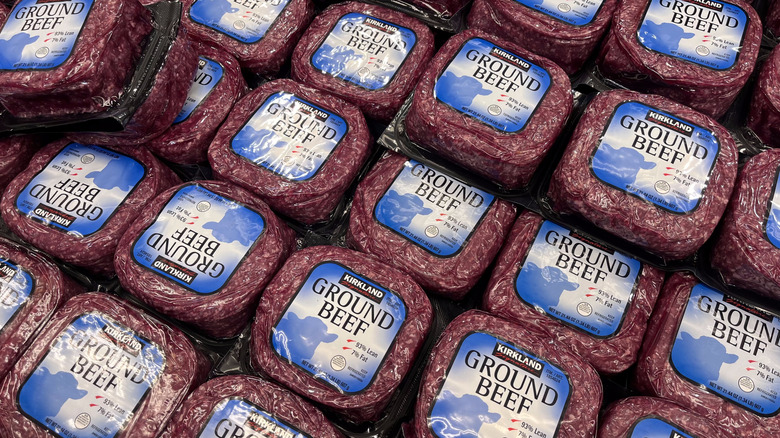
We love that Costco's Kirkland Signature Ground Beef is made fresh in-store, but not everything about it is perfect. A common customer complaint is its lean-to-fat ratio. In fact, some claim that it should be avoided altogether. Since the ground beef is made fresh using a variety of different cuts, weights, and ratios naturally vary from batch to batch. But as a general frame of reference, it typically falls somewhere between 80% and 88% lean. For many, that's a deal breaker.
It all comes down to fat. When the ground beef cooks, fat renders out, basting the meat from within and infusing it with flavor. More importantly, rendering fat keeps the meat tender and juicy, making it far more forgiving over heat. Because ground beef has such a high surface area, it's especially prone to drying out. Overcook it, and you're left with dry, flavorless, chewy crumbles that won't impress anyone at the table. That's not to say that lean ground beef doesn't have its place. In rich, saucy dishes, you don't want fat pushing things over the edge. In a soup or lasagna, for instance, lean ground beef is ideal, since you don't want the other ingredients swimming in a pool of grease.
But for other dishes, it might be worth skipping the lean stuff entirely. Few recipes make that case better than hamburgers. Using a fattier blend, think an 80/20 minimum, is essential to prevent dryness. Nobody likes a dry patty; the whole joy of a burger is the juiciness. Pick up an 88% lean ground beef, and you're basically building a burger without soul. The same logic applies to dishes with long cook times, such as meatloaf or meatballs, where fat doesn't just add flavor; it protects the meat as it cooks.