

What Using The First-Ever Slow Cooker Was Like

Up there in the ranks of the rice cooker and the dishwasher, the slow cooker is one of those inventions that truly changed the kitchen game, and, dare we say, society, forever. It automated low-and-slow cooking, allowing people to cook rich, hearty meals (like pot roasts, which need over six to ten hours) without needing to babysit an open flame or leave the oven running all day. Nearly every kitchen has been graced by one at some point, yet few people know what the original slow cooker actually looked like. It's probably a shock to no one that it was far simpler than its successors.
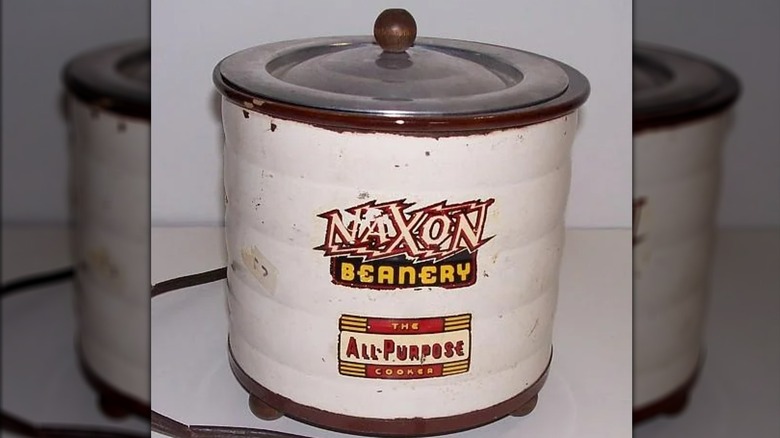
If you're obsessed with vintage kitchenware, you'd have loved the very first slow cooker. Patented by Irving Naxon in 1940 and sold as the Naxon Beanery, the retro device was a lidded ceramic pot encased in a metal shell, wrapped with a simple heating element. Forget all the bells and whistles of modern slow cookers. The features of this device were: on and off. It didn't even come with buttons; to turn it on, you plugged it into the wall, and unplugged it to turn it off. You couldn't even remove the ceramic pot — that feature would be introduced decades down the line.
Despite its simplicity, it got the job done. You were most likely to find a Naxon Beanery sitting in old-school coffee shops and luncheonettes, where it simmered away all day long. It didn't really cement itself as a household staple until Naxon retired in 1970 and sold his company, patent included, to Rival Manufacturing. Rival relaunched the Naxon Beanery the following year as the now-iconic Crock-Pot, successfully marketing it heavily toward a new generation of working women.
The Jewish origins of the slow cooker
Over the years, the slow cooker has undergone significant changes, from newer models coming equipped with handy warming features and digital temperature probes to multi-functional models that can braise, sear, and air-fry, all in a single device. But no matter how fancy the slow cooker gets, Irving Naxon's original guiding principle still holds true today: easy, hands-off cooking that saves users heaps of time and effort.
Something that has got lost along the way, however, is the story behind the invention of the slow cooker. Many link it to the liberation of the mid-century housewife, and in a way, that's true. However, the real story behind its creation is actually rooted in rich Jewish tradition. See, Naxon drew inspiration from his mother's stories of her own childhood in Lithuania, where her mother would send her to the village bakery on Friday afternoons with a crock full of cholent, a traditional slow-cooked meat and bean stew. The dish was specifically devised to get around the Sabbath prohibition on cooking, while still letting observant Jews savor a hot meal on Shabbat.
The trick was low-and-slow cooking. The crock went into the bakery's oven before sundown on Friday, and as the oven slowly cooled overnight with no one tending the fire, that gentle, dwindling heat softly cooked the stew until it was ready to eat the next day. Although Naxon never officially marketed his Naxon Beanery toward the Jewish community, the parallels are impossible to miss. It's essentially the same creative workaround that explains why some refrigerators today come equipped with a "Sabbath mode" feature. To this day, slow cookers remain widely used by observant Jews on Shabbat to keep meals warm without lifting a finger (or starting a spark).