

Pyrex Vs CorningWare: The Main Difference To Keep In Mind
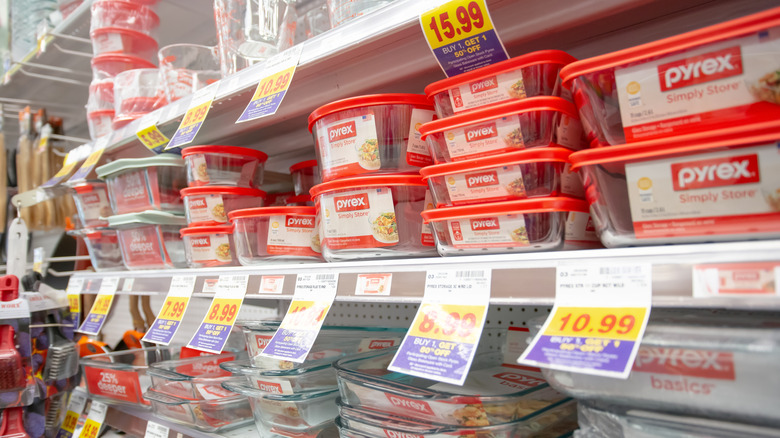
If you're looking to seriously upgrade your kitchen, forget an expensive, high-end remodel and invest in some top-notch kitchenware instead. Two brands that come to mind when we think of reliable quality are Pyrex and CorningWare. These two titans of the kitchen world have truly stood the test of time, and their vintage pieces are among the best finds a savvy thrifter can stumble upon – classic Pyrex can be worth a fortune. Both brands carry a wide catalogue of items and are particularly renowned for their baking dishes. They're even manufactured by the same parent company, but there's still some pretty big differences worth knowing.
When it comes to anything that goes in the oven, quality is defined by how well it holds up under heat. That's largely a matter of material, and both brands' materials have shifted over the decades. Vintage Pyrex (anything made before the late 1950s) was blown from borosilicate glass, while modern Pyrex switched to tempered soda-lime glass instead, which is more prone to shattering under thermal shock. CorningWare tells a very similar story. Its classic vintage pieces relied on Pyroceram, while modern CorningWare has shifted to the comparatively less hardy stoneware. Both brands perform admirably at the temperatures they're built for. But ask around, and you'll find near-universal agreement that CorningWare (Pyroceram especially) simply outshines Pyrex when the heat is amped up.
The materials also dictate what each brand is actually built to do. Vintage Pyroceram CorningWare's superior heat resistance makes it well-suited to stovetop cooking, whereas old and new Pyrex was never designed for direct flame or a heating element. But once CorningWare shifted to stoneware, most of its newer pieces lost that same stovetop compatibility, so don't make the mistake of mixing the two up.
Not all Pyrex is made from the same materials
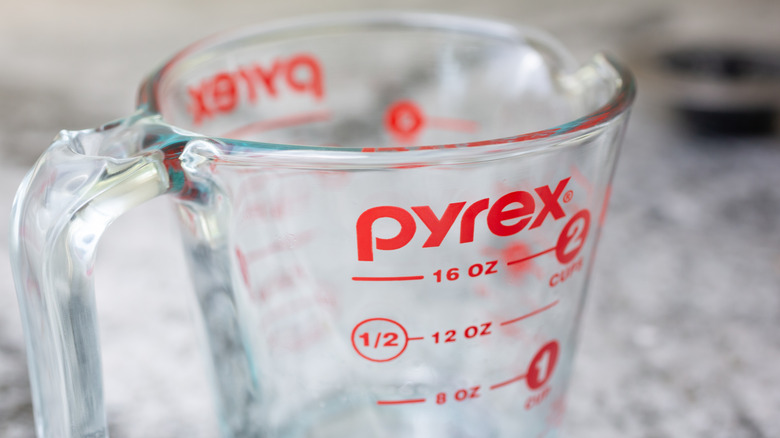
When we think of Pyrex, the first thing that comes to mind is minimalist transparent baking dishes or measuring jugs. But this wasn't always the case. Invented in 1915 by the Corning company, Pyrex did indeed start out as a clear, heat-resistant borosilicate glass, but it famously expanded into opaque, colorful kitchenware decades later. Today, transparent glass remains the most common style, giving it a unique edge over CorningWare by letting you keep an eye on your food as it cooks without having to remove the entire dish from the oven. This makes it especially well-suited for baking casseroles, roasting vegetables, or baking desserts.
One slightly unusual feature that sets Pyrex apart is that its material changes depending on where you are in the world. While Pyroceram-based CorningWare is strictly off the table unless you get lucky at a thrift store, travelers to certain European countries can still pick up brand-new borosilicate Pyrex cookware. Confused? Here's the gist: The European market simply never followed the U.S. in switching over to soda-lime glass.
There are pros and cons to each material. Soda-lime — primarily a mixture of silica, calcium carbonate (soda), and calcium oxide (lime), which is then tempered to make it resistant to damage from drops or heavy impacts, but far more vulnerable to shattering from sudden temperature shifts; it also happens to be much cheaper to produce than borosilicate. Unless you're someone who's extremely clumsy in the kitchen, we'd say temperature resistance matters more than mechanical strength. So if you ever find yourself in Europe, it might be worth swinging by a local cookware shop.
Vintage CorningWare remains the gold-standard of thermal resistance
The story of CorningWare started over 40 years after Pyrex had hit shelves. It was invented by chemist S. Donald Stookey in 1957, purely by accident. He'd overheated a glass sample in a furnace, and instead of the melted mess he expected, he encountered a tough substance that would later be named Pyroceram. The material proved so resistant to extreme, sudden temperature shifts that it was even used as nose cones in Cold War-era rockets.
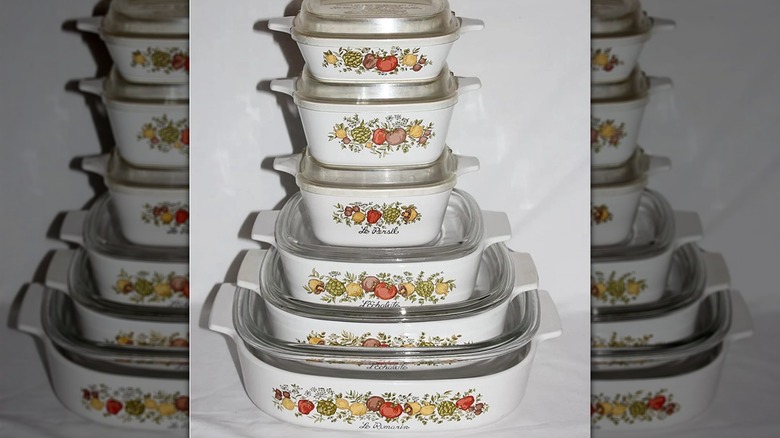
Corning introduced Pyroceram-based cookware in 1958, with many products featuring charmingly rustic designs. It's worth getting familiar with all the different patterns, since it'll make them a breeze to spot at thrift stores. For over four decades, all CorningWare was made of Pyroceram; this material was, without exaggeration, virtually indestructible. A sudden change in temperature usually causes uneven expansion, which is what makes most materials — including Pyrex — vulnerable to shattering. But Pyroceram had a near-zero rate of thermal expansion, so it could go straight from a deep freezer into a blazing-hot oven, or sit right on top of a stove, without any issues.
It sounds absurd that a material as perfect as Pyroceram would ever be phased out, but that's exactly what happened in 1998. Corning sold off its consumer cookware division to World Kitchen (now Corelle Brands). Pyroceram production itself ceased in 2000, and by 2001, the formula had re-emerged as a line of glazed stoneware. We're not here to drag stoneware; it's non-porous, resists staining and odors, and retains heat once it's hot. But it simply can't match Pyroceram's ability to handle extreme temperatures. Customers voiced their preference for Pyroceram so much so that in 2008, Corelle Brands reintroduced stovetop-safe Pyroceram, though stoneware remains the dominant material in the brand's lineup.