

McDonald's Vs Burger King: The Fast Food Chain With A Healthier Classic Cheeseburger
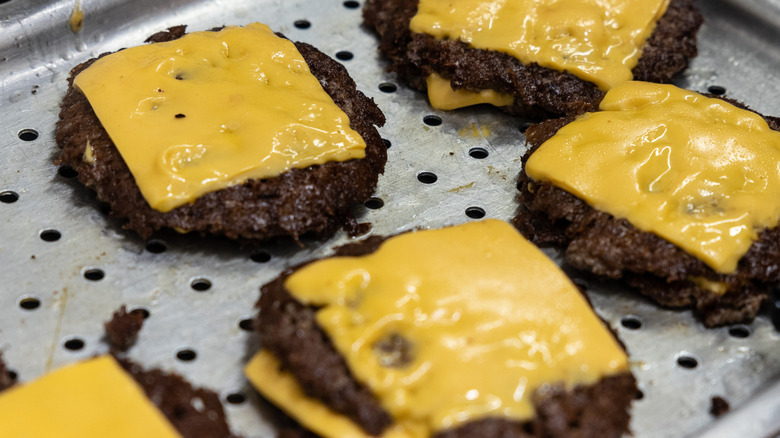
McDonald's and Burger King have an almost hegemonic dominance in the fast food burger-and-fries market. Their brand presence is permanently stamped in popular culture, as is the long-running beef between them. But, when you strip it down to what matters — the actual beef between the buns — which wins out on the health front when it comes to their cheeseburgers?
The reality is close, with almost identical nutritional profiles; McDonald's simply edges its rival out on salt, while Burger King offers a tad more protein. Granted, few would look to McDonald's or Burger King as the epitome of nutritional health, but that doesn't mean they can't be part of a balanced lifestyle. Dietitians generally warn against labelling foods as "healthy" or "unhealthy" since overall eating patterns and food intake matter most.
At the heart of both fast food powerhouses' cheeseburgers is the beef. The two chains commit to some basics, meaning there is more that unites their patties than divides them. Both are purportedly made from 100% beef without fillers, additives, and preservatives. Granted, there are some differences in preparation. Unlike many other big burger franchises, neither commits to entirely fresh beef. McDonald's uses a mix of fresh and frozen, while Burger King's flame-grilled method, which gives the patties their smoky, chargrilled taste, uses frozen. However, there's more to unpack nutritionally when it comes to the cheeseburgers than just the beef.
Choose McDonald's cheeseburgers if you're watching your sodium intake
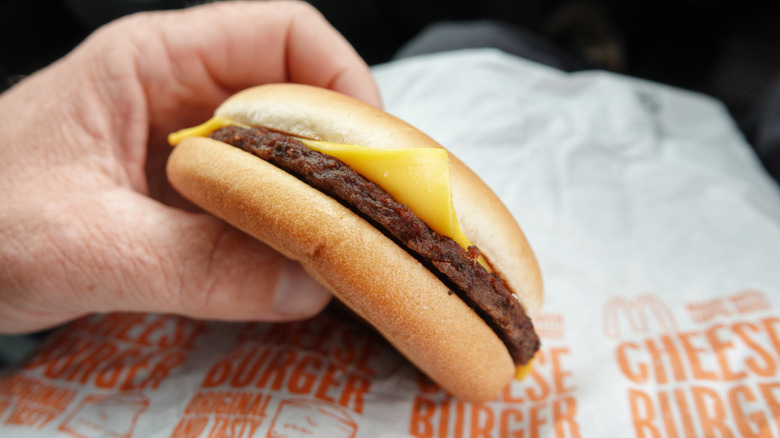
McDonald's classic cheeseburger follows a relatively straightforward formula. They're made with a standard bun without sesame seeds, a 100%-beef patty, a slice of bright yellow pasteurized American cheese, and some chopped onions, pickles, ketchup, and mustard. Compared to Burger King, McDonald's patties are often thinner, chewy, and can be somewhat on the dry side, generally garnering some accusations of being industrial-tasting and blander in quality (much like its fried chicken, which we ranked pretty low).
When it comes to a cheeseburger's nutritional profile, however, it actually has a fair amount going for it. It typically comes with 15 grams of protein and also includes a modest, but not insignificant, 2 grams of fiber. With most guides recommending a balance of different macronutrients — namely protein, carbohydrates, and fat — a McDonald's cheeseburger does just that since it also has 13 grams of fat and and 31 grams of carbs. Its micronutrient values — important for overall body functioning — is of note as well; one burger gives you 8% of your recommended calcium and 15% iron.
That said, a cheeseburger also has a lot of things to watch out for, especially for those with heart concerns or blood pressure sensitivities. 31% of your day's sodium (720 milligrams, to be precise) and 6 grams of saturated fat, a similar percentage of the advised daily maximum, is between a mere bun. Its protein, while decent, is also more modest compared to other menu items. For a leaner, higher-protein choice, McDonald's' fried poultry products, especially the Chicken McNuggets, give you a more complete meal.
Burger King's cheeseburgers are slightly more protein-forward
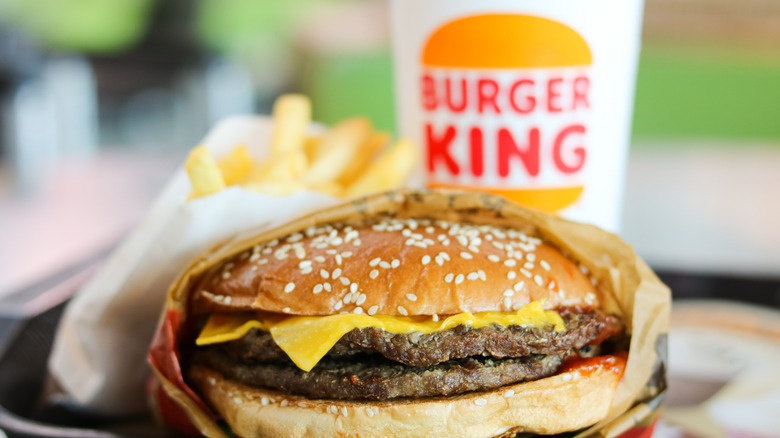
As its name implies, Burger King is often seen as having the edge on McDonald's when it comes to the taste of its burgers. Our ranking shows this, although both ended up at the bottom of our list, and it's a common sentiment on Reddit, where a widespread feeling is that it boils down to quality versus convenience. "I like Burger King's burgers more," one user said, "but if I'm thinking with my wallet, then I'd probably prefer McDonald's."
However, any perceived advantages generally end there. Burger King's cheeseburger is extremely similar to its rival's when it comes to health, with some lagging areas as well. A Burger King cheeseburger gives you more or less the same macronutrients as one from McDonald's, with an extra gram of protein (16 grams) and total dietary fat (14 grams), equal saturated fat (6 grams), and 1 gram fewer carbs — effectively negligible differences.
Where things are less trivial is on the sodium front. At 810 milligrams per cheeseburger, a Burger King sandwich gives you 90 milligrams more than McDonald's. Nutrition scientists generally warn that Americans consume too much salt, potentially contributing to a vast array of cardiovascular issues — namely hypertension, which affects nearly half of U.S. adults (via U.S. Centers for Disease Control and Prevention). But, when it comes to a mere cheeseburger, you don't get a world of difference between McDonald's and Burger King. Just pick whichever is more to your liking, and rest assured that their nutritional impact is near identical.