

5 Lesser-Known Focaccia Varieties You Need To Try
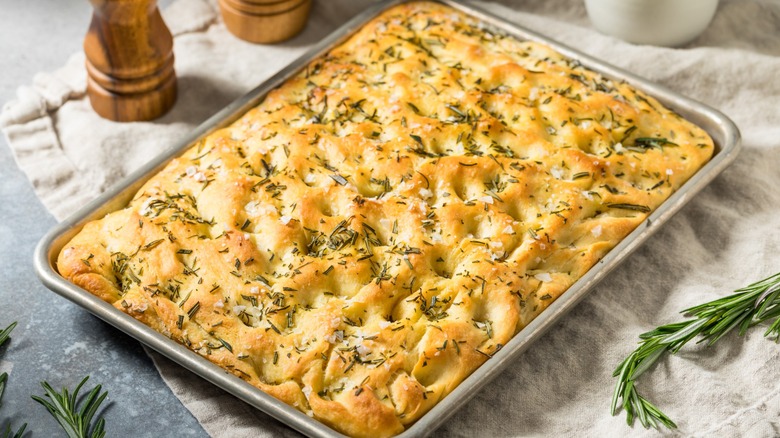
It's fluffy, delicious, simple, and yet somehow decadent: focaccia, the culinary f-bomb that detonated an irreversible bakery trend worldwide, turning the bread into a near necessity for charcuterie boards, happy hours, and hors d'oeuvres. While most people outside Italy are now familiar with standard focaccia, there are actually a variety of lesser-known types that should also be on your radar.
Classic focaccia, as it is commonly recognized — a yeasted, olive oil-brushed flatbread with distinctive fingertip dimples — is closely associated with the northern Italian port city of Genoa, which also gave us pesto. Known as "fügassa" in the regional dialect, it's far from a posh gastronomic specialty for the city's residents, and it has been an inexpensive daily staple since the Middle Ages. Locals enjoy dipping it in their morning cappuccino — and if you cross the nearby border into southern France, you can find focaccia's olive-topped cousin, fougasse.
"Focaccia Genovese" may have become the globally recognized template, but it is not the only version of the recipe. Across Italy, different towns and regions have their own distinct versions of the flatbread. As with almost everything in Italian cuisine, which is itself highly varied and far from a uniform national tradition, it's best to try things locally. From stuffed styles oozing with melted cheese to others loaded with toppings, here is a rundown of some lesser-known — but no less delicious — varieties of focaccia you can try in Italy.
Focaccia di Recco is a thin, cheese-filled treasure
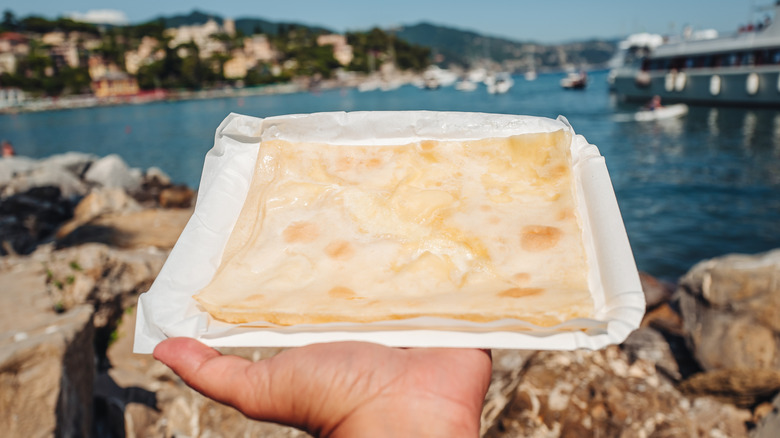
Recco is a small, unassuming seaside resort of around 10,000 inhabitants, quietly perched near glitzy Riviera heavyweights like Portofino and Santa Margherita Ligure. And yet, every year, thousands of tourists make the pilgrimage to the town to get their hands on its unique, centuries-old, cheese-stuffed specialty: focaccia di Recco.
Despite being a mere stone's throw from Genoa, its focaccia couldn't be more different. Recco's distinctive cheese-filled bread is unleavened, meaning the dough remains extremely thin, crisp, and almost pizza-like in consistency. Stracchino, a type of soft Italian cow's milk cheese, is wedged between two thin sheets of dough, which are baked to blistered, golden perfection.
Although versions of the dish are believed to have existed as early as the Middle Ages, it became established in local restaurants around the turn of the 20th century, leading to the consolidation of a specific recipe whose production was limited to a tiny area. It hasn't gone unnoticed by culinary experts either, who have lauded it as one of the world's best baked products. In 2015, the European Union granted the specialty IGP status — a certification tying the production of certain products to specific places — and restricted its "authentic" production to Recco and three adjacent municipalities.
Focaccia Barese stands out for its airy texture
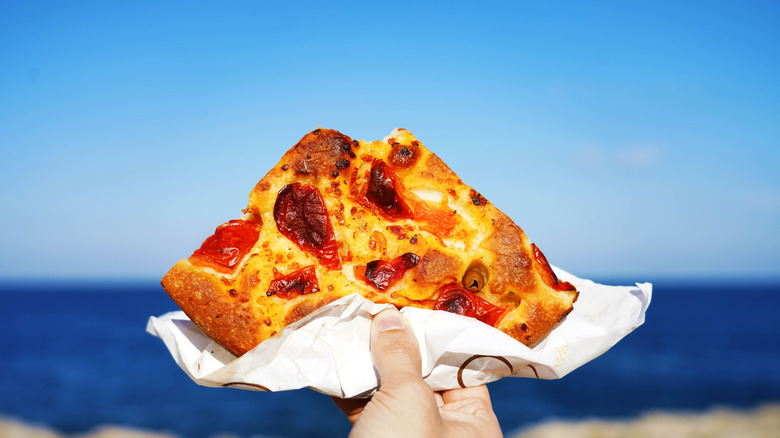
If you head south to Apulia, the "heel" of the Italian peninsula, you'll find the gritty port city of Bari. Here, the local focaccia Barese is a source of pride and daily fuel. This product has remarkably airy and fluffy dough, a result of its high water content and long rising process. The result is a bread with a tender texture that is generally thicker and softer than focaccia Genovese.
But the differences don't end there. Focaccia Barese's dough is usually made with durum wheat semolina and sometimes potato, which gives it an exceptionally plush, tender crumb. In addition, the dough is topped with fresh cherry tomatoes crushed by hand, locally grown olives (olive Baresane), oregano, a sprinkle of coarse salt, and a generous drizzle of EVOO. For anyone wanting to try their hand at it without crossing the ocean to Apulia, we have you covered with a recipe for focaccia Pugliese — the broader umbrella term for flatbreads across the entire region of Puglia.
Focaccia Messinese remains a Sicilian staple
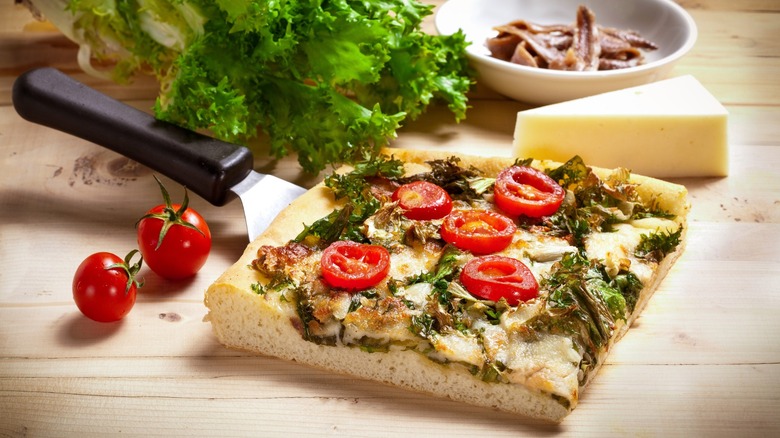
Crossing the Strait of Messina from mainland Italy into Sicily, focaccia becomes an even more elaborate affair. Sicilian cuisine isn't usually known for its restraint — from ricotta-filled pastries like cannoli to ornate arancini rice balls, the local culinary tradition likes to deep-fry, stuff, or garnish almost anything it can get its hands on — and the island's elaborate version of focaccia is no exception, going especially heavy on the toppings.
Focaccia Messinese, from the northeastern Sicilian coastal city of Messina, loads its thick, tray-baked base with a pizza-worthy array of add-ons. Among these are fresh sheep's milk cheeses like primosale or tuma, bitter greens such as scarola riccia (curly endive), a generous serving of tomatoes, and salted anchovies: a kaleidoscopic explosion of color, umami flavor, and dairy-infused richness. It's a staple both in local bakeries and Sicily's distinctive delicatessens, known as "rosticcerie."
Closely related to focaccia Messinese is Palermo's sfincione, which provided the inspiration for square-slice American Sicilian-style pizza, one of New York City's four main pizza types. It's also spongy, rectangular, and thick, although it differs slightly from the Messina variety in that it's a little flatter and traditional versions commonly include onions, anchovies, cheese, oregano, and breadcrumbs.
Focaccia con le cipolle remains an underrated classic
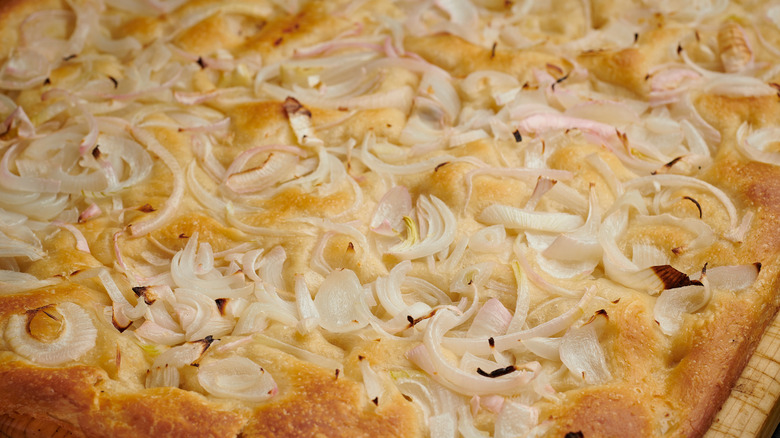
Now, this may technically count as a form of focaccia Genovese, but onion focaccia — or "focaccia con le cipolle" — is an underrated, old-school Ligurian classic whose appeal may have become increasingly niche, but which is no less worthy of your consideration.
Essentially a standard focaccia Genovese topped with an almighty heap of oiled onions, the recipe was once a staple among Genoa and the surrounding region's no-frills, seafaring working class, who revered it as an almost treat-like indulgence. White onions are the traditional choice — and these added alliums add a wonderful sweetness to the bread while infusing the dough with an oily softness derived from the vegetables' moisture. It is one of a range of traditional local focaccia varieties — such as focaccia with olives or sage — that can still be found in more traditional bakeries across the city and the neighboring Riviera.
Thin and rustic, Tuscan schiacciata makes legendary regional sandwiches
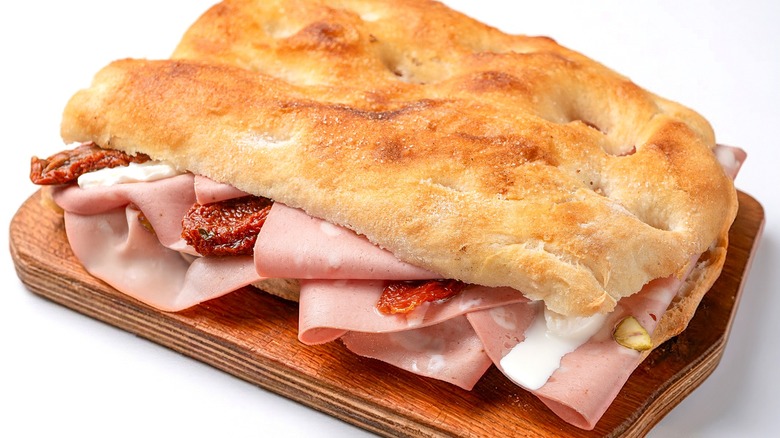
Focaccia takes quite a different form in Tuscany, where it's quite literally squashed — as its name, "schiacciata," means in Italian — into a relatively thin loaf with crisp edges and an open, uneven crumb. Rustic and crisp, one of Tuscan schiacciata's defining characteristics is its suitability for sandwiches: thin enough not to overwhelm the palate, but sufficiently rich to be considerably more luxurious than your average bun.
All'Antico Vinaio, the Tuscan sandwich chain that uses schiacciata as its bread, has become nothing short of a global sensation. Outside its shops in Florence and Rome, lines of tourists meander between Renaissance palazzi and medieval alleyways, hoping to get their hands on the famed sandwiches. These are large and made with popular fillings such as fennel salami ("finocchiona"), porchetta, soft and aged cheeses, various roasted vegetables, and an assortment of savory creams.