

The Difference Between NYC's 4 Most Common Styles Of Pizza
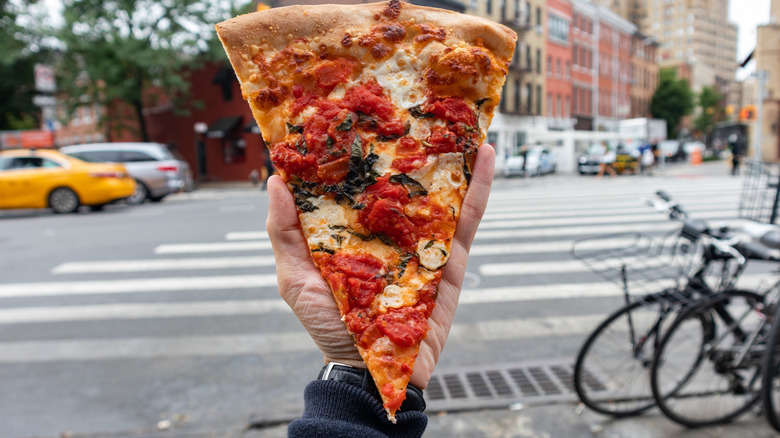
It would be no understatement to say that New York is America's unofficial pizza capital, although some other places would vie for the title. Indeed, the Big Apple and the "big pie" are so intertwined that ordering a slice needs no further explanation. Yet, the city's parlors don't all make the same kind of pizza. While you can find countless varieties, New York City pizza can broadly be subdivided into four categories: coal-oven, New York slice, Sicilian, and Neapolitan.
These four styles can generally be distinguished by their thickness, shape, crust type, serving format, and preparation. Coal-oven pizzas, for instance, tend to have a dry crust and smoky, charred patches. The classic New York slice is foldable, greasy, and generally consumed as a single portion, topped with low-moisture mozzarella. Neapolitan pies, on the other hand, have a tender center and a thicker, airy crust, while the rectangular, thick Sicilian style is baked in an oiled pan.
These specific categories, while each with its own distinct history, can overlap: A pizzeria can borrow from another's style or ingredients, and a "coal oven" technically describes a preparation method just as much as it does the finished product. They are also only four of the many types of pizza in the U.S., showing just how each location can shape the dough, sauce, cheese, and oven.
Coal-oven pizza is New York's old-school original
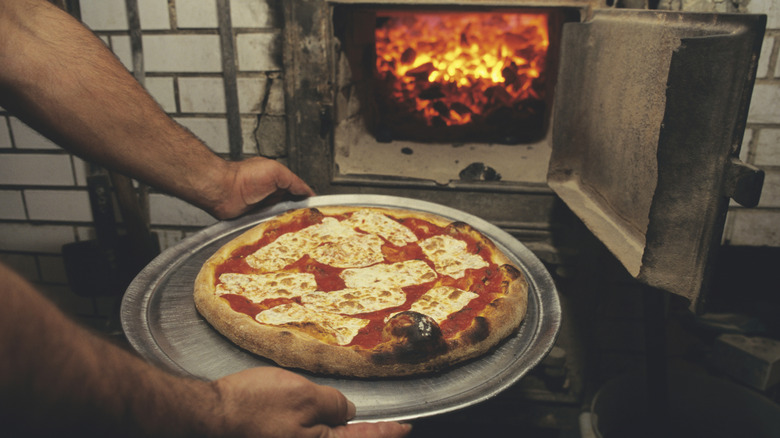
Coal-oven pizzas are deeply intertwined with New York City's history, their distinctly familiar sight and scent telling a long story of a city shaped by its many waves of Italian migration, especially from the country's south.
At the beginning of the 20th century, the city's earliest pizza restaurants had giant coal-fired masonry ovens, which they initially used for bread and eventually for making pies. They can still be found in some of Manhattan's oldest pizzerias: Lombardi's, for instance, claims to be the country's oldest pizza parlor, tracing its roots to 1905, while John's of Bleecker Street sustained the tradition using smaller-sized ovens. The arrival of gas deck ovens ultimately innovated pizza-making and led to the softer, more foldable slice associated with New York City's pizza scene, but coal ovens remain a consolidated part of the city's food culture.
Coal-oven pizzas are distinguished by their relatively dense, dry crust and dark, leopard-like pattern of charred spots, giving them their distinctive appearance and smoky flavor. This is a result of the burning coal, which allows the ovens to reach temperatures as high as 800 to 1,000 degrees Fahrenheit. Traditionally, coal-oven pizzas go lighter on the toppings — think basic tomato, mozzarella, and maybe anchovies or pepperoni — and are sold as whole pies rather than by the slice. They're also less suitable for reheating or staying out overnight, as the crust can harden as it cools.
The classic New York slice is built for portable convenience
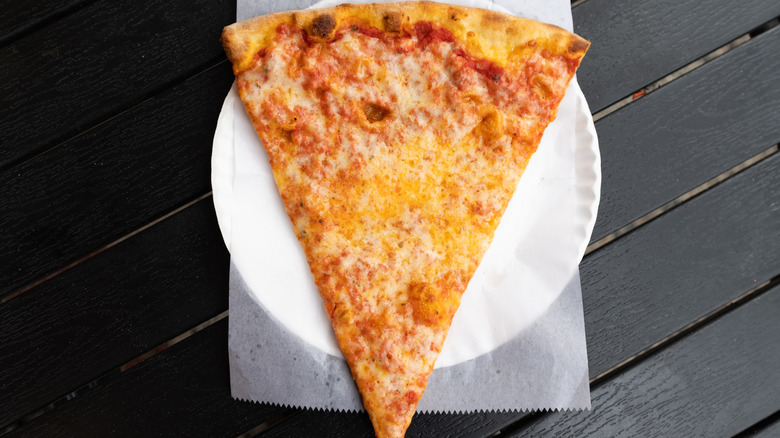
The thin slice is synonymous with New York City pizza — the feature of many a Hollywood film scene — and developed in the 1930s and 1940s following the introduction of the gas-fired deck oven, growing in huge popularity after the end of World War II, when dedicated shops selling single slices became widespread. Compared to coal-oven pizzas, they are cooked at lower temperatures — usually around 500 to 550 degrees Fahrenheit — and consequently take a little longer to bake. This lower-temperature bake helps retain internal moisture in the crust, making the pizza perfect for its purpose — being put in a display case and reheated without becoming overly dry, brittle, or hard.
A recognizable New York slice is usually large, served on a paper plate or in a paper wrapper, with a crisply thin underside and a pleasantly chewy base. The ideal crust should be bendable enough to be folded lengthwise while also maintaining a certain consistency: Since slices are often ordered to-go, no one wants toppings slipping out everywhere. The dough is classically made with small amounts of oil and sugar, which both support the pizza's chewy texture, allow it to brown, and counterbalance the acidic tang of the tomato sauce — hence the two ingredients that give New York pizza dough its famous flavor.
Sicilian pizza offers a thick, airy alternative to thin slices
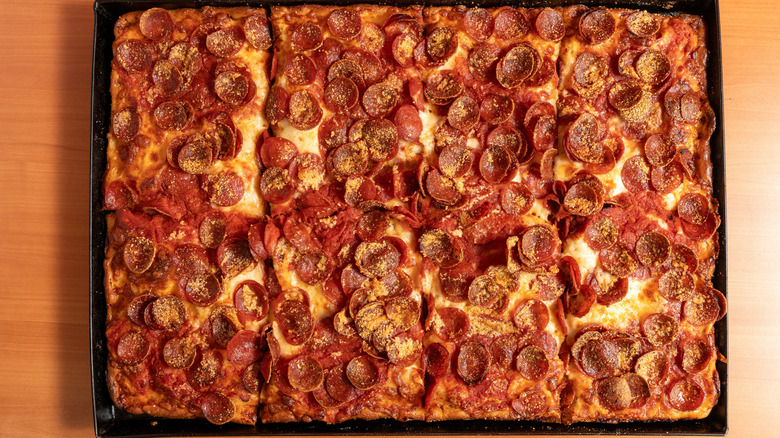
New York City hosted numerous migrants from Sicily, and they brought with them their sfincione tradition — a thick, doughy, focaccia-like pizza that has long been a popular street food in Palermo. Sicilian pizza, as it came to be known, ultimately became an easily recognizable and widespread pie type across display windows in the city's boroughs, identifiable by its rectangular shape and airy, sponge-like texture — a result of the dough proofing for an extended period before being pressed into an oiled pan.
Historically, New York's Sicilian pizzas borrowed from sfincione's traditional toppings: anchovies, breadcrumbs, Mediterranean herbs, and a variety of local cheeses. Over time, however, common ingredients became more uniformly Americanized, including classic mozzarella, pepperoni, and sausage. On occasion, some Sicilian-style pizzerias place the cheese beneath the sauce, which can help preserve the dough's crispiness and prevent it from becoming excessively moist. Sicilian pizza is easy to confuse with grandma pizza — which also shares a rectangular shape — although they are distinct, owing to the former's greater height and airiness.
Neapolitan pizza pairs fresh toppings with an ultra-thin center
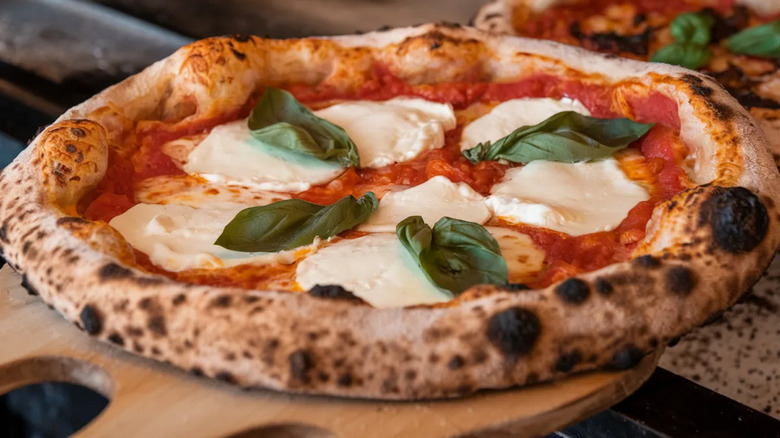
Ah, Naples ... where it all began. The Italian port city, at the foot of Vesuvius, is widely acknowledged as the birthplace of pizza margherita — with the city's "art of pizza-making" even getting a nod from UNESCO — and it, too, brought its tradition past Ellis Island. Neapolitan pizza is now a well-established category within the Big Apple's pie scene and can be spotted by its distinct appearance: round and smaller than other pizzas, with a fluffy, charred border (or "cornicione," as it's known in Naples) and an extremely thin, floppy center that can barely contain the weight of the cheese — one of the reasons why it's often eaten with a knife and fork.
Neapolitan pizza follows strict standards to be labeled as such, with authentic versions being defined by the Associazione Verace Pizza Napoletana. These include being stretched by hand and baked directly on the floor of a wood-fired oven at around 806 to 896 degrees Fahrenheit for a short burst of time, typically one minute to no more than 90 seconds.
Toppings tend to remain on the spartan side, focusing on the quality and freshness of the ingredients: hand-crushed tomatoes, fresh fior di latte or bufala mozzarella, basil, extra-virgin olive oil, and maybe some anchovies or "salsiccia e friarielli" (sausage and rapini). The deliberate use of high-moisture cheese means Neapolitan pizza is usually a sit-down affair at one of the city's numerous Neapolitan-style pizzerias, including Song' E Napule, Una Pizza Napoletana, and Kesté Pizza e Vino.