

5 Common Disadvantages Of Using Your Air Fryer
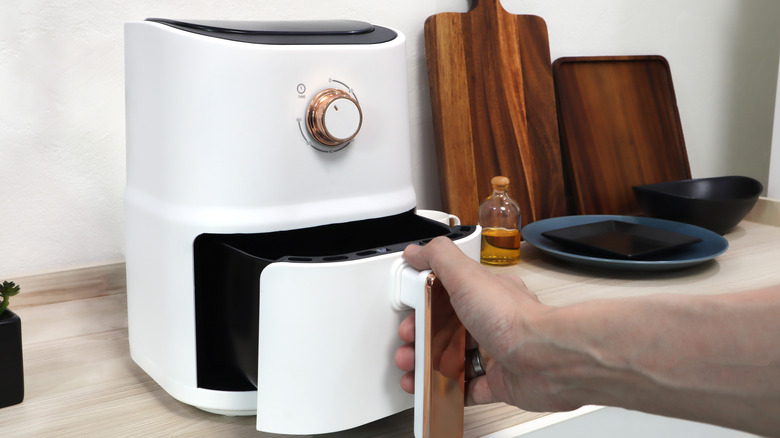
Few kitchen appliances have come into trend quite like air fryers. The compact convection oven shook off its initially misunderstood status, now turning into a countertop cornerstone in many kitchens. The list of foods to air fry keeps growing, chefs continue to fine-tune its functionality, and the appliance's design keeps evolving, too.
Undoubtedly, the mode of cooking offers many perks: remarkable efficiency, low usage of oil, and delectable crispy foods (especially opposed to a microwave, for example). Yet as with any culinary setup, the benefits come with noted downsides, too. Not only can common air fryer mistakes ruin your meal, but the appliance comes with some intrinsic limitations.
The countertop machine poses issues with size, occupying always-in-demand countertop space, while not being able to cook much food in the process. As opposed to using a sheet pan in an oven, an air fryer isn't exactly a treat to clean. And while the appliance is running, the noise can be bothersome, too. Sure, the resultant crunch keeps drawing users back — but waves of hot air also predispose your food to dryness. With some know-how, air fryers add a lot to a kitchen, but don't gloss over the shortcomings.
Air fryers come with a limited cooking capacity
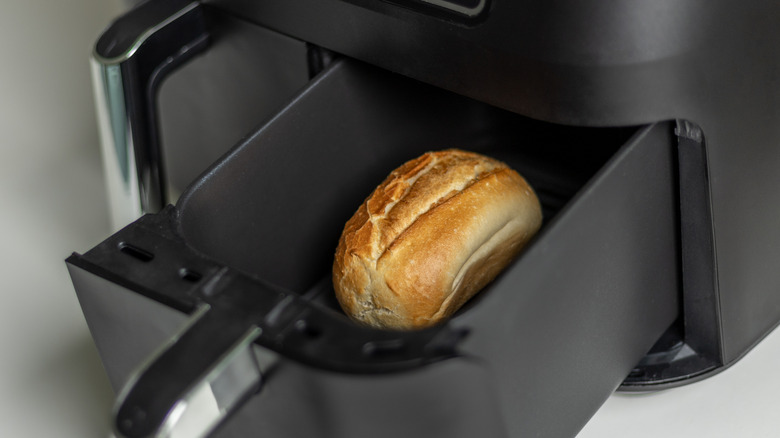
Few air fryer downsides come more immediately than the appliance's space. With a traditional oven, there's limited deliberation regarding cooking capacity — you can easily fit a large roast, a whole bird, or a spacious sheet pan of food inside. Glance at the typical air fryer setup, and you're cooking with only a round or square basket, typically in the two to six quart range.
This creates approximately the same surface area as a large stovetop pan. Trouble is, though, air fryers work markedly better with a spacious setup, with your food spread apart for optimal crispiness. Essentially, your standard air fryer model is really designated for two to three people max. With an average model, you can squeeze in around a dozen wings, approximately a pound of fries, and about the same quantity of Brussels sprouts in an air fryer.
Whipping up an easy weeknight meal for two? No stress. However, when cooking for families or entertaining, the air fryer starts to create issues. Cooking in batches means dishes start to get cold, inevitably invoking the need for a larger oven. There are larger models on the market, involving two baskets or even exceeding 10 quarts in volume. However, keep in mind an air fryer is traditionally a countertop appliance, so the larger you go, the more kitchen space you sacrifice.
Consider the air fryer countertop footprint
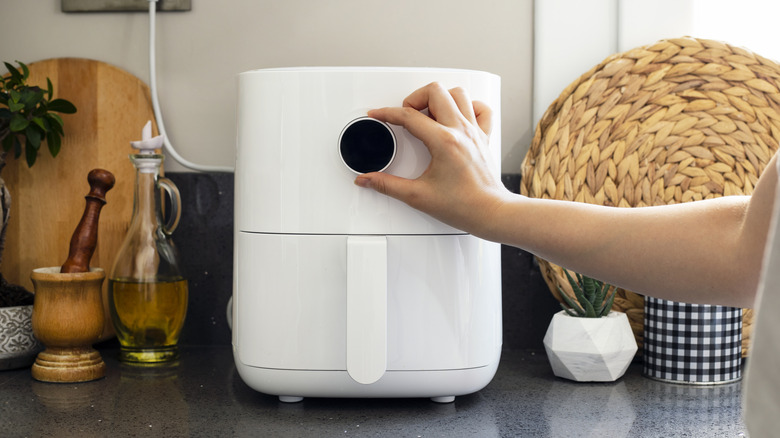
For the relatively limited preparation volume, an air fryer occupies a sizable chunk of your kitchen. Naturally, the precise dimensions depend on the model. If you're buying an air fryer toaster oven or a French door-style air fryer, expect the largest use of space. Such models stretch from around 12 by 12 inches across to double that, requiring an entire section of your kitchen. Compact models like cylindrical style air fryers occupy less space, but you're sacrificing cooking capacity. Across the board, though, you'll need to consider height, too: A vertical foot or more is common for air fryer models.
With so many options, picking an air fryer to match your kitchen can be tricky, especially if you haven't used the appliance prior. Employ the tech frequently, and the entailed size is worthwhile, but if you're only occasionally crisping up bites, then the sacrificed space may not be worth it.
Air fryers get noisy while cooking
Many cooking methods generate noise — take the sizzle of a steak or bubbling pot of water, for example. Nevertheless, not every sound is pleasant, and an air fryer falls on the not-satisfying end of the spectrum. The appliance involves a heating element combined with a fast-spinning fan, meaning the appliance produces a persistent whirring noise that's hard to escape.
"It is around 52, 53 decibels," noted a YouTuber running a Philips model as they measured the output. While nothing jolting, such a volume is approximately comparable to people talking, except that the noise is industrial in nature. Subsequently, the hum can be distracting while cooking and entertaining guests, making it a downside worth considering.
Food in an air fryer easily dries up
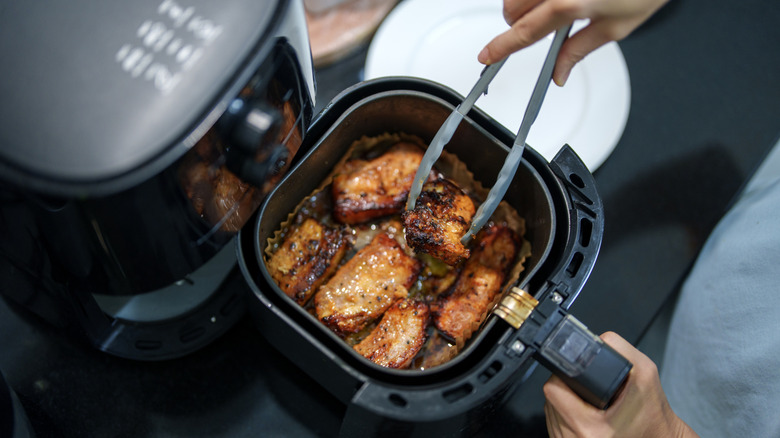
Air frying comes with benefits — you can heat a wide array of ingredients evenly, generating crispiness in the process. However, convective cooking does come with drawbacks, especially when compared to traditional frying. The most glaring is the issue of moisture. In a deep fryer, oil permeates into the foodstuff exterior, retaining interior juiciness (effectively steaming the food center), all while browning and crisping the outside.
Conversely, an air fryer pelts a food's exterior with hot air — which can also generate crispness — but predisposes to a drier result. Even opposed to a conventional oven, the constant flow removes juiciness, which is especially apparent when preparing meaty foods. The process is the reason air fryer burgers fall short of juicy, and you won't want to air fry chicken breasts or a steak. An air fryer also falters when it's overloaded with food: You're increasing the odds of cold and soft food in spots.
Such temperature control means you should also steer clear of preparing wet foods in an air fryer. Tempura, for example, won't crisp up in the appliance, leading to excessive smokiness instead. Similarly, soft baked goods like cakes and muffins can struggle to firm up in an air fryer. The process is best reserved for smaller, crispy-ready bites that don't need to cook in a complex fashion.
Cleaning an air fryer can be cumbersome
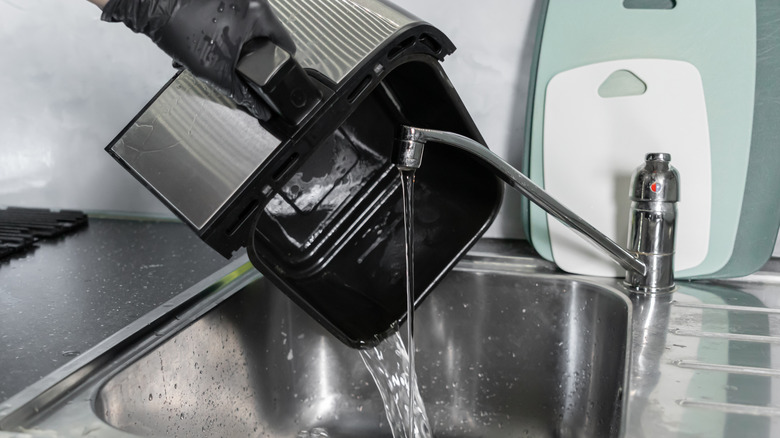
You found a home for your appliance, crisped up fryer food, and already enjoyed the merits. Only one final — yet nevertheless frustrating — step awaits: cleaning. Unlike a sheet pan in an oven, foil is hard to position inside an air fryer, as it can impair functionality. Essentially, the appliance warrants a scrub after every use, as even trace amounts of food residue contribute to potentially dangerous contamination.
Thankfully, many models come with a non-stick coating, meaning no need for laborious scrubbing. Plus, many air fryer parts are dishwasher safe — although you should check your manual to be sure. The issue is, though, the appliance parts are bulky. Whether it's the basket or drip tray, positioning the piece even into a sink can prove cumbersome. You'll then need to rinse with hot soapy water and lay out to dry, too (even more counter space to consider!). So unlike a single sheet pan and a sporadic self-cleaning cycle, an air fryer requires far more day-to-day care, maintenance potentially not always worth the hassle.