

Where Does The US Import Most Of Its Meat From?
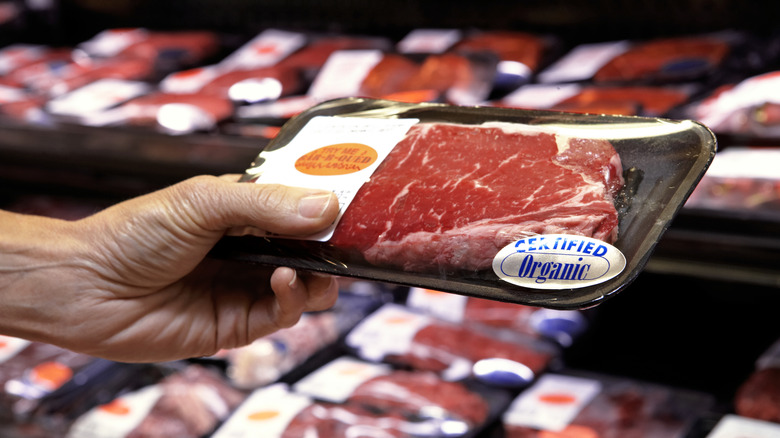
Have you ever found yourself wondering where Wendy's gets its burger meat? What about when you're at the grocery store? Have you ever asked yourself where the meat comes from? While the vast majority of meat sold in the United States is produced domestically, a significant portion of it is imported from abroad — up to 20%, to be precise. From Australia to Japan, our meat comes from far and wide, but in most cases, it doesn't end up traveling too far. As reported by the USDA's Agricultural Marketing Service (AMS), the U.S. imports most of its meat from its northern neighbor, Canada.
In 2026 alone, the U.S. imported 398,909 metric tons of meat from Canada. The exact breakdown by meat type wasn't disclosed, but Canada's beef industry is one of the country's economic heavyweights, and in 2025, 75% of its beef exports were sent to the United States (via Government of Canada). It also sends a significant share of its pork and lamb exports south of the border. The reason is based in simple geography — with a shared border and free trade agreement in place, there's no country more convenient to trade with than the U.S.
The proximity of the United States and Canada also makes trading live cattle and meat products remarkably simple. Most cattle imported from Canada are sent straight to U.S. meatpacking plants since Canadian ranchers and American processors operate almost as one integrated market. The two countries' meat industries are so intertwined that companies like Cargill (Taco Bell's beef supplier) and JBS run plants and supply chains on both sides of the border, resulting in a massive, interconnected supply chain.
Canada is known for producing high quality meat
Canada's meat industry is globally renowned for producing high-quality meat under strict national standards. Its meat industry is regulated federally by the Canadian Food Inspection Agency (CFIA), which provides a robust framework for quality control and traceability. The CFIA and USDA have also established a regulatory partnership, out of which mutual recognition agreements have emerged, allowing each country to acknowledge the equivalency of the other's meat inspection system.
Canada will often change its rearing and feed regulations to align with U.S. standards, and vice versa. In 2026, for example, the CFIA had pre-published proposed amendments to align Canada's enhanced feed ban more closely with U.S. requirements. This agreement streamlines cross-border trade and helps to maintain consistent safety and quality standards. The two countries also have a strongly aligned beef grading system, and USDA Prime and Choice are considered to be equivalent in marbling, tenderness, and flavor to Canada's respective Prime and AAA grades.
While Canada has legislation in place laying out the regulations for the humane slaughter of animals, the rules are worryingly less defined when it comes to rearing. Surprisingly, it has no legislative framework governing the ethical welfare standards of livestock; this is in stark contrast to the U.S., whose welfare laws operate on both a federal and state level. Canada's welfare regulations are instead defined by the National Farm Animal Care Council, whose Codes of Practice are non-binding. On top of that, while a company may claim that its meat was reared under stringent ethical standards, there's no legal requirement for a third-party assessment to back up these claims. Its hands-off approach to animal welfare protections has garnered much controversy, with many activists claiming it's not doing enough to protect its livestock.