

The Brilliant Carl's Jr. Burger Concept Inflation Destroyed
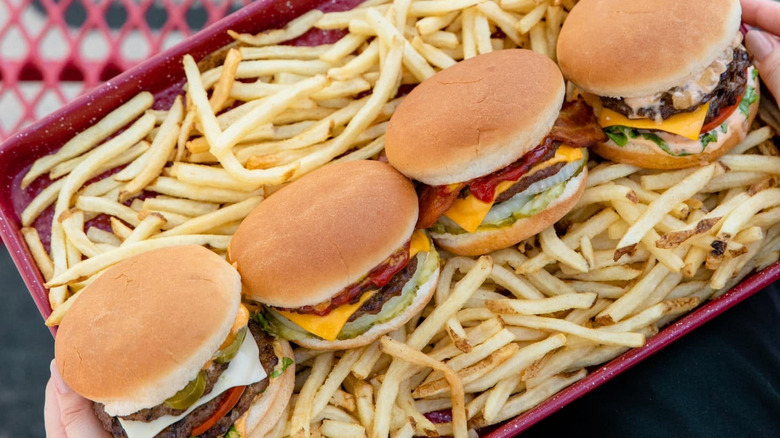
Once upon a time, when inflation was not on our minds as much — and fast food had not yet turned into a borderline luxury — Carl's Jr. sold a burger with a name that seemed risibly expensive. The "Six Dollar Burger" was launched by the chain in 2001, suggesting a price that, back then, seemed exorbitant for a fast food burger — McDonald's Big Mac, for reference, was just over $2.00 — yet which only cost diners a more reasonable $3.95. The idea was to lure customers with a more high-end, restaurant-style burger at a more affordable price — until inflation ultimately killed what was an undeniable stroke of marketing genius.
The Six Dollar Burger was intended to be more lavish and substantial than the typical fast food sandwich. Built around a half-pound charbroiled Angus patty with American cheese, lettuce, onion, pickles, tomato, mustard, mayonnaise, and ketchup, it was noticeably thicker than the thin-patty burgers you'd find at drive-thru competitors like McDonald's or Burger King.
The strategy worked so well that the Six Dollar Burger became one of Carl's Jr.'s defining products in the 2000s, even resulting in sister chain Hardee's adopting its own version in 2002. After the business's humble origins — it started off as a mere Los Angeles hot dog cart back in 1941 — It further helped consolidate the chain as a giant in the burger industry, as it now also ranks among Reddit's list of best fast food burgers. But as smart as the idea was in business terms, it ultimately came with an expiration date (one shorter than some fast food burgers themselves): as food, and especially restaurant, prices eventually soared in the following years, what seemed like a bargain ended up sounding more like a regular fast food menu item.
The Six Dollar Burger became too accurately named
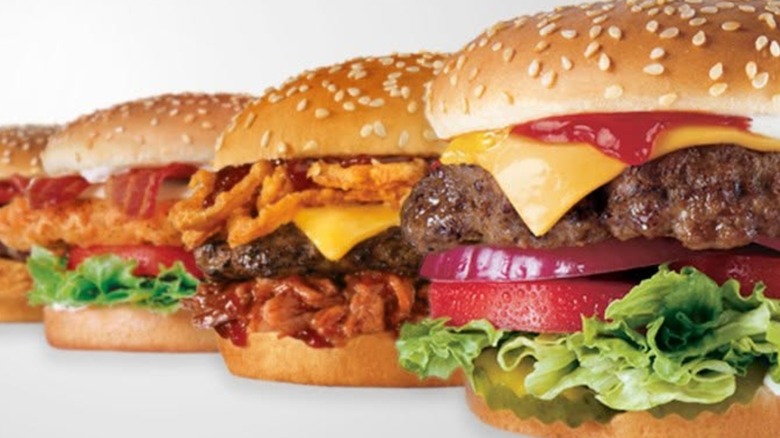
Inflation ended up ruining the punchline of the joke. What in 2001 was worth $3.95 would now cost over $7, while the hypothetical Six Dollar Burger would more accurately be called Eleven Dollar in 2026. By the mid part of the last decade, some of the chain's Six Dollar Burgers were approaching or even exceeding the item's advertised price — coming in at $5, while a Big Mac was selling for $4.79 — thus making the entire concept increasingly bereft of meaning, and increasingly confusing from a branding standpoint.
While inflation may have killed the branding, it did not erase the recipe. The name was eventually dropped from Carl's Jr.'s menus — although its essence still lives on in the Angus Thickburgers, which maintain the same thick, restaurant-, charbroiled style. The change ultimately reflects more deep-rooted changes within the fast food industry, as demonstrated by the arguable King of Burgers — the Big Mac — and how dramatically its price has risen over a quarter of a century, from 2000 to 2025.
Behind this all also lies a creeping, widespread feeling of cost-of-living fatigue, with several fast food chains being deemed overpriced, including Carl's. While Carl's Jr. has tended to occupy the pricier, more high-end side of the drive-thru market, the chasm between "premium fast food" and casual dining has narrowed, as the disappearance of the Six Dollar Burger shows. This has not gone unnoticed online, with Redditors expressing nostalgia over what might seem like a simpler time in fast food culture. "The good old days," one Redditor wrote. "[T]hey don't even have anything even similar," another lamented in reference to Hardee's, "except for maybe the famous star, but that meat patty looks smaller."