

How Accurate Is The Big Mac Index?
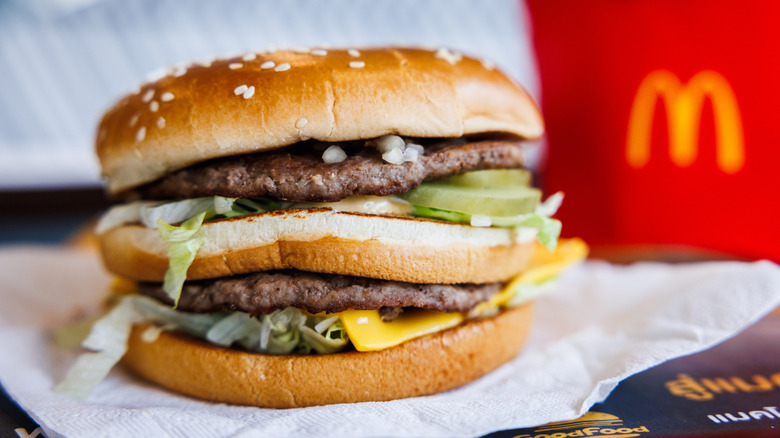
If there's one restaurant chain you can count on finding just about anywhere — except Iceland, interestingly enough — it's McDonald's. The fast food giant, with more than 44,000 establishments in over 100 countries, is so omnipresent at this point that the "Big Mac Index," coined in 1986 by The Economist, has been used to compare the price of the chain's signature burger to estimate how currencies are valued relative to one another. Yet while the index remains useful, it is somewhat limited in its analysis: It's more of a digestible tool for showing how exchange rates diverge than a precise currency forecast.
The idea is based on purchasing power parity, or PPP. Since the same product should cost roughly the same amount in different countries once exchange rates are taken into consideration, and the Big Mac is one of those food items sold around the world — with 550 million sold in the U.S. alone each year, per McDonald's — using the same recipe and roughly the same ingredients, it became a convenient stand-in.
The Big Mac Index is a useful but limited tool
The main strength of the index is its simplicity, as it uses a single recognizable product — who hasn't heard of a Big Mac? — rather than resorting to complex arithmetic or abstract concepts. As of 2026, Switzerland tops the list with a $7.99 Big Mac, a 38% difference from the United States, while Taiwan sits at the bottom at $2.38, or 59% lower.
But that is still far from saying the index can capture the entire state of an economy or its currency. A Big Mac might share the same core ingredients — its iconic sauce is unmistakable — but its value in every context can vary. In some countries, it's a cheap everyday food or a post-party meal; in others, it's an outright treat bordering on a middle-class luxury. The burger might taste pretty much the same, but people's preferences vary from culture to culture, and it isn't always measuring the same thing socially as it is economically. Indeed, prices can even vary within a single city. In New York City, for example, the cost of a Big Mac Meal can differ significantly, even within Brooklyn itself.
Overall, the index does reveal something real, showing whether exchange rates are aligned with consumer prices, and offering a very rough sense of whether a currency looks cheap or expensive compared with the U.S. dollar. But the best way to think of the index is as a clue, not a crystal ball; like a thermometer on your porch, it can give you insight into the temperature, but it can't provide a full weather forecast. For a comprehensive assessment of PPP, economists use a whole range of goods — not just one famous sandwich.