

This Fan-Favorite Gas Station Food Dates Back To Ancient Times

Gas station food has its ups and downs. Some is best skipped, like these microwaved Sheetz burgers, whereas others are always worth the pit stop (even if you've got a full tank of gas), such as Casey's delicious breakfast pizza. But one gas station regular that's always a certified favorite is beef jerky — Buc-ee's alone carries 14 flavors! Salty, convenient, and delicious, most people don't know that jerky is far more than just a simple road trip snack and has been enjoyed in one form or another for centuries.
Long before electric refrigerators and freezer aisles existed, people had to find ways to preserve precious meat before it spoiled. The method used to create beef jerky is one of the oldest and most fundamental preservation techniques: dehydration. When meat is left at room temperature, it can become unsafe to eat in just a few hours. To counter this, ancient cultures discovered that removing moisture creates an environment hostile to bacterial growth.
Typically, lean cuts of beef were trimmed of fat, sliced into thin strips, and then left to dehydrate. These days, we have advanced machinery to dry out beef, but back in antiquity, the meat was simply hung up and left to dry in the sun or freeze-dried in cold regions. Often, the drying process was followed by smoking, with the smoke containing compounds that can slow the growth of bacteria while also repelling insects. Combined, these methods allow meat to last months — sometimes even years — longer than it otherwise would.
Jerky played a major role in the history of North America
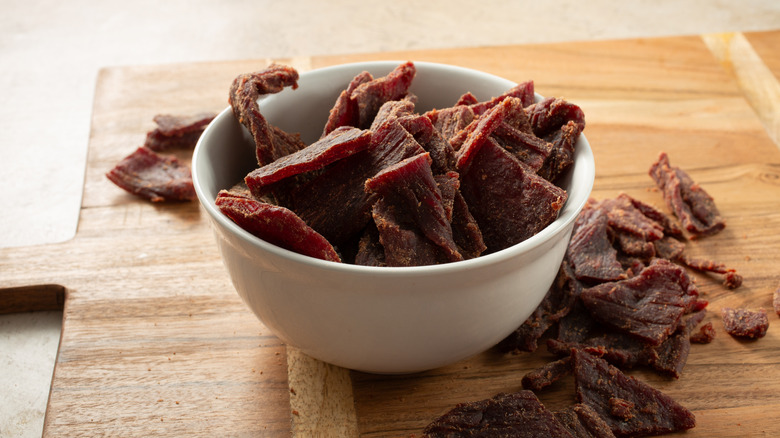
Jerky has a long and storied history in North America, with dried meat serving as an important food source for many different groups. The earliest known practitioners were Native American tribes, which developed sophisticated methods for preserving meat long before European settlers arrived on the continent.
However, beef itself was a European import, so for much of North America's history, Indigenous peoples instead worked with native game such as bison, elk, and moose. One of the most famous preserved foods they created was pemmican, a nutrient-dense mixture of dried meat, rendered fat, and dried berries. While it wasn't jerky in the modern sense, in many ways it can be viewed as a precursor to modern jerky. The meat was dehydrated to extend its shelf life, making it easier to transport and store, while the added fat provided a concentrated source of calories.
When Europeans introduced cattle to North America, they encountered Indigenous food-preservation techniques that had been refined over generations. Among these was the process of drying and smoking meat, which proved fundamental for settlers during long journeys and expeditions. References to dried beef appear in historical records from the early 17th century, with the earliest recorded mentions of beef jerky dating to 1612.
Beyond Indigenous communities and European settlers, jerky also became an important source of nutrition for cowboys traveling across the American West in the 19th century. These cattle herders developed their own variations, often referred to as "cowboy jerky." The long shelf life of dehydrated meat — as well as cured salt pork — was essential for life on the trail, where access to fresh food could be limited for days or even weeks at a time.