

Can You Scramble An Egg In Its Shell With Pantyhose?
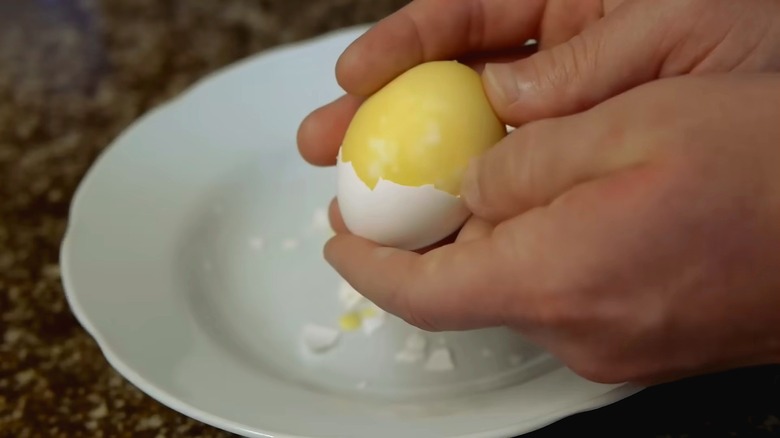
Many people may remember the L'Eggs pantyhose that came in a plastic egg. Well, now there's a trend on social media reversing that by putting an egg into pantyhose. In an Instagram reel, a Food Network chef tested an online trick for scrambling an egg inside its shell by spinning it around in some pantyhose. Apparently, if you agitate the egg enough, the membrane surrounding the yolk will break, mix with the white, and create a golden egg with an omelette-like texture. Spoiler alert: It didn't work out for Chef Voltaggio, but he didn't have much of a recipe to work on and didn't know how long he needed to spin the egg in order for it to scramble.
You can find more detailed instructions online, like advising home cooks to spin the eggs 12 times to theoretically end up with a self-contained scrambled egg. Supposedly, a Facebook user managed to achieve the desired result in just 10 spins (though the camera does cut away multiple times). Other online sources recommended spinning the egg at least 20 times to arrive at a golden egg. When successful, the resulting egg isn't always uniformly scrambled, and some sources pointed out that it can take several attempts before you reach success. Most cooks who've attempted this, including Chef Voltaggio, mentioned that you can hear the insides of the egg sloshing around when you spin it close to your ear, and this is supposedly an indication that the egg is scrambling. Besides using pantyhose, some people have used stockings and long-sleeved T-shirts. I decided to test out this trick at home to see if it actually works (it doesn't).
How I attempted to scramble two eggs in their shells using hosiery
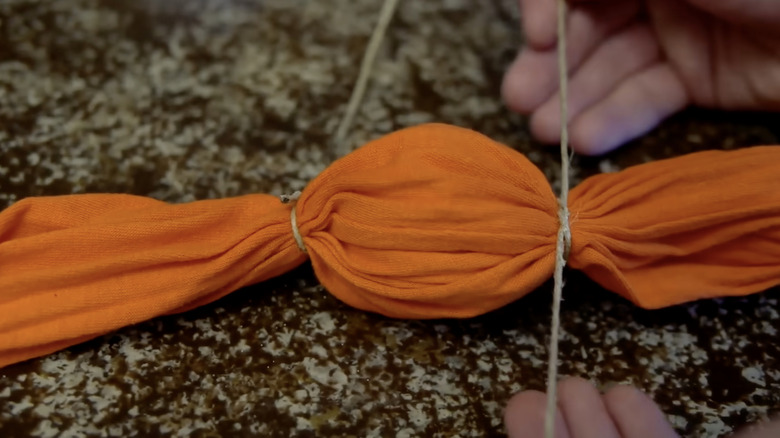
I didn't have any pantyhose on hand and didn't want to buy a pair just for an experiment. If I'd known about this unusual way to store onions so that they last months longer, I might have ventured out to get some. However, I did have a pair of stockings from an old Halloween costume (don't ask). I also decided to test the process with an old dress sock, and I marked the dress sock egg with an X so that I could tell them apart once boiled.
I secured a brown egg in the stocking with rubber bands and gave it a little room so that it could rotate a bit inside the stocking, assuming that it would help in the scrambling. I spun it 12 times, each time allowing the stocking to unwind itself, so the egg technically spun 24 times. I put another brown egg into a dress sock, let it settle to the bottom, made sure there weren't any holes or loose seams, and then spun it around in front of me like an airplane propeller for three minutes, switching the direction every 30 seconds.
I then boiled both eggs in my preferred method that I've been using since I was a kid, which is to place them in a saucepan with enough cold water to cover them and a pinch of salt, which helps the eggs peel more easily (or so I was taught). I brought the saucepan to a boil, then removed it from the heat and waited 15 minutes before draining the eggs, placing them in an ice bath, and peeling them.
The results and what could have been done differently
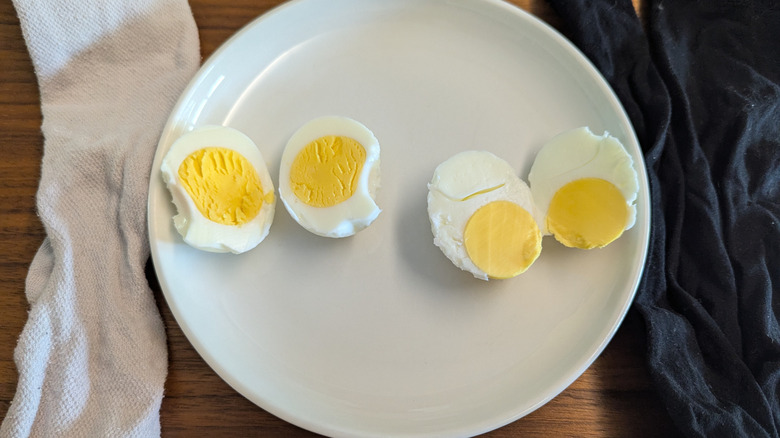
The eggs were difficult to peel, which other online cooks either commented on or demonstrated as they attempted this scrambled egg trick. The thin membrane that typically makes it easier to remove the shell in a few large pieces seemed to have broken up and mixed with the rest of the egg, and I had to chip away at tiny pieces that ripped away at the edible part, creating these craggy ellipses. The peeled eggs were ugly.
Apparently, that sloshing noise didn't mean anything. The eggs did not scramble, and this should be added to the bottom ranking of the ways you can cook scrambled eggs. The dress sock egg was just a normal hard-boiled egg that looked like a rat had nibbled on it. The stocking egg was similar, but the yolk seemed bigger and settled to one side of the egg. They were both perfectly cooked, but they were too unattractive to serve as is, and they ended up in a somewhat rubbery egg salad.
There are a couple of things I could have done differently. Chef Voltaggio commented that perhaps using a lower-quality, older egg could yield better results. The membrane surrounding the yolk is flimsier, and the white is more liquidy. One tip that an online cook shared was to use a flashlight to check whether the egg has scrambled, but this works best on white eggs. If the egg is scrambled, it will appear pink when you shine a flashlight on it. Regardless, it's a lot of effort for something that gives mixed results. I prefer to follow this celebrity chef's go-to recipe for the best scrambled eggs – crack them straight into the pan.