

Peanut Butter Vs Almond Butter: Which Spread Has More Protein?
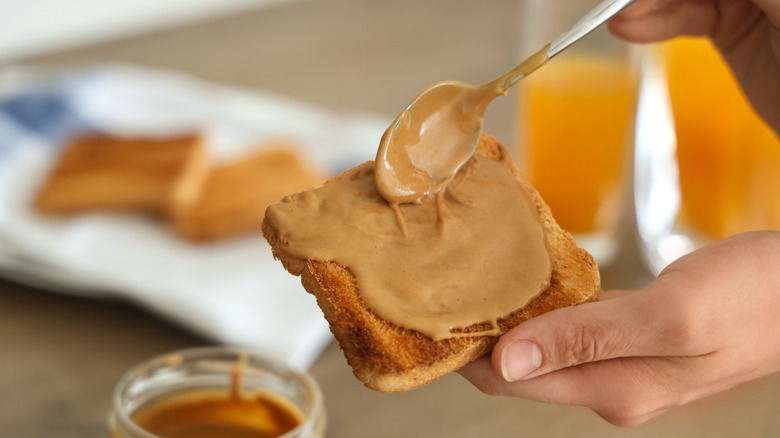
Protein is all the rage nowadays, and as we're scrambling to optimize our diets and hit our daily macronutrient goals by protein maxxing, we're often left wondering which ingredients can best help us get there. Both peanut and almond butter are much-loved spreads touted for their nutrient-dense profile — the former, a long-standing staple of American household pantries; the latter, a newer addition to the U.S. diet. Their distinctive savory-sweet profile and creaminess make them excellent pairings to morning toast, yogurt bowls, curries, or even just by the spoonful. But which of the two wins out as the better protein source?
As nut-based spreads, both peanut and almond varieties have relatively similar nutritional profiles. Purely on numbers alone, however, peanut butter technically has the slight edge over almond — providing around 7 to 8 grams versus 6 to 7 grams per two-tablespoon serving. While both offer a solid dose of plant-based protein, the real kicker is that many nutritionists would argue their main macro contribution is actually "heart-healthy" unsaturated fat – an important counterbalance to the high, LDL cholesterol-raising saturated fat commonly present in Western diets. With differences also boiling down to the specific brand and preparation method — some are packed with additives – it's important to check individual labels before making conscious choices, or even just learning how to make either from scratch. All it takes to make it at home is your nut of choice and a food processor — no other ingredients save a little salt.
Peanut butter is an American classic
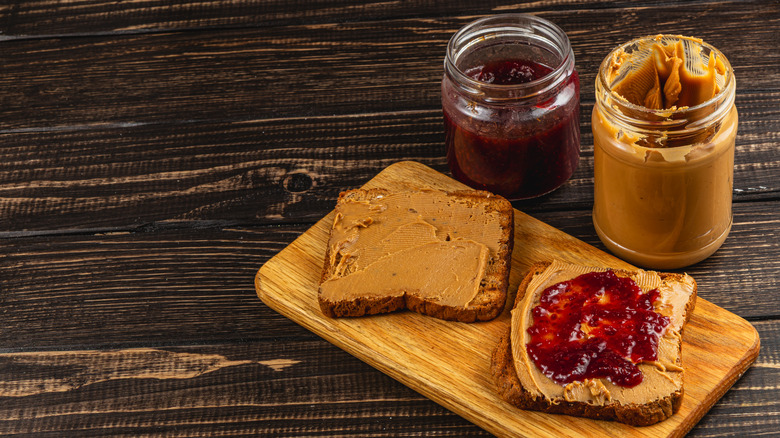
America's love affair with peanut butter goes back over a century — who hasn't had a classic PB&J sandwich, the age-old comfort food? While the Incas may have been grinding peanuts for hundreds of years already, the spread (as is known today) was first developed in the U.S., patented by Dr. John Harvey Kellogg in the 1890s, and was eventually introduced to the public at the 1904 St. Louis's World Fair. Its sturdy nutrient profile and protein were acknowledged early by health officials, as it was widely promoted during the 1910s wartime era as a cheap and efficient substitute for meat rations.
It's a love story that shows no signs of stopping, with Americans eating roughly 4 pounds of the spread per person annually. With its excellent macronutrient profile, this is no bad thing. The average U.S. adult needs around 1.2 to 1.6 grams per kilogram of body weight – increasing to 1.4 to 2.0 grams per kilogram of body weight for athletic individuals and 1.7 to 1.9 grams for those who are pregnant or breastfeeding – and a mere two-tablespoon serving of peanut butter can deliver over 10% of the daily requirements.
But peanut butter offers far more than a hefty dose of plant-based protein. Aside from its excellent unsaturated fat contribution, it also includes substantial amounts of micronutrients and minerals essential for healthy body functioning, including vitamin E, B3, copper, and manganese. That said, peanut butters' nutrient profile often varies by brand. Aside from on toast, peanut butter makes an excellent companion to açai bowls, a variety of Asian dishes — satay sauce itself is made with spread — and even in no-bake pies.
Almond butter is a great alternative to peanuts
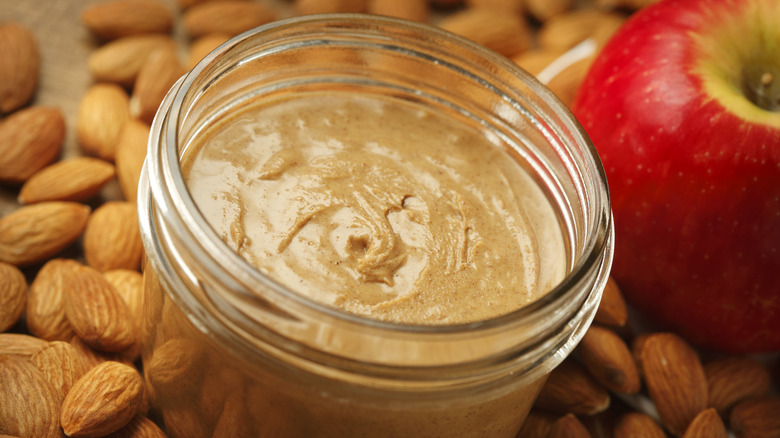
As nut butters have exploded in popularity in the last few decades, almond butter has become a popular alternative to the classic peanut spread. Its sweeter, woody-aromatic profile makes it somewhat more delicate than the sturdier saltiness of peanut butter. Its presence in American kitchens may be more recent and still relatively more niche, but it has an arguably long — or even older — history. Almond butter's origins can be traced thousands of years to the Mediterranean and the Levant, where it was ground into paste for a variety of sweet delicacies, and was part of the medieval European diet.
Technically, almond butter has slightly less protein than peanut butter — by only a mere gram per serving — and is generally more expensive, making it somewhat less efficient as a protein source. It still has some advantages when compared to its peanut variant. Not only does it have 33% more vitamin E, but it also has almost double the fiber, a gut and heart-essential nutrient 90% Americans fail to get in sufficient quantities. Whether buying it from the store or making it yourself at home (may we suggest a chipotle honey almond butter?), almond butter tastes great in fruit smoothies, in oatmeal, or even as a hummus substitute.