

The California City That Has Banned Restaurant Chains Since The 1970s
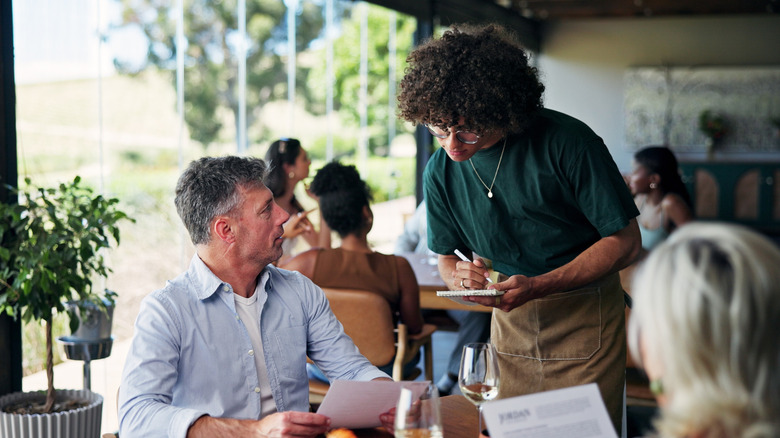
Throughout much of the world, restaurant chains are synonymous with U.S. food culture — indeed, the country is said to have birthed the world's first fast food establishment. But one Californian municipality has long gone against the current. As early as the 1970s, the oceanside resort of Carmel-by-the-Sea has kept national chains and formula businesses out of its 1.1-mile territory — and in its place, has fostered one of the country's liveliest gastronomic hubs.
A quaint village of just over 3,000 inhabitants, Carmel is nestled within Monterey County's rugged Pacific Coastline. Visitors setting foot upon the town are immediately presented with an idiosyncratic landscape: a striking combination of central California's classic Mediterranean shrub and lush pine woods with faux-Tudor cottages that seem straight out of "The Lord of the Rings'" Middle-earth. Even more apparent is the lack of big-chain logos and billboards; in their place are little shops, galleries, bakeries, and cafés. All of this is a result of Carmel-by-the-Sea's Code Book, which not only bans "all [drive-in], fast food, [and] formula food establishments," but has stringent restrictions on the exact type and number of specific shops permitted across the town. While some of the mayors took things to an extreme and refused to even allow ice cream parlours to open, when Clint Eastwood became mayor, he made it slightly easier for independent businesses to open.
Carmel-by-the-Sea's chain ban aims to preserve local character
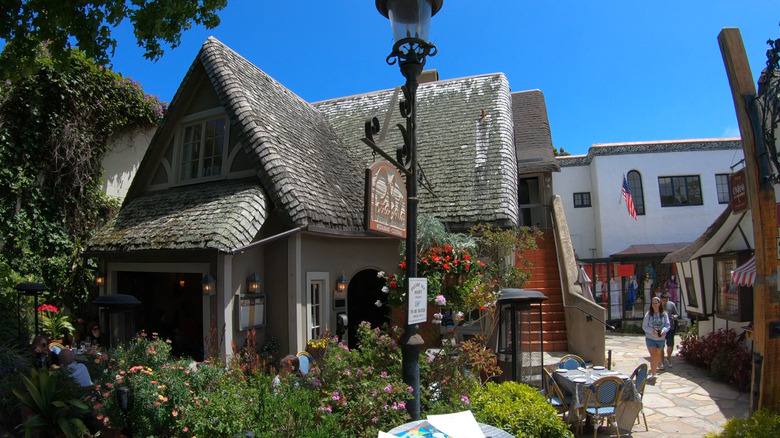
Carmel-by-the-Sea has a long history as a refuge for artists, writers, and other creatives looking for an idyllic spot along the mid-Californian coast. After Spanish colonizers settled in the 1700s — leaving behind the Baroque Carmel Mission — and the area passed from Mexican to American sovereignty, it quickly developed into a village-like community sheltering bohemians and Hollywood royalty alike. As post-World War II U.S. culture leaned heavily into mass consumerism and strip mall development, Carmel's citizens went to painstaking efforts to safeguard its local charm, culminating in the City's Code Book banning restaurant chains to "preserve Carmel's character as a residential village and perpetuate a balance of land uses that are compatible with local resources and the environment" (per Carmel-by-the-Sea's Municipal Code).
A lack of food chains is not the only oddity encountered in Carmel. Among other things, the town did not have numbered street addresses until recently — using individual descriptions for individual homes — or a home mail service. All of this contributes to Carmel's distinctive, almost fairytale-like flair, one which has helped establish its unique reputation.
In a state chock-full of fast food establishments – McDonald's itself first opened in California – Carmel-by-the-Sea is nothing short of an anomaly. But as Americans increasingly shift away from chain restaurants to independent eateries, Carmel's devotion to family-run, local businesses can come as a much-needed breath of air as fresh as the nearby ocean. Indeed, the town boasts more restaurants per capita than anywhere else in the U.S., including an ample buffet of both high-end and intimate eateries: from gourmet Côte d'Azur-inspired bistrots like L'Escargot to Japanese-Californian fusion spots such as the Flying Fish Grill, as well as its oldest establishment still in situ — the 1899-founded Carmel Bakery.