

Which US State Produces The Most Cranberries?
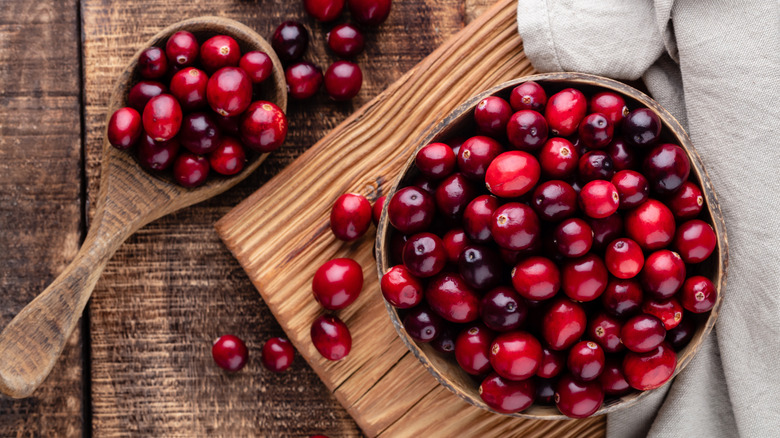
Cranberries are one of the most versatile fruits out there. With a tart, tangy taste, you'll find them pressed into delicious juice, simmered into an Ina-Garten-approved sauce, or dried into a sweet, chewy snack. With its wide range of uses, it's no surprise that they're ranked as Americans' second-favorite berry (per the USDA). This got us wondering which state produces the most cranberries. Here's a hint: It's not California. While the sunny state is widely considered to be the agricultural heart of the U.S., it's actually Wisconsin that leads the nation's cranberry production.
Producer of the most cheese in the country, a lesser-known fact is that Wisconsin produces more cranberries than all other states combined. In 2025 alone, it produced 5.3 million of the 8.1 million barrels produced in the U.S. that year (per the World Population Review). Other major producers include Massachusetts, Oregon, and New Jersey. Alongside contributing the majority of the United States' cranberries, Wisconsin also supplies more than 50% of the world's total supply.
Today, Wisconsin's cranberry industry is worth roughly $1 billion and employs over 4,000 people. With these numbers, it's no surprise that the cranberry was designated the official state fruit in 2004, and a cranberry festival is held every September in Warrens that attracts over 100,000 visitors. The state is also leading innovation in cranberry development. The University of Wisconsin-Madison significantly contributes to development within the industry, which includes creating new varieties. Fresh cranberries are hard to enjoy on their own thanks to their natural tartness (which is why cranberry juice should be sweetened for cocktails). To tackle this issue, the University developed new, sweeter berries like the "Sweetie" cranberry.
How are cranberries grown in Wisconsin?
Cranberries in Wisconsin go back hundreds, if not thousands, of years. They're one of the few commercially grown fruits native to the United States, and are known to have been used by Native Americans living in the Wisconsin region. Known as hoocake by the Ho-Chunk indigenous peoples, they served a wide variety of purposes that were passed on to European settlers. Commercial cranberry production only began around the 1860s, with cranberry farming being encouraged by the 1867 Cranberry Law. This unique law allowed farmers to build dams that they could later use to flood their cranberry bogs.
While cranberries are closely related to blueberries and lingonberries, the ways they're grown and harvested set them apart. Cranberries grow on low-trailing, creeping vines in bogs. Most of the time, these bogs are man-made and are composed of acidic soil. But to grow them, these conditions need to pre-exist. That's why Wisconsin is the perfect hub of cranberry production. Due to glacial deposits from the last ice age, Wisconsin's central and northern regions match these exact conditions. The number one producer is Wood County, which produces one in every nine cranberries consumed globally. Overall, cranberry bogs span 21,000 acres of land in Wisconsin.
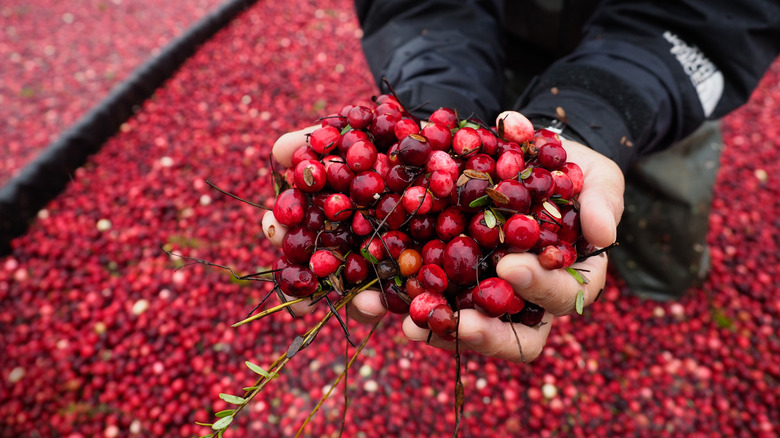
Water only plays a small part in the cranberry production process. During harvest — which falls between September and November — the bogs are flooded. As the cranberries contain tiny airpockets, they naturally float to the surface. They're then harvested with specialized machines or by hand. Many farms offer tourists the chance to harvest their own cranberries, but arachnophobes beware. When the fields are flooded, the resident spiders take refuge on the cranberries and often hitch a ride on unsuspecting farmers.