

5 Fast Food Scandals That Shocked The Industry
From its humble beginnings in the early 20th century, fast food has taken the world by storm. Driven by convenience, affordability, and sheer accessibility, it's become a defining feature of the modern food landscape. Whether you like it or not, its influence is impossible to ignore. McDonald's alone operates over 41,000 locations worldwide, and it's just one player in a vast global industry. But with such reach, controversy is almost inevitable.
Fast food scandals take many forms. Some involve bacterial outbreaks with serious, even fatal, consequences. Others center on questionable ingredients or misleading claims. Then there are employee incidents that spread rapidly online for all the wrong reasons. Some scandals even turn out to be hoaxes, and patrons of Wendy's will be relieved to hear that the chili doesn't come with a side of human fingers. Some cases have even reached the highest level of attention, drawing in political figures, while others have become memorialized online as memes.
Few major chains emerge completely scandal-free. In the United States, industry giants like McDonald's, Taco Bell, and Burger King have all faced their fair share of controversy. In fact, it's more common for brands to carry multiple scandals than none at all. Yet there is often a constructive side to these moments. Public scrutiny has led to meaningful changes, from stricter food safety regulations, like zero-tolerance policies for E. coli in ground beef, to operational adjustments, like lowering serving temperatures for hot coffee.
Undercooked burgers at Jack in the Box caused multiple fatalities
Founded in 1951, Jack in the Box is a major fast food chain known for its 24-hour service and eclectic menu featuring burgers, tacos, and salads. As of March 2026, it boasts more than 2,000 locations across the United States, but a severe food safety scandal in 1993 nearly spelled the end of the brand.
The cause of the outbreak was identified as undercooked burger patties contaminated with E. coli that were served to customers. Jack in the Box had been warned that its cooking times of two minutes were far too short to kill any potential bacteria, but it did not heed this advice, as it was believed that longer cooking would make the burgers too tough. This decision proved to be a deadly oversight. More than 500 individuals were infected with E. coli, and four children tragically lost their lives. Beyond the fatalities, 178 survivors reported permanent injuries, including brain and kidney damage. The scandal was on such a scale that it gained intense public attention, with then-President Bill Clinton attending a meeting with the families of those affected.
While the devastating consequences of the outbreak can never be reversed, it did lead to major regulatory shifts that still govern food safety regulations today. In 1994, the USDA declared the specific strain of E. coli responsible for the outbreak an "adulterant," making it illegal for suppliers to sell contaminated meat. On top of that, to repair its reputation, Jack in the Box became the first fast food chain to adopt Hazard Analysis and Critical Control Points, or HACCP, a food safety system that would eventually become standard practice in the industry.
Burger King became a meme for all the wrong reasons
As one of the world's largest fast-food chains, Burger King is often recognized for its playful rivalry with McDonald's. However, the burger chain gained the wrong kind of online attention in 2012.
The scandal started on 4chan, an anonymous, image-based online forum. There, a photo was uploaded depicting a Burger King employee standing in two bins of lettuce. The image had the following tag: "This is the lettuce you eat at Burger King." Yikes. Fortunately, 4chan users quickly located the exact Burger King where the infamous image was taken, identifying it as a franchise in Mayfield Heights, Ohio. Local news outlets were informed, alongside the store and Burger King corporate. The situation was resolved quickly, with the franchise owner firing the three employees involved in the incident.
While Burger King may have hoped the scandal was behind it, the internet had other plans. In 2017, a YouTube channel revisited the incident in a video titled "Top 15 Mysteries Solved by 4chan." Its deadpan delivery, particularly of the now-iconic line "Number 15: Burger King foot lettuce," quickly took on a life of its own. The clip spread across social media, racking up millions of views and cementing itself as a defining meme among Gen Z audiences. The story did not end there. In 2024, a user claiming to be the original "foot lettuce" employee took to Reddit to offer their own account of what really happened (for what it's worth, they claim that the lettuce was discarded immediately after the photo was taken).
One McDonald's lawsuit raised debates over legal reforms
McDonald's is often seen as the undisputed leader of the fast food industry, so it's no surprise that the company has faced numerous lawsuits over the years. However, one case in particular — centered on a cup of hot coffee — stands out. It sparked widespread debate about the boundaries of personal responsibility and the reasonable limits of tort law.
In 1992, Stella Liebeck, 79, suffered full-thickness burns when she accidentally spilled a hot McDonald's coffee on her lap while sitting in her car. She suffered extensive burns to her lower body, requiring eight days of hospitalization and extensive skin grafts. While the media often underplayed her injuries, Liebeck endured permanent disfigurement and a multiyear disability that severely affected her quality of life. Prior to filing a lawsuit, Liebeck asked McDonald's for around $20,000 to cover her medical expenses. It responded with $800.
Following McDonald's refusal to cover her medical costs, Liebeck filed a suit accusing the fast food giant of gross negligence. At the time, McDonald's policy was to serve coffee at 180 to 190 degrees Fahrenheit, which expert testimony revealed was hot enough to quickly cause third-degree burns. This also wasn't the first incident in which a customer reported burns. The jury found McDonald's 80% responsible for the injuries and Liebeck 20% responsible. She was subsequently awarded $160,000 to cover medical expenses and $480,000 in compensation. To avoid McDonald's appealing the verdict, the parties settled privately. Shockingly, during the case, McDonald's revealed it did not intend to reduce the temperature of its coffee, but it has since lowered it to 170 to 180 degrees Fahrenheit.
Taco Bell's seasoned beef stirred up controversy
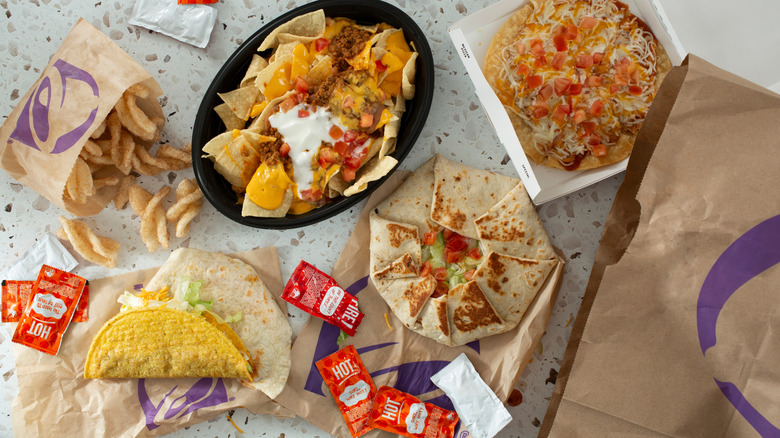
As the largest Mexican-inspired chain in the U.S., Taco Bell is no stranger to controversy. But one claim certainly hit harder than the rest.
In 2011, Alabama law firm Beasley Allen filed a lawsuit against Taco Bell alleging that its seasoned beef was only 35% beef. According to the firm, if this were the case, it would not meet USDA standards to be labeled as beef and should instead be called "taco meat filling."
Understandably, Taco Bell spent millions to defend its name. It claimed that its famous ground beef was 88% beef, with the remaining 12% made up of fillers, seasoning blends, and water. A full ingredient list was even released for public view, explaining the purpose of each and every additive found in the ground beef.
Later that year, largely due to Taco Bell's radical transparency, Beasley Allen withdrew its lawsuit, and Taco Bell was in the clear. The chain made sure to get the last laugh, however,releasing a snarky ad that pointedly questioned why its accusers hadn't offered a formal apology. While this story was put to rest, in 2019 over 2 million pounds of seasoned beef were recalled after a customer found a piece of metal in their food — perhaps Taco Bell forgot to include that in the ingredient list.
A finger in Wendy's chili uncovered an elaborate plot
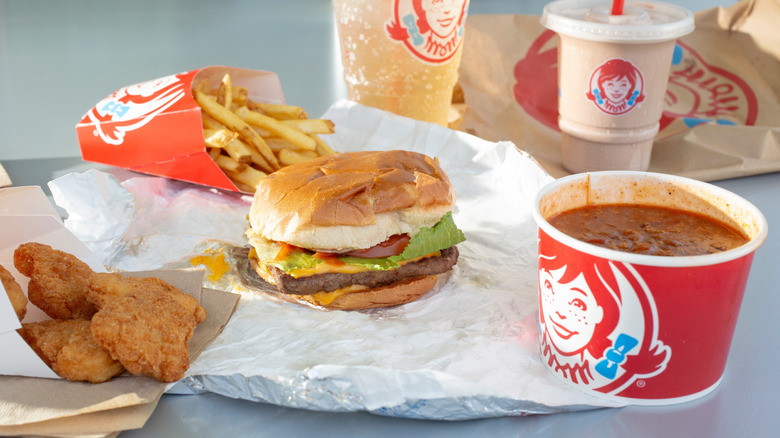
Most scandals occur because of something a chain did, but in this unique case, Wendy's got dragged for something completely fake. At a San Jose, California location, a customer named Anna Ayala claimed she found a severed finger in her chili. She was quick to share the discovery and even appeared on "Good Morning America" to describe the experience of biting into the "crunchy" digit (via YouTube). She also hired a lawyer and filed a claim against Wendy's. On the surface, this sounded like a nightmare scenario that Ayala was well within her rights to seek compensation for. However, investigators quickly began to uncover holes in her story.
Despite Ayala claiming to have bitten into the finger, forensics could find no trace of her saliva on it. Suspicion also arose because the condition of the finger was not consistent with being cooked in the chili for an extended time. Then, when Wendy's offered a $100,000 reward for information about the finger, a tipster linked Ayala's husband, Jaime Plascencia, to his co-worker, who had lost a finger at work. It was later discovered that Plascencia had paid $50 for the finger to settle a debt, which Ayala admitted to cooking herself and planting in the chili. It was also revealed that Ayala had a long track record of scamming businesses.
With the scam uncovered, the couple pleaded guilty to conspiracy and attempted grand theft, with Ayala receiving a nine-year sentence and Plascencia 12 years. Despite justice being served, Wendy's still lost an estimated $21 million from the negative press, which the duo were found liable to pay back. Unsurprisingly, Ayala also received a lifetime ban from all Wendy's locations.