

Boneless Vs Bone-In Vs Spiral Ham: How Do The Cooking Processes Differ?
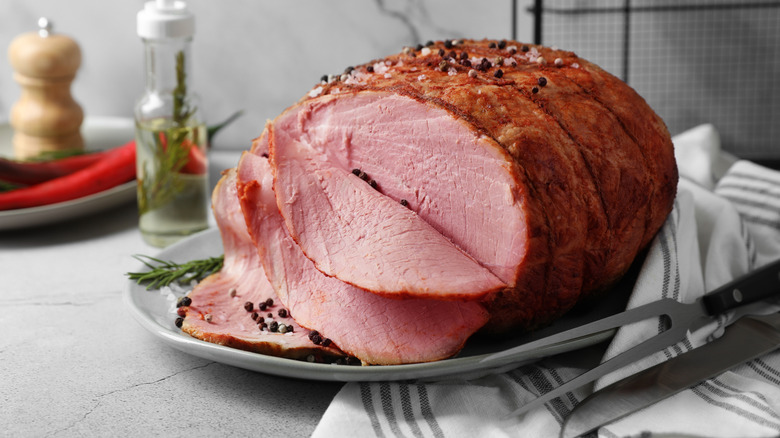
If you already have a recipe in mind, it's vital you avoid the common mistake of choosing the wrong ham. While there's no clear winner between bone-in, boneless, and spiral-cut ham, each has its own requirements to bring out its full flavors.
All three are the same basic cut, the back thigh of a pig, so their general shape and flavor are fairly comparable. Despite their differences, there are a handful of rules for baking the perfect ham, regardless of its preparation. Best practices like avoiding anything labeled as "in water" and cooking them on their flattest side deliver the best flavor and make cooking easy, but the real changes come down to timing and temperature. Boneless and spiral varieties are usually fully-cooked, so all you have to worry about is nailing the perfect glaze. Bone-in ones can be either raw or partially cooked, and while their thick bones might mean more taste, this also means they'll take longer to reach a food-safe temperature.
Bone-in hams allow you a bit more customization in their final flavor profile, whether that's through seasoning or the cooking method, such as baking versus smoking. Still, you can flavor spiral and boneless cuts quite thoroughly, though via the glaze or sauce. Regardless of the type, most recipes call for baking a ham between 12 and 20 minutes a pound at about 325 degrees Fahrenheit until it reaches an optimum, food-safe temperature.
Boneless hams are fast and easy
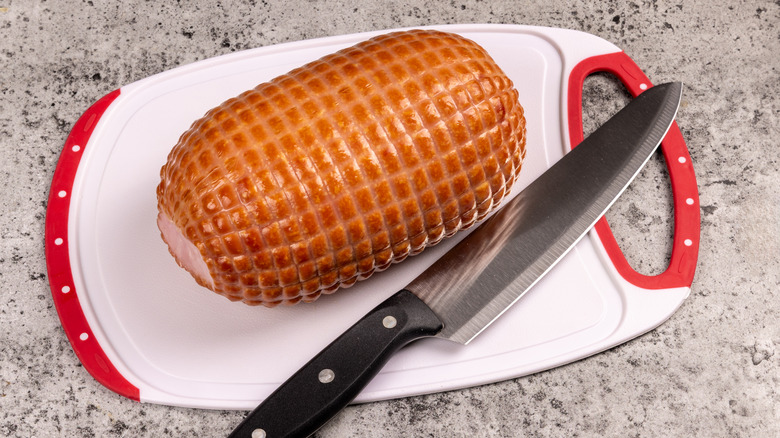
If you're looking for something fast and easy, a boneless ham is probably the way you'll want to go. Since they're already cooked, all you're really doing is bringing them to a food-safe temperature of 140 degrees Fahrenheit. Plus, they warm up far more quickly than either spiral or bone-in varieties.
Because a boneless ham has the shortest cooking time, it'll never get quite as much flavor from standard cooking tips like inserting cloves into the exterior. However, this means that other tricks like perfect glazing rules and scoring the exterior are more important than ever. You'll still want to cover it with foil for the majority of the bake to keep the exterior from burning, but you'll likely need to add less water to the pan to prevent it from drying out.
Once it's done cooking, let it rest for about 30 minutes before slicing to preserve the juices. You can wrap it in foil or let it sit in a cooler if you want it to stay warm longer, but let it cool to around 110 to 120 degrees Fahrenheit before slicing to ensure the juices have had time to redistribute properly.
Bone-in hams may take longer but are extra delicious
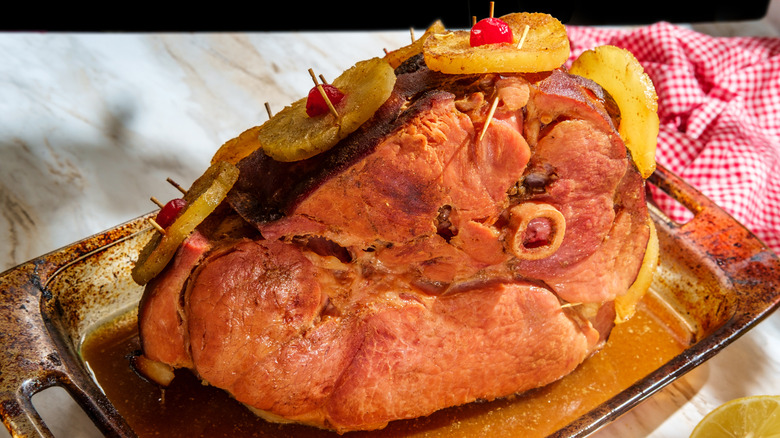
While you can easily find fully-cooked bone-in hams, most stores sell them raw. Since they can hover anywhere between 15 and over 20 pounds, they take the longest to cook. Also, if raw, you'll need to cook it to 165 degrees Fahrenheit to ensure there are no harmful bacteria or parasites.
That giant femur running the length of the cut is packed with collagen, a heat-soluble connective tissue that melts into flavor-packed juice. While it's an unavoidable pain to cut around, it's also your most potent seasoning. Since it'll take so long to cook, a bone-in ham is perfect for seasoning methods that take a while to sink in, like spearing the exterior with pineapple or letting it steam in stock rather than water. While neither of these options may yield much of a result with boneless or spiral-cut hams, the hours your bone-in cut spends in the oven are perfect for letting those flavors sink deep into the meat.
Depending on the size of your meat, it'll likely need a little longer to rest. If it's closer to 20 pounds, you may not even want to wrap or tent it in foil. However, since it'll be resting for so long, this is the perfect chance to apply an extra layer of glaze. While it won't harden up into a shatteringly crisp coating, it does create some additional sheen and taste that should perfectly complement the extra flavorful interior meat.
Spiral-cut ham, a middle-ground perfect for extra glaze
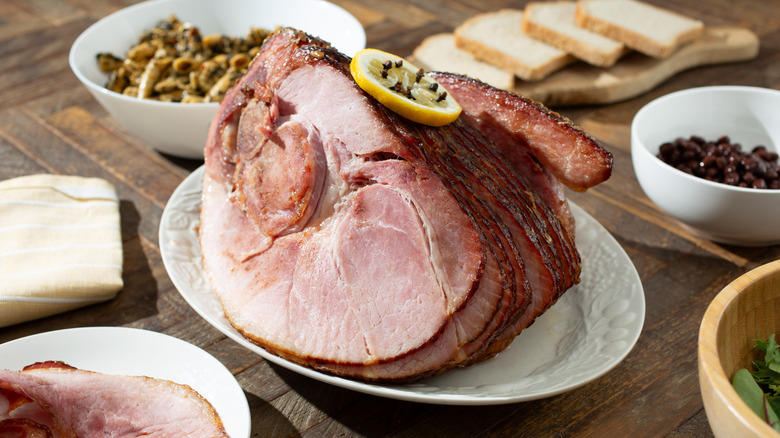
Spiral-cut hams are a nice middle-ground between boneless and bone-in varieties in terms of timing, taste, and temperatures. The biggest difference is that since they're already cut, you might want to cook them at 300 degrees Fahrenheit rather than 325 to keep them from drying out.
With both boneless and bone-in hams, you're largely relying on a thermometer reading to determine when to apply the glaze. However, spiral-cut ones have an additional visual cue for when they're ready for more flavor. Despite their name, they'll appear just as compact as any other when you take them out of the package. But, as they warm up, those slices slowly start to open up like a flower blooming. This is your signal to start applying the glaze, as it's almost at a perfect 140 degrees Fahrenheit.
Since it has more surface area than the other two types, it's extra important that you prepare an ideal glaze. Each slice will have substantially more, so if you burn it or get your measurements off, there'll be no hiding the taste. To serve, cut a circle between the meat and the bone. Since it's pre-sliced, pieces should fall right off without much effort.