

Matzo Vs Crackers: Here's The Actual Difference
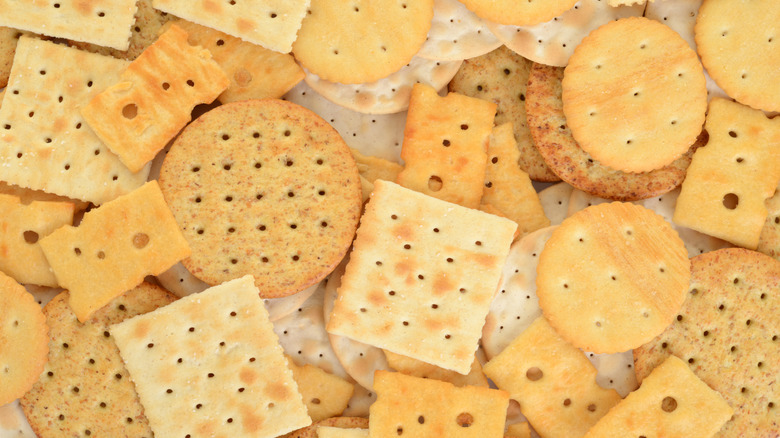
At first glance, matzo and crackers look strikingly similar. Both share a brittle texture, a relatively neutral flavor, and make for easy snacking. But beyond these surface-level similarities, the two are quite distinct. From their ingredients and preparation rules to matzo's deep religious significance, there are several reasons why it would be inaccurate to simply call matzo a cracker.
Crackers may be an everyday snack for just about everyone, but matzo holds a far deeper cultural meaning. While anyone can enjoy it, matzo is deeply rooted in Jewish tradition. Crackers might appear on holiday platters or Super Bowl snack spreads, but no Passover Seder is complete without matzo, which is a central part of the ritual. Passover is one of the most significant holidays on the Jewish calendar, and while varieties like Ritz Crackers or graham crackers may be delicious, they hold no religious or cultural importance. With Passover traditions stretching back roughly 3,000 years, matzo predates modern crackers by millennia.
Beyond cultural and religious differences, the ingredients set these two foods apart as well. While the contents of crackers can vary widely by brand, most include flour, water, oils, preservatives, and leavening agents. Matzo, by contrast, keeps things simple. The traditional recipe for Seder-compliant matzo calls for just two ingredients — flour and water — though some varieties are consumed outside of the Passover holiday that include ingredients like egg or fruit juice. Because it contains no leavening agents, it is more accurate to classify matzo as a form of flatbread than as a simple snack cracker.
Matzo is a staple of Jewish cuisine
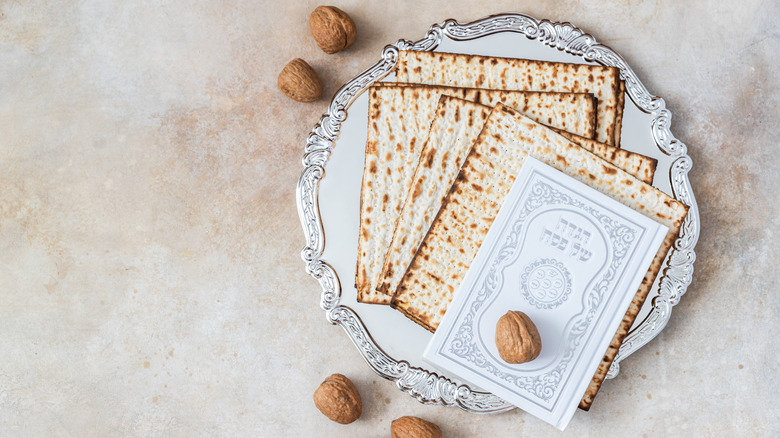
The reason matzo contains only flour and water stems from the strict Passover laws prohibiting the consumption of chametz (leavened bread). The rule reflects the biblical story of the Israelites' hasty exodus from Egypt, when they fled so quickly they had no time to let their bread rise. Because of this history, matzo carries meaning beyond that of a simple cracker.
To ensure no leavening occurs, matzo must be prepared within 18 minutes of mixing flour and water. During the Passover Seder — the traditional 15-step ritual — three pieces are placed on top of each other and covered with a cloth. In the fourth step, yachatz, the middle matzo is broken in two, and the larger half is set aside as the afikoman, which is hidden for children to find later in the evening. The matzo is then blessed and eaten during motzi matzah, when participants recite the blessings over bread and over the commandment to eat matzo. Later in the meal, it is used again during korech, when diners assemble a sandwich of matzo and bitter herbs (maror) dipped in a sweet fruit-and-nut paste (charoset).
Outside of Passover, matzo also has many everyday uses. It can be pulsed in a food processor to make matzo meal, which is commonly used to prepare matzo ball soup. Leftover matzo can also be transformed into quick, modern dishes like matzo pizza, or into sweets such as matzo crack, a dessert made by coating the crispy bread with caramel or chocolate. So while it may be simpler than most crackers, its versatility makes it a staple far beyond the Passover table.
There are countless different types of crackers
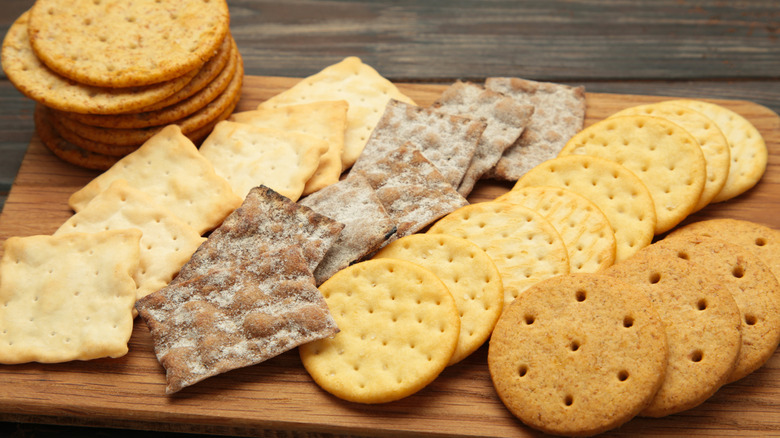
Compared with matzo and its millennia of history, crackers are relatively new to the scene. That is, unless you're counting buccellatum, a twice-baked bread eaten by soldiers in the Roman Empire as durable army rations. The modern cracker, however, did not appear until the 19th century. In the early 1800s, baker Josiah Bent began selling "water crackers" in Massachusetts, a crisp biscuit that, like buccellatum, also proved useful as military provisions. From there, the category expanded quickly. The mid-19th century and early 20th century saw the introduction of common household brands, like graham crackers in 1829 and Ritz Crackers, which debuted in 1930s during the Great Depression.
While most matzo recipes are fairly uniform, crackers come in a wide variety of styles, shapes, and ingredients. Some, like cream crackers, are made with yeast, flour, and oil for an airy texture. Another classic variety is saltines, which are salted and made with baking soda. Then you've got specialty crackers, which incorporate cheeses, herbs, or sweeteners into the mix.
Crackers are usually limited to snacking or dipping, and you can even find them wrapped in bacon in the South. A few, like graham crackers, can double as a base for cheesecake or pie crust. In contrast, matzo commonly shows up in a much wider range of dishes. Take matzo brei, for example, where pieces of matzo are cooked with scrambled eggs — a dish that demonstrates how matzo is often integrated into prepared meals, a different culinary path than the one typically taken by most modern crackers.