

10 After-School Snacks Kids Loved In The 1980s
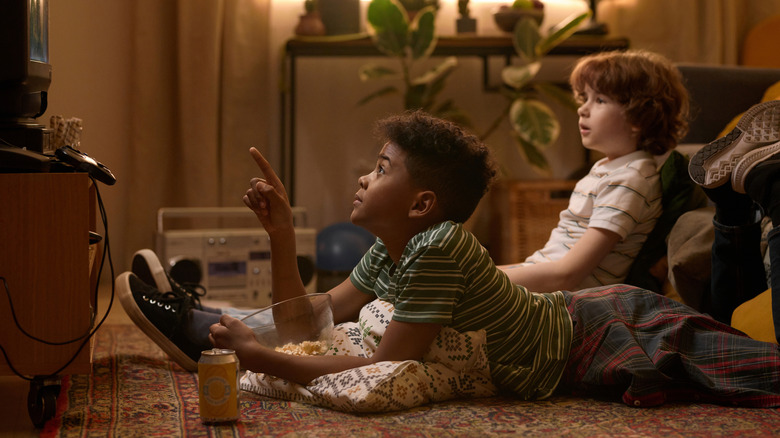
In the 1980s, snacking was as distinct as the fashion trends, and there were some goods that gobbled up more attention than others after school. As synth-pop and big hair replaced disco and bellbottoms, research and innovation made their own strides throughout the food industry. The Cold War carried on, but hot and quick snacks were all the fashion. Frightening headlines didn't stop consumers from microwaving — nicknamed nuking — as the device was a mainstay with other items every '80s kitchen had.
The crispy outside and molten insides of microwaved pockets, bites, and rolls account for only some of the cravings for roller-rinkers and arcade heroes. Bike rides searching for where your friends gathered in the days before cellphones demanded fruit snacks, cracker packs, or a zesty new flavor of Doritos challenging Nacho Cheese for its crown as the favorite. Grab your appetite and buckle into your DeLorean to find out which after-school snacks were seen as totally radical.
Fruit Roll-Ups
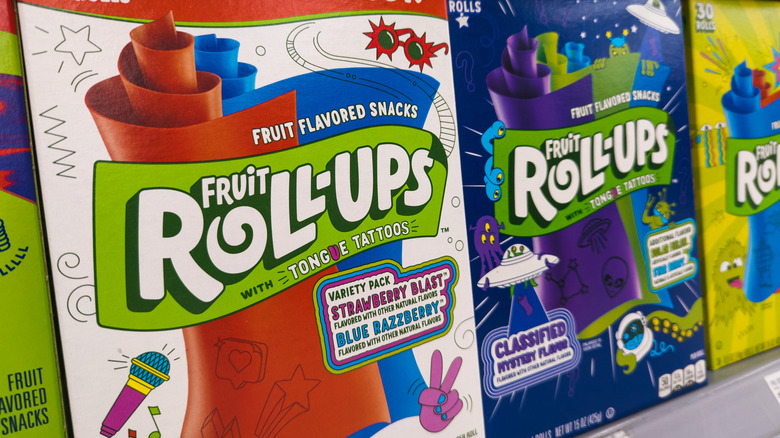
A precursor to other fruit snacks that took school cafeterias, pickup games, and backyard hangouts by storm, Fruit Roll-Ups first hit the market in 1983. However, it was a long road for the pectin-packed, spooled sheets to reach store shelves courtesy of General Mills. Known as amardeen, what was commonly referred to as fruit leather arrived in the United States via Ellis Island when immigrant George Shalhoub made it available at his grocery store in his Syrian community. Taking the sales to the next level, Shalhoub's grandson Louis started Joray and began selling individually-wrapped versions of the fruit snack.
When 1975 arrived, General Mills sought to make available its own fruit leather snack. After four years of development and another four years in test markets, Fruit Roll-Ups debuted and became commonplace in lunchboxes and at birthday parties. Subsidiary Betty Crocker marketed them as "real fruit and fun rolled up in one." The popularity of the treat — that doubled as currency in barters for baseball cards — led to the release of similar snacks like Fruit by the Foot, Fruit String Thing, and Gushers. Similarly, Betty Crocker explored whether the rolled-up delivery system was the real selling point when it offered Pudding Roll-Ups in butterscotch and chocolate flavors. These resemble a wax paper ancestor to squeeze pouches such as Go-Gurt and GoGo squeeZ.
Pizza Rolls
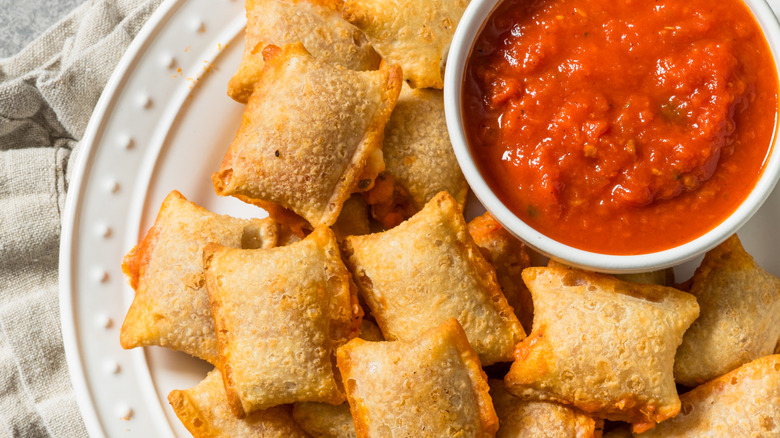
These days, pizza rolls are a staple of gamers and couch quarterbacks alike. But their control of prime real estate in supermarket and convenience store freezers is owed to innovation and the pizza prevalence of the '80s. Between Pizza Hut's debut of the Personal Pan Pizza and Domino's lawsuit-inducing fast food policy we wish still existed, consumers wanted their pizza fix quick. As it happened, Luiginio "Jeno" Paulucci found just the solution a couple decades after setting out to bring Chinese food to pantries and freezers.
As part of the sale of his Chun King company in the '60s, Paulucci envisioned swapping out egg roll filling for other ingredients and his development team scored big with pizza rolls. The purchase by R.J. Reynolds at $63 million included an agreement to bring Jeno's Pizza Rolls to market. The craze coincided with Minnesota's Totino's Italian Kitchen launching Totino's Finer Foods and revolutionizing frozen pizza with its "Crisp Crust" patent. The result was a buyout by Pillsbury in 1975. A decade later, '80s snackers made Jeno's worth $135 million to the company that bought them before eventually folding the brand together with Totino's.
Cool Ranch Doritos
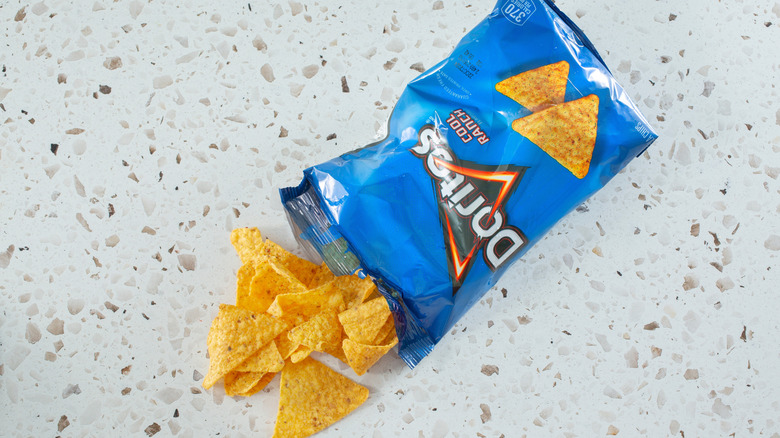
A dividing line was drawn in 1986 that split Doritos fans into one of two camps: the introduction of the Cool Ranch flavor. To reach the point where snackers instinctively knew to look for the blue bag of the zesty chip or the red bag of its dominating predecessor — Nacho Cheese — the former first had to make it to market. That was made possible when Frito-Lay Vice President Archie West stopped in at Casa de Fritos, a restaurant opened in conjunction with Disneyland at the theme park. Inspired by his first taste of a Dorito, West arranged for mass production before a merger with Pepsi in the '60s brought about nationwide sales.
As flavors were added, Nacho Cheese reached tastebuds across America in 1972, earning a strong following before its "Cool" new competition made a splash. Commercials for the flavor suggested combined ingredients to bring the ranch taste to a chip was an out of this world development, as well as a technological achievement. Testifying to the passion Cool Ranch fans still hold to their original experiences with the chip, Alinea chef Grant Achatz — who once replicated the flavor while teaching at the Chicago restaurant — told Maxim in an interview, "If you grow up on something, it becomes an iconic flavor memory."
Handi-Snacks
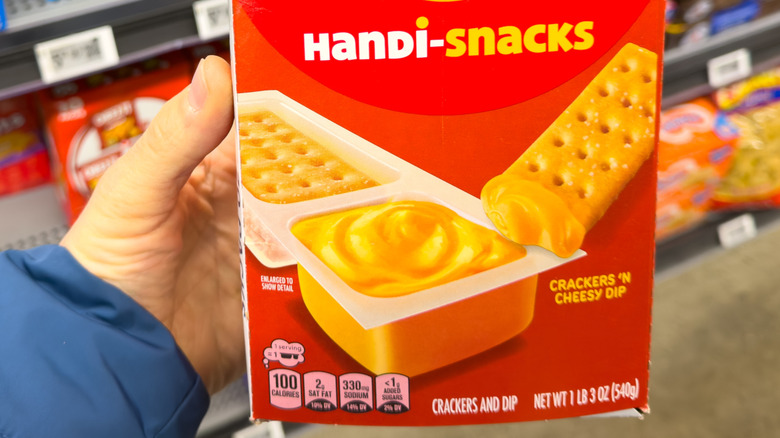
Like peanut butter and jelly or cookies and cream, cheese and crackers pair up for an ideal and convenient snack. In 1983, much to the delight of peckish pre-teens and others, Kraft revolutionized a delivery system to make something old new again with Handi-Snacks. Wartime meant big developments for old-school foods like corn dogs and Cheetos. In the years that followed, a trademark was applied for after Kraft came up with a spreadable cheese that originally bore the Handi-Snacks name. It was then repurposed for the cheese and cracker combo readily remembered for its complimentary red stick.
Unquestionably marketed to the younger crowd in the '80s, Handi-Snacks expanded beyond simple cheese and crackers to include alternative flavor options. Whether promoted by a prisoner in a poncho or a vampire in his crypt, Kraft added Peanut Butter, 'Pizza' cheese, and Honey selections alongside the original Cheez'n Crackers. Later produced through subsidiary brand Nabisco, Ritz crackers have since become the star of Handi-Snacks, but the much-celebrated red stick used to spread the cheesy dip has been ditched, leaving snackers to rely on dunking.
Hunt's Snack Pack Pudding
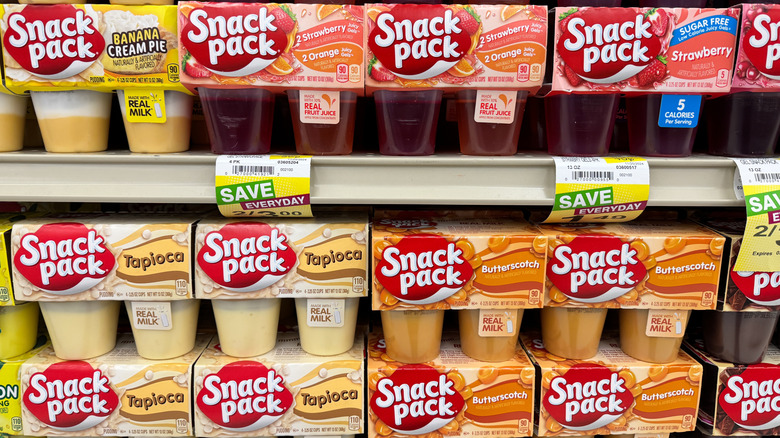
With a nod to more than five decades of delighting tastebuds, Hunt's prides itself on the history of its Snack Pack Pudding. From dishing out calcium without high-fructose corn syrup, to its presence in pop culture, the Conagra Brands treat is particularly proud of its reference in the 1995 film "Billy Madison." Those familiar with the film know that Adam Sandler's adolescent-behaving titular character would have spent many of his childhood years snacking after school in the '80s.
Further reinforcement for the nostalgia of the decade of hair bands and arcades came courtesy of the Netflix series "Stranger Things." Set in 1983, a year before the pudding would gain new life with a package change to plastic cups, the first season found characters Dustin and Lucas raiding a refrigerator in the school cafeteria. Within, they uncovered dozens of the original tin cans, gathering as many of the chocolate pudding desserts as they could carry. As with harkening back to memories of neighborhood bike rides, trips to the mall, and Dungeons & Dragons, TMZ reported that the appearance of Hunt's Snack Packs in the show left fans wanting more. So much so, in fact, that they called the company to request a packaging refresh so that viewers could experience their treats in tin cans while watching the adventures in Hawkins.
Teddy Grahams
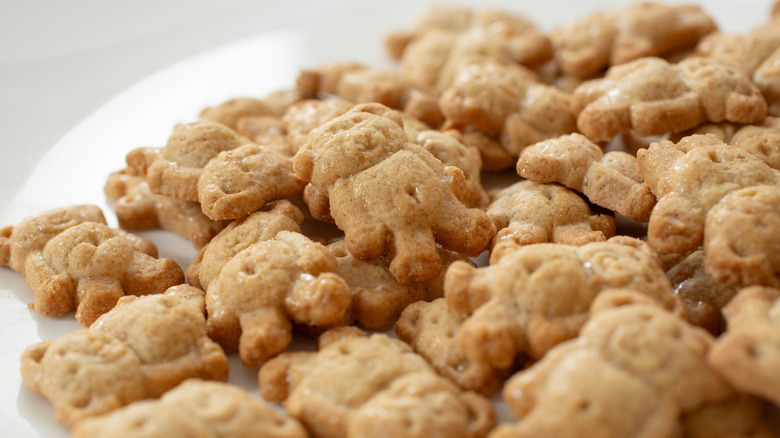
A late entry into the '80s snack market, and a personal favorite of this writer's childhood, Teddy Grahams more than squeaked in before the decade could come to a close. They roared onto the scene. Offered in three flavors — cinnamon, chocolate, and honey — the trio of smiling bear-shaped cookies earned an accolade as one of the Best New Products of the Year from the American Marketing Association while earning Nabisco tens of millions in sales.
While Teddy Grahams hadn't topped regular Oreo cookies, they had beat out Fudge Covered Oreos for the award, in addition to Ritz Bits. The success was quickly followed by Nabisco's release of Teddy Grahams Breakfast Bears Graham Cereal in 1989. The same rockin' bears used to promote the regular cookies would go on to make appearances selling the cereal and the follow-up effort to continue striking gold: Teddy Grahams Bearwich's, which featured a creme between the cookies designed to have a front and backside.
Bagel Bites
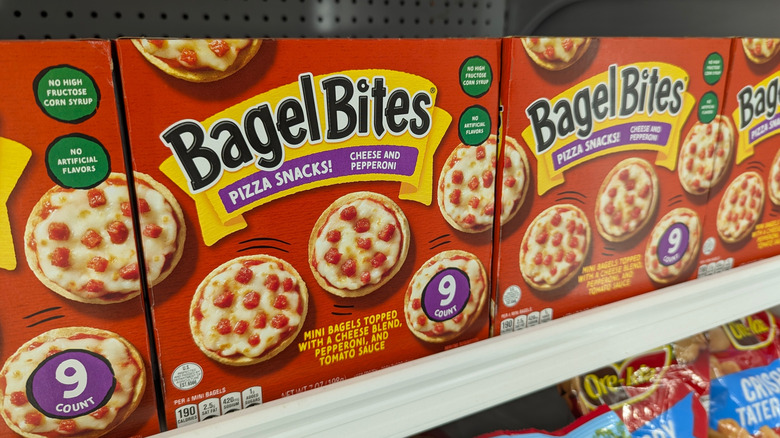
Fans of Bagel Bites likely can't think of the snack without calling to mind the jingle about how with pizza on a bagel, "You can eat pizza anytime." However, Bagel Bites had already spent most of the '80s satisfying after-school hunger before the ear worm was penned. Building off the existing concoction that is a pizza bagel, inventors Stanley Garczynski and Bob Mosher dreamed up an hors d'oeuvre to satisfy pizza lovers for the latter's catering business.
After consideration for other vehicles — like English muffins or bread — miniature bagels were picked because of the prevalence of the full-sized versions in the '80s. Success led to space in warehouse clubs like Sam's Club and Costco, where pizza options are among freezer deals you shouldn't skip. Ultimately, Bagel Bites became the property of Heinz through Ore-Ida Foods which had purchased Labatt Beer's parent company four years after Garczynski and Mosher sold off the brand.
Jell-O Pudding Pops
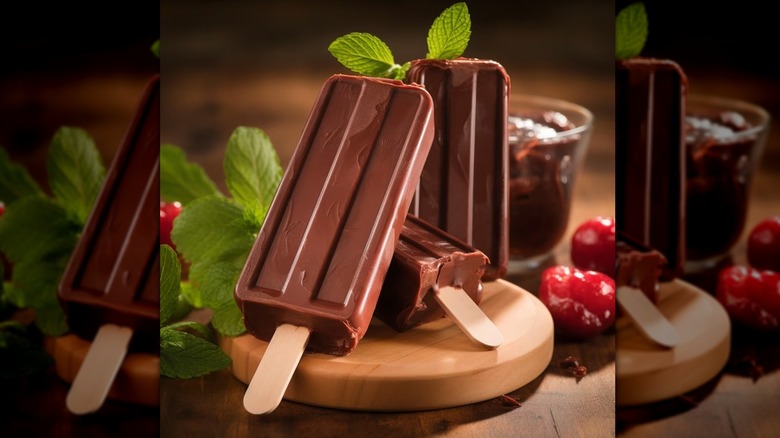
Until this point, the list of after-school snacks loved by '80s kids includes foods Gen X and beyond can still enjoy to this day. Unfortunately for the nostalgic among us, there's one vintage frozen treat we only wish freezer sections still carried. Launched in the '70s, Jell-O Pudding Pops truly had their time to shine when the gelatin and pudding company teamed up with one of the biggest sitcom sensations of the '80s, actor and funnyman, Bill Cosby. The star of "The Cosby Show" became synonymous with Jell-O for America's youth even before he became known as Dr. Cliff Huxtable.
Continued collaboration with the comedian from one of the decades top-rated shows could only carry a product so far. While Jell-O Pudding Pops remained popular throughout the '90s, they failed to make parent company Kraft a profit. An effort to keep the product afloat kicked off in 2004 through a licensing agreement with Popsicle, but by 2011, the frozen treat was officially discontinued. That said, all is not lost for those longing for the cool and creamy taste.
Hot Pockets
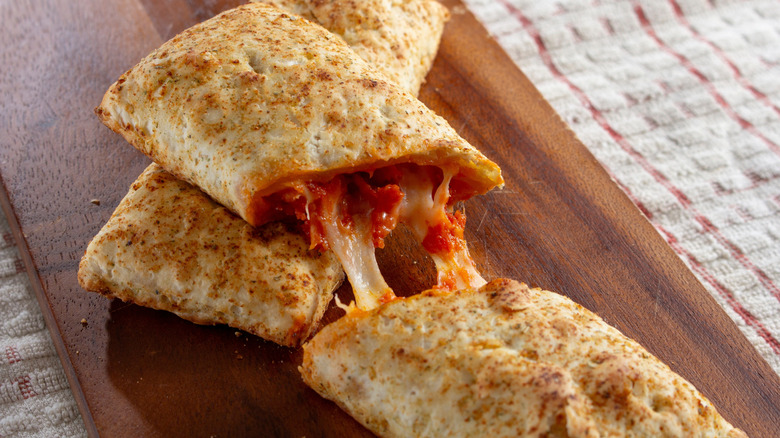
Before they were commonplace in dorm rooms and man caves alike, Hot Pockets were called Chunk Stuffers — and the grocery store wasn't even the primary customer base. Years after emigrating to the United States, Iran-born brothers Paul and David Merage founded the company Chef America Inc. Application of nearly a decade of experience with product management and new products at other food companies steered Paul to address the trend of moms entering the workforce. While devising a food that could be prepared easily and enjoyed without having to stay stuck at a table, the brothers also commissioned an invention changing the microwave game.
The readily identifiable Hot Pockets sleeve has a technical name — the susceptor — and its purpose is to convert electromagnetic energy to heat. The result: crispy crust instead of soggy dough. Aiming the new creation at restaurants, the hand-held snacks with fillings like pepperoni pizza, ham and cheese, and beef and cheddar grew into a massive success starting in 1983. Sold with dozens of different flavors as well as spinoffs like Lean Pockets and Croissant Pockets, it was the company itself the Merage's went on to sell. In 2002, at a price of $2.6 billion, Nestlé S.A. became the proud owners of Hot Pockets.
Microwave popcorn
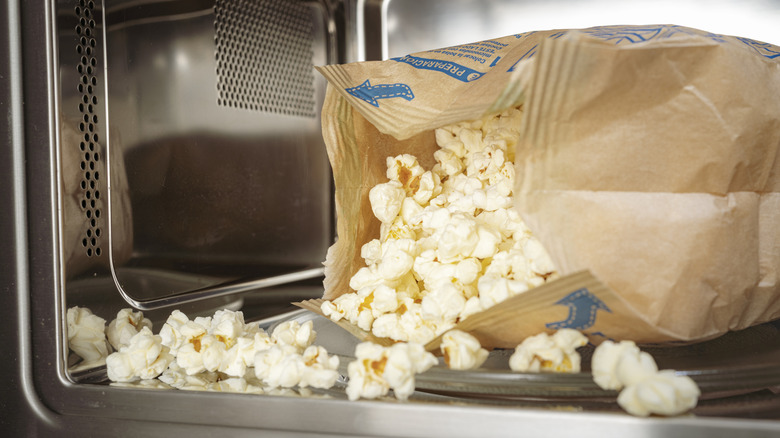
Those in search of a true blast from the past are welcome to learn all about how to pop popcorn on the stove. The rest of us can rest easy looking back to the future courtesy of another '80s game changer: microwave popcorn. A couple years prior, the first patent for the snacking solution was filed, but the real breakthrough came in 1984 with Act II. This followup to Act I —which required refrigeration due to the use of real dairy ingredients — differed from its predecessor in that it was shelf-stable.
That means that in only a few short years, consumers had gone from either exclusively enjoying popcorn at the theater, or dealing with the production on the stove, to merely having to push a few buttons (and did you know you can actually microwave popcorn without the bag?). Whether or not they stuck around in the room while the microwave worked varied based on individual comfort levels. It isn't nicknamed the nuker for nothing. The only thing missing was a trip to the local video store to complete a home movie night.