

Chlorinated Chicken: Why It's Ok In The US But Banned In The EU
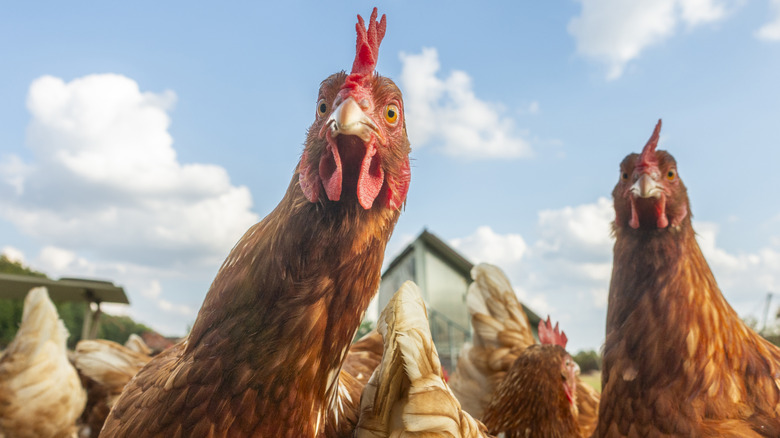
Since the dawn of time, people have argued over whether the U.S. of Europe has better food. People tend to think Europe has superior cuisine, and their rationale lies in different quality standards. The EU, which is made up of 27 European nations, has banned a number of food products from import, including several household staples in the USA. One of the most controversial examples is chlorinated chicken, which the EU has prohibited since 1997.
The ban doesn't just apply only to U.S. chicken; it's actually a blanket prohibition on poultry treated with antibacterial washes to eliminate bacteria like Salmonella or E. coli. This means that chlorinated chicken itself isn't considered unsafe to eat. Instead, the EU's objection is about farming practices. European regulators argue that chemical washes can be used to compensate for lower hygiene and animal welfare standards.
This difference also reflects how the EU approaches food safety more broadly. European regulators often follow what's known as the precautionary principle, meaning products can be restricted or banned if there's a potential environmental or health risk. In contrast, regulatory action in the U.S. tends to follow when there's proof that a product causes harm. This is why far more American products are banned in Europe than the other way around. Public opinion also plays a critical role in decision making, too. Across much of Europe, consumers are united in opposition to chlorinated chicken appearing on supermarket shelves. When the U.K. left the EU in 2020, the possibility of U.S. chicken entering the British market became a huge public scandal. In a rare moment of political unity, all sides of the political spectrum joined against it, despite mounting pressure from the White House.
Other U.S. foods banned in the EU
Compared to the other U.S. products banned in the EU, chlorinated chicken has something of a unique position as the precautionary principle is applied over concerns for the chicken's welfare, whereas the vast majority of its bans are based on potential public health concerns.
One of the most talked-about EU regulations is its ban on the vast majority of U.S. pork and cattle. In the U.S., the use of growth hormones to encourage weight gain is a common farming practice. However, the EU found evidence suggesting that some of these hormones could be carcinogenic (per the European Commission). While there is no definitive proof of harm arising from consuming hormone-treated meat, the precautionary principle was still firmly applied, and a formal ban came into effect in 1989.
Beyond meat, the EU also takes a strict approach towards food chemicals and additives. Commonly used chemicals such as potassium bromate (a dough strengthener) and titanium dioxide (a whitening agent) are also banned due to public health concerns. This is the reason you'll struggle to find Arby's locations in Europe and why French flour is different from American flour. Other additives, such as Red 40, Yellow 5, and Yellow 6, are not fully banned in the EU, but since 2010, it's a requirement that any food or drink containing them has the following label: "May have an adverse effect on activity and attention in children." As a result, many European manufacturers chose to switch over to natural colouring alternatives, making these dyes uncommon in the EU despite not being completely banned.