

This Old-School 'Luxury' Deli Meat Was The Star Of 1970s Lunches
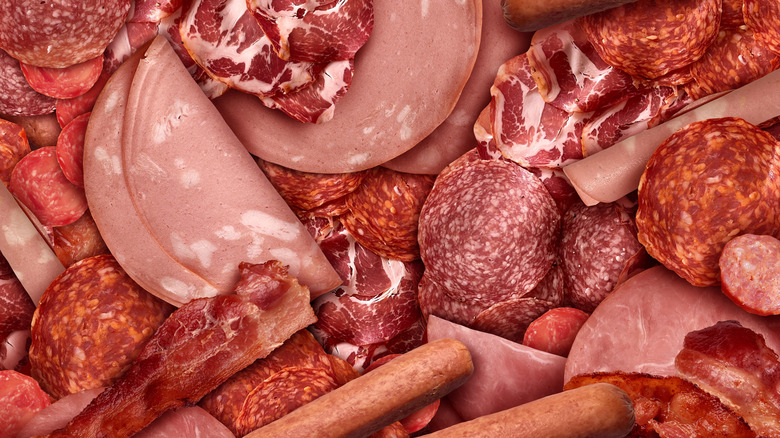
These days, deli meat doesn't exactly have the most favorable reputation. It's often dismissed as mystery meat, with many people linking it to a long list of concerns. But there was once a time when it was a lunchbox staple, and in the 1960s and '70s, no packed lunch felt complete without a slice of Oscar Mayer deli meat neatly tucked between two slices of white bread. The brand offered an impressive variety of cold cuts, including the fashionably named luxury loaf.
While any child of the '70s is sure to remember the catchy Oscar Mayer jingles like "My Bologna Has A First Name" and "The Oscar Mayer Weiner Jingle," far fewer recall the brand's luxury loaf. On Reddit, one user lamented that "our children will never know the glory of the LUXURY LOAF," yet many others struggled to recall ever seeing it in stores. While discontinued faves like olive loaf sparked waves of nostalgia amongst fans, it seems luxury loaf left a fainter impression on '70s kids.
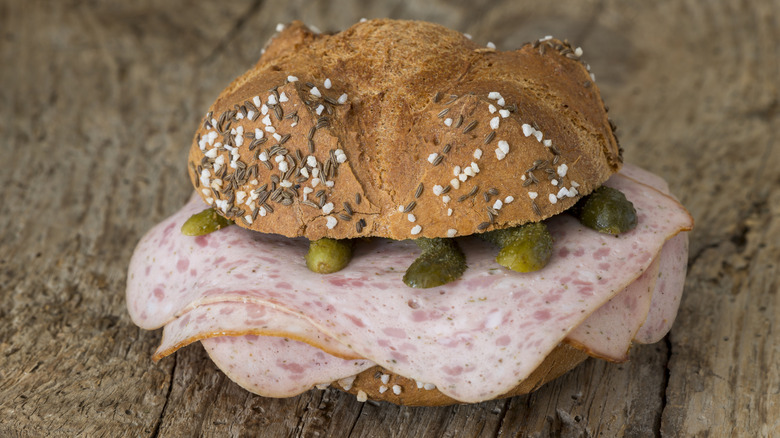
Fans were quick to question the meaning of the "luxury" in the name. One user joked that "it was made from aristocratic pigs," while another suggested, "[it] must have been for really special occasions." With a little digging, we found that variations of luxury loaf still exist today, with speciality grocers like Schaller & Weber selling a product called Leberkäse Luxury Loaf, which looks incredibly similar to the Oscar Mayer version. Leberkäse, a Bavarian-style meatloaf, is made up of finely ground pork (sometimes beef), bacon, and spices. It literally translates to "liver cheese," so we see why most brands stick with luxury loaf instead — especially as the name isn't exactly accurate.
Why deli meat is no longer a lunch box staple
Like nearly every other Oscar Mayer cold cut from that era, luxury loaf was eventually discontinued. But how did a lunchbox staple that was once the peak of convenience, the subject of one of the most iconic advertising songs ever, and an all-around shopping list must-have eventually become the target of such intense public scrutiny?
The downfall of deli meat can largely be blamed on changing perceptions of ultra-processed food. While few took issue with deli meat in the 1960s and '70s, the 1980s saw a cultural and social phenomenon known as "The War on Fat." This period grossly overgeneralized fat as the primary cause of heart disease, and as a result, foods high in fat and sodium experienced a sharp decline in popularity. Unfortunately, while deli meat is known for many things, it's not exactly famed for its long list of health benefits, so it consequently fell victim to people's changing eating habits.
Today, deli meat is having a bit of a renaissance, but it's still nowhere near as popular as it once was. However, in some parts of the world, it never left. Over in Korea, where deli meat was brought over by U.S. soldiers during the Korean War, it remains a staple of the local street food scene. And while its reputation still suffers over in the continental U.S., Hawaii is considered to be the spam capital of the world, and no trip to the beautiful island is complete without trying its delicious spam musubi.