

What Is The Golden Ratio For Making Lattes At Home?

Whether your go-to caffeinated cup of goodness is a Starbucks-inspired flavored latte, your own rendition of a creamy pumpkin spice latte, or a simple take on the classic, the goal when you're making it at home is likely to achieve that perfectly balanced coffeehouse-style flavor. According to Mekayla Bramlett, Founder and Head Barista of Charlotte Mobile Coffee, the key is using the "golden ratio." She told Food Republic, "In specialty coffee, the latte 'golden ratio' typically refers to approximately one part espresso to three to five parts steamed milk, finished with a thin layer of microfoam. In café terms, this looks like a double shot of espresso combined with 120 to 180 [milliliters] of textured milk in a 6 to 8 [ounce] drink."
Bramlett explained that the ratio is necessary in order to combine the espresso and the milk in a way that allows the two ingredients to work in harmony. "When diluted by about 3–5 [times] its volume in milk, those compounds fall into a 'sweet spot' where bitterness softens, acidity rounds out, and natural sugars in milk become more perceptible," she said. If the proportions are off, the flavors won't come together in equilibrium. Without enough milk, the latte can lean toward being bitter. Meanwhile, with too much milk, the taste of the espresso will become significantly less pronounced.
Building a homemade latte
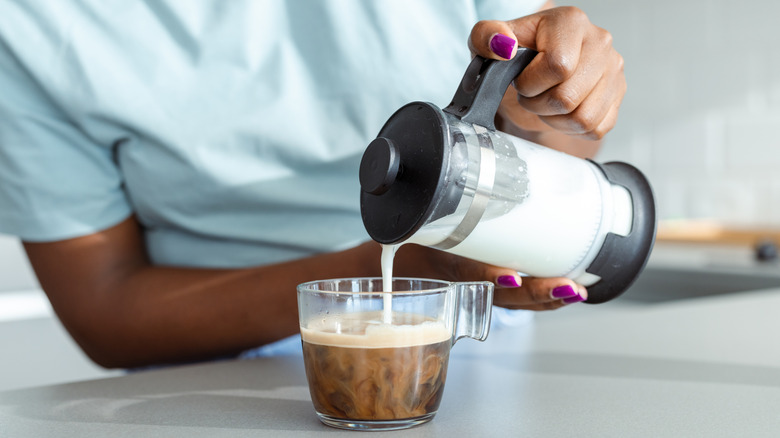
Consistently crafting coffee shop-style lattes at home may be easier than you think if you follow Mekayla Bramlett's advice. The first key is to follow measurements of both ingredients as precisely as possible. "Measure the espresso and milk, not the cup size," Bramlett said. "Aim for a 1:3 to 1:4 espresso-to-milk ratio by volume. For example: 36 [grams] espresso with 120 – 150 [milliliters] milk. Even without a scale, this is roughly a double shot plus milk to just below the rim of a 6 – 8 [ounce] cup."
The second important part is to heat the milk to the right temperature. Bramlett suggested 55-65 degrees Celsius or 130-150 degrees Fahrenheit. At this temperature, she said the milk reaches peak sweetness while maintaining its consistency. No thermometer? No problem! Bramlett said you can tell it's at the right temperature when your pitcher or mug reaches the point at which it's a little too hot to hold onto.
The final, and crucial, element is to create a microfoam. "Microfoam adds viscosity and perceived sweetness without creating separation," Bramlett said. It may sound like a fancy process, but it's actually quick and easy. If you have a French press, you can pour the milk into it and pump it about five to 10 times, being gentle as you do it. Or, you can use a hand frother for two or three seconds. If you don't have any of those tools, simply pour it into a jar, secure the lid, and shake it. Whichever method you use, Bramlett said the milk should turn out glossy and paint-like.
Combining and troubleshooting

Once the components of the latte are prepared, there's one step left before combining the espresso and milk to create the silkiest consistency. "Swirl or tap the milk container to merge [the] foam and liquid," Mekayla Bramlett said. "The milk should pour as one texture, which mimics café microfoam and keeps the latte balanced." Then bring the two ingredients together in one mug and settle in with your warm cup of comfort — unless you want to try your hand at making latte art, too.
If you find that your homemade version of this espresso-based beverage is still not up to snuff, there could be some common pitfalls that you can remedy. In particular, Bramlett stressed watching the temperature and viscosity carefully. "Many home lattes fail because they use either overheated milk or dry foam[,] which disrupts that silky balance." Other mistakes can be related to the espresso. Be sure to always use fresh beans and grind them just before brewing. Finally, use precision when grinding to avoid espresso that winds up too fine or too coarse.