

10 Ways You Can Ruin Your Food In The Microwave
Microwaves seem like easy enough appliances. Everybody's familiar with the mechanics of one. Just chuck your food in there, press a few buttons, and voilà; your leftovers are ready to eat. Sounds easy enough. But it's never that straightforward, is it? Almost everybody's tried to reheat leftovers in a microwave and ended up with food that's somehow bone-dry, hot as lava at the edges, and Ice Age–cold in the middle. What gives?
Though they've been culprit in countless ruined dinners, microwaves are actually pretty good at what they do. Sure, they've largely been outpaced by air fryers when it comes to reheating food — you can't really beat an appliance that somehow manages to resurrect day-old fries. But microwaves still excel at plenty of things: steaming vegetables like broccoli, poaching eggs, cooking rice, cleaning and shucking corn.
Still, extracting good food from a microwave requires a bit of finesse. A run-of-the-mill household microwave may be a simple machine, but it isn't a blunt instrument. Crude habits don't work if you're trying to get the most out of it. What they will do, instead, is reliably ruin your food. So what habits throw the microwave completely out of rhythm with your meal? Here's a roundup of microwave mistakes that can actually ruin your food, along with tips and tricks on how to get the most out of your microwave.
Using a microwave without a turntable
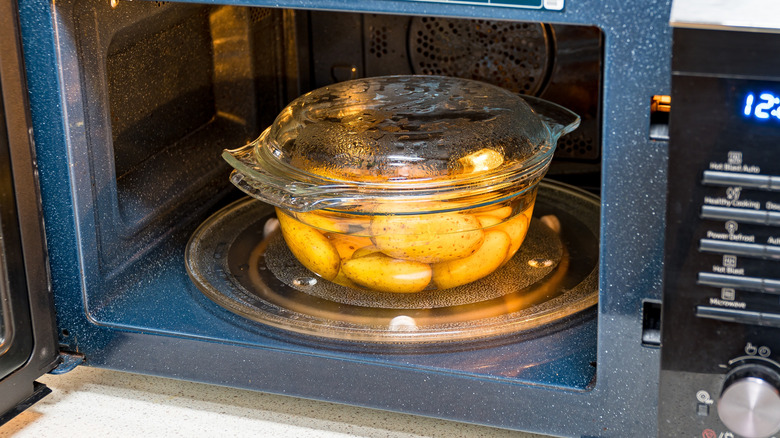
There's a reason every microwave comes outfitted with a turntable — and, no, it's not to give you something to stare at while your food cooks. Microwaves heat food by generating electromagnetic radiation that bounces off the metal walls, creating standing waves, which is just science-speak for hot and cold zones, per a study published in Physics Education. Unfortunately, this energy, whether high or low, is localized; it doesn't circulate the way heat does in a convection oven or an air fryer.
That's where turntables come in. The slow, rotating motion moves the food around the neighborhood, making sure it's spending as much time in the hot spots as it is in the cold ones. This all helps average out heat intensity throughout your food, notes the Journal of Food Engineering, so it heats uniformly despite the temperature differences. They're not perfect. You'll still need to go in there and stir the food to really circulate the heat, but you can count on them to do a lot of the heavy lifting.
So what happens if you opt to leave the turntable out of the equation? Your food stays static, and because microwave energy refuses to circulate, some areas get blasted while others barely warm. The degree of damage will, of course, depend on the food. High moisture foods like sauces and pureed soups are a bit more forgiving since the water ends up distributing the heat throughout the food. Dense foods like casseroles are almost impossible to salvage without rotation. Heat builds in water-rich areas, creating steam pockets, while leaving the rest of the food barely warm and bone dry. The result is a confusing mishmash of soggy, overcooked, and frozen bites; not something you can just stir your way out of.
Reheating the wrong foods
Not everything belongs in the microwave. It's a lesson many cooks have learned the hard way. You're probably familiar with the most common offenders. Bread goes rubbery, french fries go limp, and pizza turns into a soggy, sad mess. Baffling, right? After all, other appliances manage these foods pretty well. So why do microwaves struggle with certain dishes?
It all comes down to the physics of microwave cooking. Microwaves primarily target polar molecules; molecules with a positive and negative end, per Physics Education. The electromagnetic energy acts like a beat, and those molecules are tiny dancers forced to keep up. All that spinning and wobbling creates friction, which generates heat and warms your food. The biggest problem with this mechanism is that not everything in your food has high polarity. Water and, to a lesser degree, proteins absorb the microwaves efficiently, but fats are largely non-polar, which means they barely feel the heat. That's why reheating day-old french fries turns them soggy. The water heats first and migrates to the surface, while the fat barely warms up; goodbye crispiness.
Microwaves also spell ruin for starchy foods. The water inside the starch molecules heats up, causing the starch to swell with moisture and almost instantly gloop into rubber once cooled, notes Scientific Journal. Basically, anything that depends on a delicate balance of moisture — pasta, rice, steak — will suffer in the microwave. Foods with shells or skins, like sausages or hard-boiled eggs, also don't fare too well. Steam builds up inside the cavity, causing, you guessed it, a messy explosion.
Not covering your food
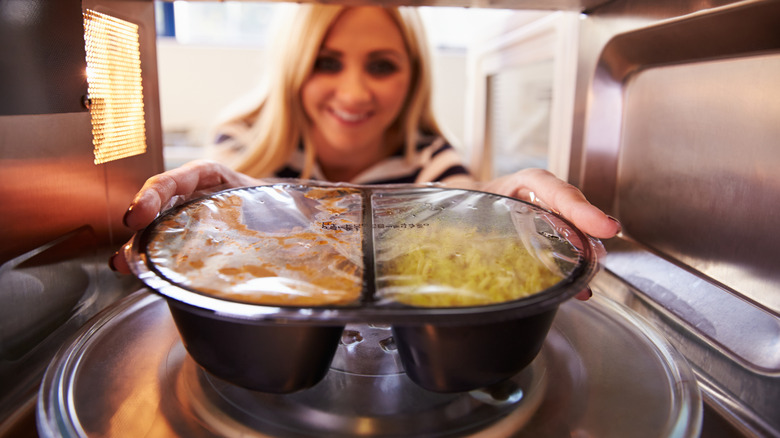
If the microwave is your go-to for reheating liquid foods, then you probably already understand that microwave covers aren't optional equipment. They're what stands between you and ruining your dinner and the microwave in one fell swoop. You've got to possess a truly impressive amount of confidence to leave your food uncovered in the microwave. Unfortunately, it won't count for much when your food splatters all over the cavity, leaving you with a cleanup job that'll probably siphon the last bit of energy you had for the day. It's better to put the hubris aside and use a cover. It will only take a moment, and your food will thank you for it.
For one, your food won't turn out quite as dry if you use a cover. Microwaves are really drawn to the water in your food, which means food heated in the microwave uncovered will dry out pretty fast, notes the International Journal of Heat and Mass Transfer. Covering your food also traps steam, averaging out heat throughout the dish, which lessens the chances of cold spots in your leftovers. But it's not just about making your food more palatable. If parts of your food are not heated to recommended temperatures, bacteria can survive, exposing you to food poisoning, per the USDA.
Of course, the covering shouldn't be so tight as to prevent ventilation. Steam builds up quickly inside sealed containers, and with nowhere to escape, pressure can warp or crack the container. Worse, it may cause a small explosion, leaving a hectic cleanup job in its wake. To get around this, cover your food loosely or use a cover with vents.
Heating too long at full power
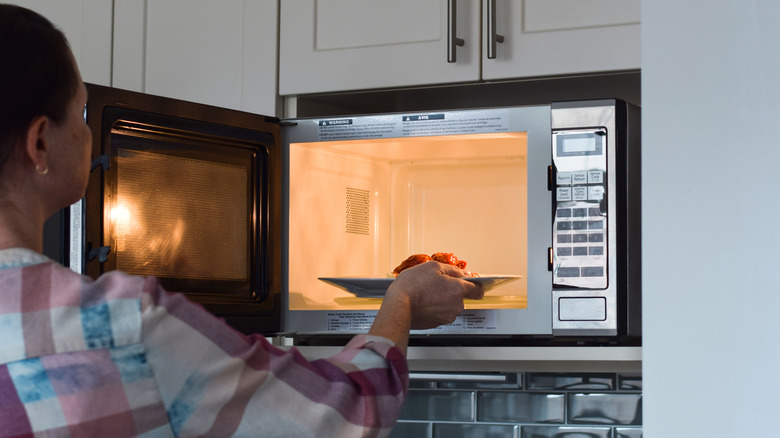
Some days you don't really have the patience to babysit the microwave. Who wants to stand there for an hour tapping the counter like an overwrought general? Time consciousness is key, which is why it's tempting to just chuck your food in there and blast it with the power of three suns, consequences be damned. But though a nifty microwave cooking hack in theory, nuking your food is actually a pretty regrettable choice.
Blasting your food with heat doesn't make it heat up faster, at least not entirely. Microwave heat doesn't distribute uniformly. At full power, not even the steady rotation of a turntable can save you, which means that some parts of your food will heat faster than others. But why doesn't this heat migrate to other parts of the food? Well, those other parts simply can't keep up. Hot foods are extremely reactive to microwaves, per the journal Foods. At full power, they'll keep absorbing energy, getting hotter while the cold regions lag. This, of course, will create a harsh and disturbing temperature rollercoaster. Some bites will singe your tongue, others will chill it, which is only fun if your mouth likes surprises.
Food texture also changes drastically when blasted with heat for too long. As hot zones ramp up, moisture rushes outward toward cooler spots, leaving some areas dry and overheated while others remain soggy and icy. Setting your microwave to nuke can also destroy the nutrients in your food. At high temperatures, heat-sensitive vitamins can undergo irreversible chemical changes, causing them to lose their nutritional value. You might also end up destroying the proteins in your food, as these denature rapidly at high temperatures, notes the National Library of Medicine.
Using the wrong containers
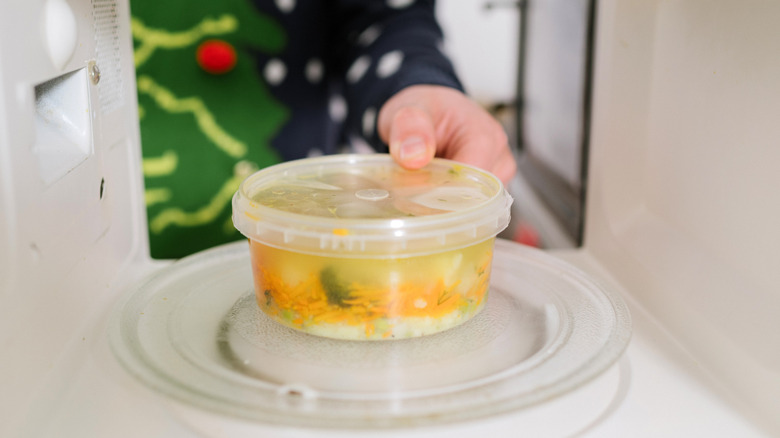
Everybody understands the basics of picking a container for the microwave. Metal containers and aluminum foil are definitely out of the question. These can disrupt the energy in the cavity, which can lead to arcing — when sparks fly in the microwave and not because a rom com is happening in there, per the USDA. But did you know that a container can be unsafe even if it doesn't cause your microwave to light up like a Christmas tree?
Take those mythical microwave-safe plastic containers, for instance. While designed to withstand microwave heat, they can still leach harmful chemicals into your food. Scientists have linked chemicals like phthalates — a type of plasticizer commonly used to make plastic more pliable, per the journal Healthcare — to hormone disruption, which can cause reproductive issues, insulin resistance, and thyroid dysfunction. Ordinary plastics like takeout containers or margarine tubs are even worse. Expose them to heat, and they deform, or worse, melt into your food. To protect your health — and avoid regret — it's best to stick to microwave-safe glass or ceramics. These materials are not only safer, but they also conduct heat more evenly, helping solve the microwave's heat distribution problem.
Once you've nailed down the type of container, turn to shape. Steer clear of containers with sharp edges and opt instead for oval or round shapes. Round containers encourage more even heat distribution. Square ones tend to absorb more heat at the edges, overheating those areas while the rest of the food lags behind. Also, try to skip the tall containers and reach for shallow ones, instead. Vertical real estate reduces surface area, and because microwaves don't travel too deep, the top of your food will end up overheated while the bottom will barely warm up.
Not taking proper precautions when microwaving water
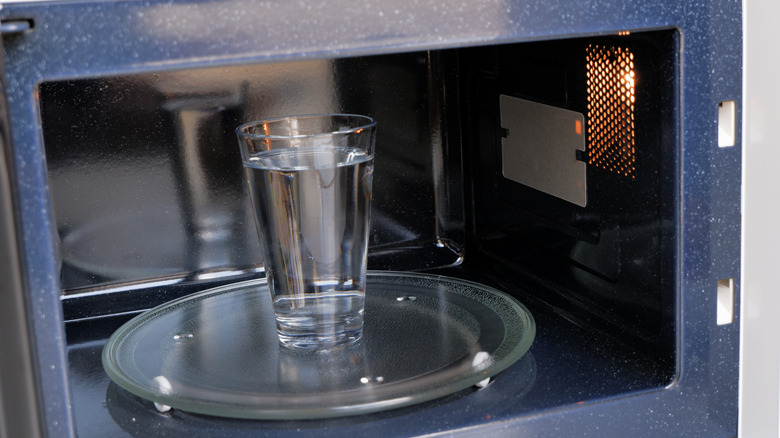
Heating liquids in the microwave is always a gamble. Sauces are seemingly just one missed step away from popping and splattering all over the place. Milk can boil over suddenly without warning, and gravy can look perfectly fine on the surface, and then erupt from volcanic bubbles lurking just underneath. But arguably the most unforgiving of all is water. You've got to take a lot of precautions with this one, or it will just splatter violently or worse — shatter the container, and leave you with severe burns.
The biggest non-negotiable is to never microwave water without making arrangements for steam bubbles to form. Because microwaves have an inherent heat distribution problem, water can heat beyond its boiling point below the surface while remaining completely still on top. The real danger comes when you take it out of the microwave, disturb it with a jerky movement, or simply add a spoon or a tea bag. That superheated water can erupt all at once. Adding a wooden stick or a microwave-safe spoon is a simple workaround. The object gives steam bubbles a place to form, reducing the risk of superheating.
It's also never a good idea to boil water at high heat for long stretches for the same reason. Instead, set the microwave to a lower power and heat the water in short bursts, stirring periodically to help distribute the heat. Your last line of defense is letting the water sit for a moment before taking it out of the microwave. This gives any remaining superheated spots a chance to settle, so they don't boil violently the moment the water is disturbed.
Skipping the rest period
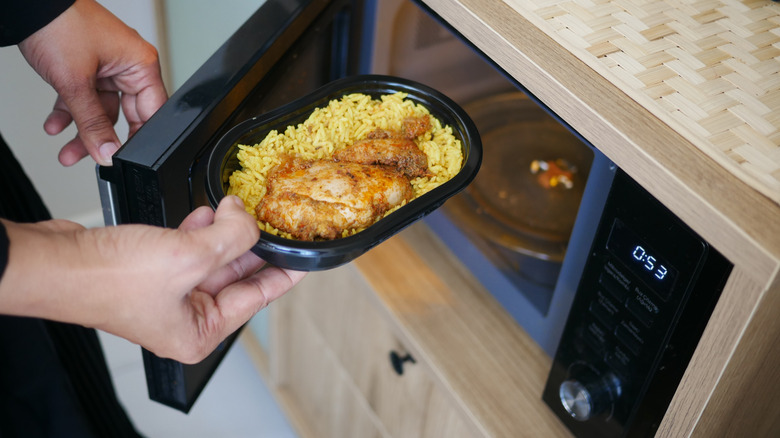
Everybody knows that once the microwave dings, it's time to grab your food and get down to the main event. But as obvious and obnoxious as that buzzer is, it's actually not a reliable indicator of doneness. Your food doesn't stop cooking the moment the set time lapses. Just like with any cooking method, your food isn't fully done until you've given it a moment to rest once it's off the heat. Though, unlike regular cooking methods, where the main point is to perk up flavor and texture, microwave standing time serves a variety of purposes — some of which are actually lifesaving.
Because microwaves only penetrate your food to a certain depth, the interior relies on heat conducted from the exterior to warm up. Even after the heating cycle ends, the hotter outer regions continue conducting heat to the much cooler interior, evening out the temperature gradient inside your food. The rest period leaves a little extra room for residual heat to spread, so your food isn't scorching hot on the outside and ice cold on the inside.
There's also the issue of food safety. Although occasional stirring and using a turntable go a long way in averaging out heat, cold spots can still form. These hidden pockets can harbor dangerous bacteria like salmonella and listeria, which could make you violently sick. A proper resting period allows your food to warm up to safe temperatures throughout, saving you the hassle of a bad bout of food poisoning.
Not cooking food immediately after defrosting
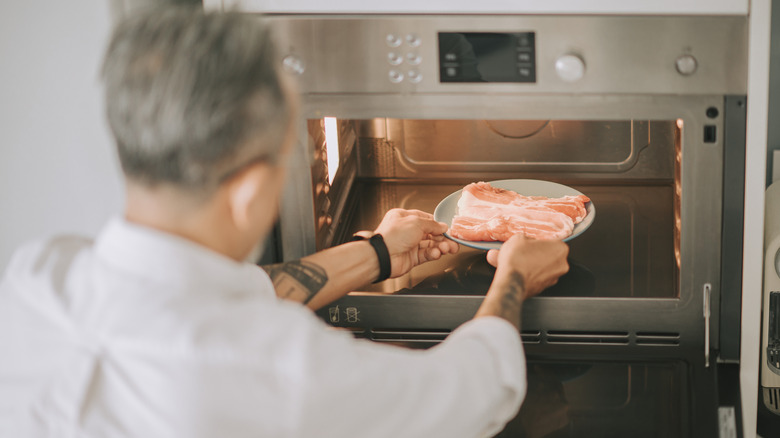
Defrosting food in the microwave is always a bad idea. It's got to be one of the biggest mistakes people make when defrosting meat, and for good reason. The uneven heat changes the structure in weird, somewhat gross ways, and the end product is almost always a nightmare to work with. The interior never thaws properly, and if you leave it in too long at high heat, the exterior might start cooking, turning rubbery and hard before you even get to the actual cooking.
But sometimes it's a necessary evil — like on those days when you didn't have the foresight to thaw everything in the fridge the night before. In those circumstances, microwave defrosting becomes unavoidable. The one main precaution you've got to take is to never let food defrosted in the microwave sit around too long before cooking. The biggest hurdle this prevents is food poisoning. Freezing, while excellent for preservation, doesn't kill bacteria, it just inactivates them. When the food warms up, it can quickly enter the danger zone, USDA speak for the temperature range that bacteria love most. The risk is especially high at the edges, which tend to heat far faster due to the microwave's inability to penetrate food evenly.
But though pretty up there, food poisoning isn't the only reason to cook immediately. There's also texture. The moisture in your food continues to leak out long after thawing, leaving proteins like meat and poultry hard and stringy on the outside. Uneven thawing can also push moisture from hotter exteriors to cooler interiors, creating watery, mushy pockets in some areas while others dry out and overcook. Flavor doesn't fare too well, either. The juices that carry taste keep escaping long after defrosting. Cooking immediately helps salvage what's left before time works its cruel hand on your food.
Heating high water and high fat foods together
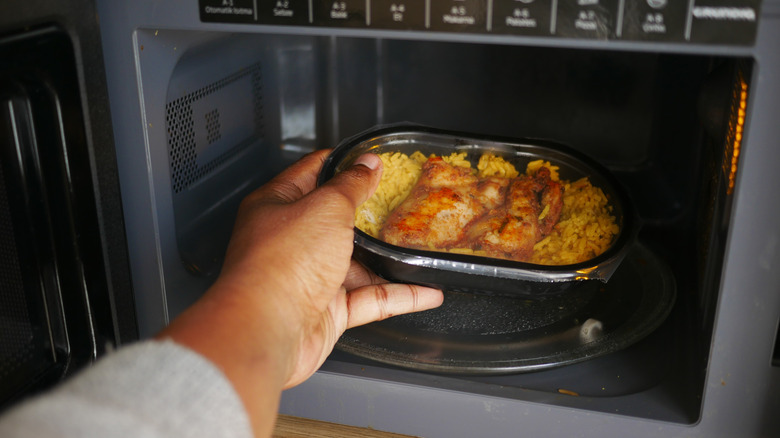
Making the most out of your microwave is a pretty noble aspiration. But, like with everything, there has to be a limit — or at the very least, a few lines you absolutely don't cross. One of the biggest is never heating high-fat and high-water foods together. It might feel like a stroke of genius to shove every part of your dinner into the microwave at once, but it won't save you time; you'll just arrive faster at disappointment.
Water and fats interact with microwaves in starkly different ways, differences that can absolutely ruin your dinner if left unchecked. Heating high-fat and high-water foods together essentially forces the microwave to pick a favorite; and it always chooses water. Water is extremely reactive to microwaves, which means it heats up fast and aggressively. Fats, on the other hand, are far less excitable, so they tend to lag behind. It's not an ironclad rule. In some cases — like when food is unevenly spread on a plate — fats can heat faster than water. But even then, they're still operating on completely different timelines.
Heating foods with wildly different water and fat contents is like assigning a group project to two people who refuse to cooperate. The water-rich parts rocket toward boiling, while the fatty bits sit there lukewarm and unbothered. That's why dishes like cream soups, cheesy sauces, and curries are infamous for splattering the microwave. The water boils almost immediately, the fat barely warms up, steam gets trapped, pressure builds, and boom — you've baptized the inside of your microwave in eau de regret.
Microwaving in thick chunks
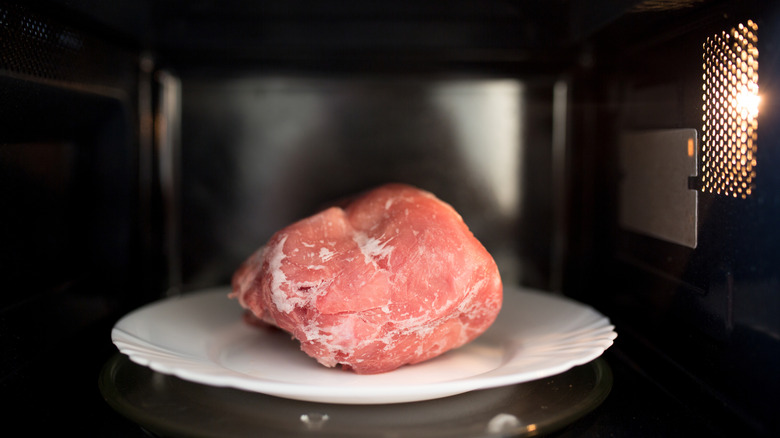
Microwaving is not meant to be a fussy affair. No one pauses midway to consider staging their leftovers perfectly before reheating them. The microwave isn't the crowd at a gourmet restaurant, after all; it shouldn't care about presentation. Shockingly, it actually does. Not in an aesthetic way, more in a geometric one. For starters, the microwave prefers food evenly distributed on the plate. It also has a real soft spot for anything spread out. Give it a towering monolith and you're very much on your own.
Contrary to popular opinion, microwaves don't heat food from the inside out. They can only penetrate food to a certain depth; usually just a couple of centimeters. Anything deeper relies on heat being conducted inward from the exterior. With large chunks, that process is painfully slow, which means the inside can still taste like it just came out of the fridge, no matter how long you blast the outside with heat.
This is exactly why defrosting large chunks of meat in the microwave almost never ends well. The exterior warms up almost immediately and thaws long before the interior has felt so much as a whisper of heat. By the time the center finally catches up, the outside has already crossed into overcooked territory; good luck salvaging that on the stove. To work around this, spread your food out evenly on the plate to encourage more uniform heating. It also helps to avoid reheating or defrosting large slabs of meat in the microwave altogether. If you have no choice, break them apart or rotate them periodically to give the heat a fighting chance of reaching the inside.