

The US State That Grows The Most Tomatoes By A Long Shot

Few fruits and vegetables are as versatile as the tomato. When raw, it adds freshness and structure to salads and sandwiches; when cooked, it can be reduced into pastas, sauces, and canned products that form the backbone of countless dishes. Given its importance in global cuisine, large-scale and reliable production is essential, and one state doing far more heavy lifting than others is California.
In 2025, California produced a staggering 229.2 million CWT of tomatoes (per World Population Review). CWT stands for hundredweight, a unit commonly used in large-scale agricultural figures. One CWT equals 100 pounds, so California's 229.2 million CWT translates to 22.92 billion pounds of tomatoes. While the state dominates total tomato volume, Florida supplies nearly all of the nation's winter tomato supply and accounts for over 50% of domestic fresh-market production (per USDA), despite producing only 6.5 million CWT. Globally, California alone supplies roughly one-third of the world's processed tomatoes (per Tomato News). Even so, the United States still ranks fourth in global tomato production, behind top producer China, followed by India and Turkey.
California's tomato-growing dominance is largely due to its climate. Most tomatoes are grown in the Central Valley, the region that supplies much of the nation's processing tomatoes, including those used by chains like Olive Garden. In particular, the San Joaquin and Sacramento valleys are prime growing areas, as they benefit from a Mediterranean climate of warm, dry summers and cool winters that are ideal for tomato cultivation. However, increasing droughts and water scarcity threaten the future of the industry.
California is an agricultural powerhouse
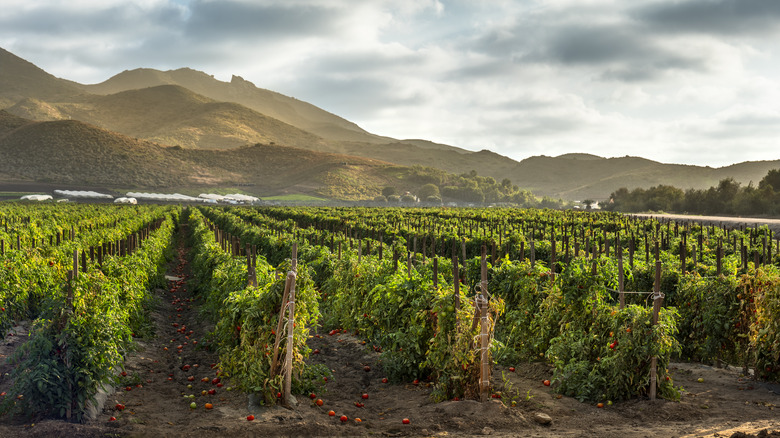
Many people often describe California as if it were its own country, and economically, that is not far off. Less widely recognized, however, is its extraordinary agricultural power. The state is one of the largest food producers in the world and by far the most important agricultural state in the United States.
According to the California Department of Food and Agriculture, the state grows more than 400 different crops, supplying half of the nation's vegetables, three-quarters of its fruits and nuts, as well as producing more ice cream than any other state. It dominates production in several areas, holding a near-total monopoly on the cultivation of many crops, including almonds, pistachios, and artichokes. According to the USDA, tomatoes generated an eye-watering estimated production value of $1.18 billion in 2021, yet ranked only ninth among the state's agricultural commodities.
California's productivity is driven not only by its favorable climate and fertile soils but also by extensive water infrastructure. For starters, approximately 40% of the state's land is used for agriculture (per Public Policy Institute of California), with nearly 270,000 acres dedicated to tomato cultivation. Although California's dry conditions can benefit tomato growth, tomatoes still require adequately moist soil. To address the state's frequent droughts, the Central Valley Project was implemented. This is one of the largest water management systems in the U.S., redistributing water from northern regions to the state's drier agricultural areas and enabling large-scale crop irrigation. While the project faces ongoing debate over its environmental impacts, its combination with the state's leading role in agricultural technology and innovation allows California to sustain its unmatched output.