

What Gives McDonald's Filet-O-Fish That Square Shape?
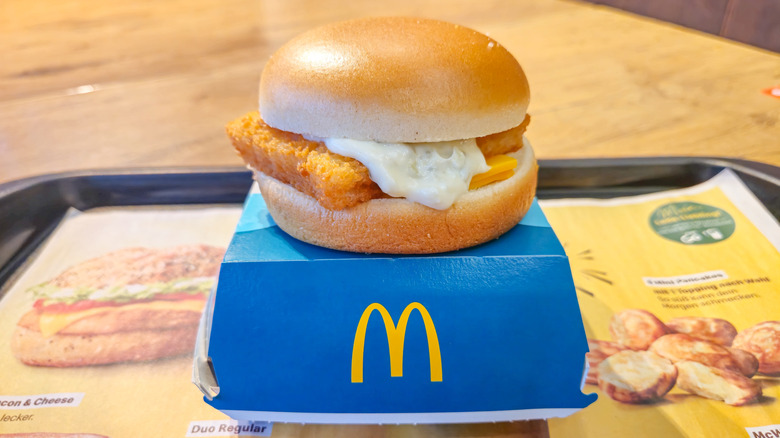
For a chain famous for its Big Macs, McNuggets, and ultra-delicious fries, the Filet-O-Fish is a bit of an outlier since it's the only seafood-based item on the menu. This delicious item features a breaded Alaskan Pollock filet topped with tartar sauce and a half — never whole — slice of American cheese, all served on a soft steamed bun. Another detail that sets the Filet-O-Fish apart from other burgers is its square shape. Unlike the round patties used for beef or chicken-based items like the Quarter Pounder or the McChicken, the fish filet is square; it's a design choice that's actually based on a practical reason.
In a Facebook post, a McDonald's employee explained that at sea, the Pollock filets are layered into a block and then sliced into squares to create a uniform square shape. Uniformity is key for a chain like McDonald's, where the brand promises consistency no matter what store you visit, even across its global locations. Cutting the filets into squares instead of circles is also a smart way to reduce waste, making the most of the fish while streamlining operations.
Another reason that Filet-O-Fish patties are square rather than round is due to the unique texture of fish. Unlike beef or chicken, which are typically ground and re-formed into stable round patties, breaded fish sandwiches usually aim to preserve the fish's natural texture. Grinding fish would destroy its delicate, flaky interior that contrasts with the crisp breaded coating. While fish can be formed into patties (just think of fish cakes), doing so produces a much softer and creamier product that requires plenty of additional binders to prevent it from falling apart during breading and frying.
The history of the Filet-O-Fish

Not only does the unique square shape set the Filet-O-Fish apart — it actually has a unique story behind it. Unlike other menu items, the Filet-O-Fish was created to serve a very niche purpose. In 1962, McDonald's franchisee owner Lou Groen noticed a sharp decline in meat sales on Friday. This was due to the majority of his clientele being Catholics, who typically avoided eating meat on Friday. In a friendly competition with Ray Kroc, the CEO of McDonald's, following an infamous betrayal, the Filet-O-Fish went up against Kroc's "Hula Burger," a slice of grilled pineapple with cheese on a bun. Whichever item sold more on a Friday would become the first non-hamburger item added to the menu. Unfortunately for the pineapple lovers out there, the Filet-O-Fish outsold the Hula Burger by a landslide and became a permanent menu fixture in 1965. Back then, it would only set you back $0.29!
Today, this cult-favourite menu item has developed a loyal fan base. While it remains the only seafood item in U.S. McDonald's locations, it paved the way for other global seafood offerings, such as the Ebi Filet-O, a Japan-exclusive burger that features a panko-breaded shrimp patty topped with a tangy sauce. It's also one of the freshest menu items, with the Alaskan Pollock being filleted and flash-frozen very quickly after being caught.