

The Canadian Bacon In A McDonald's Egg McMuffin Isn't Slow-Brined
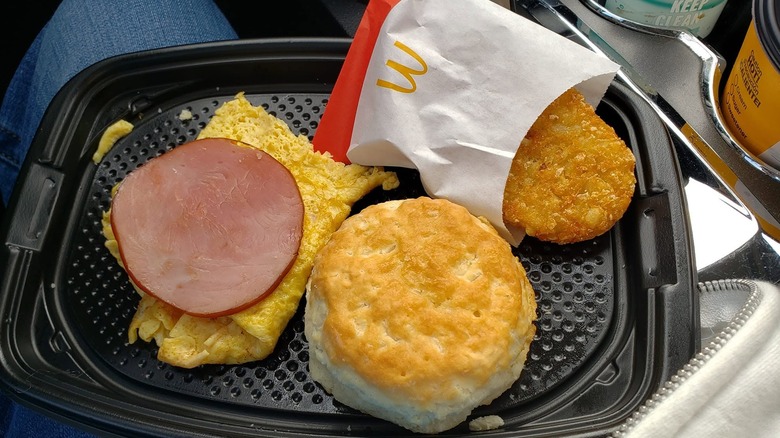
Along with the fact that the McDonald's Egg McMuffin is endlessly customizable (even the simple addition of extra butter upgrades the sandwich), its base ingredients make for a bite that is a symphony of rich, savory flavors and includes enough variety of textures to keep your mouth interested until the very end. One of the most compelling components of the once good, now great McMuffin is the Canadian bacon: the thin, disc-shaped meat that seemingly has more in common with ham than the crispy strips we associate with bacon. It might interest you to know that this tender slab of pork doesn't get its salty flavor from a slow brine, or really, any immersive procedure at all. Instead, the brine is actually injected into the meat during the manufacturing process, according to Food Tech Today (per YouTube).
McDonald's hasn't publicly released which of its partners actually produces its Canadian bacon, but it's as good a guess as any that it could be Lopez Foods, a long-time known beef supplier for the burger chain. Whoever manufactures the Canadian bacon, though, does so by following a highly mechanized process, where the pork loins, fresh from the slaughterhouse, go through a series of machines in the plant. One of these machines contains hundreds of needles that automatically inject the brine, made mostly of salt, sugar, sodium nitrate, and food coloring, into the trimmed but still largely unprocessed pork as it travels down the production line. The brine is necessary for flavor, as well as texture, to ensure the meat stays tender and juicy.
How the Canadian bacon arrives at restaurants, and how it gets cooked
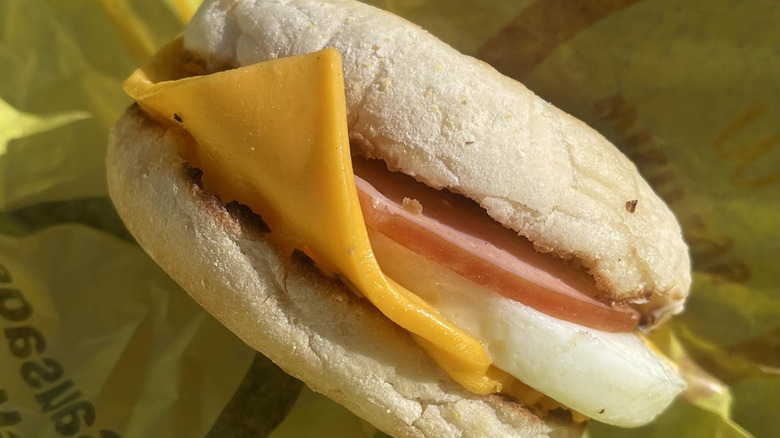
The journey those pork loins make from the moment they enter the processing plant until they end up as slices on a McDonald's McMuffin is actually fascinating, and no part is more interesting than the second half of the operation. This is where the pork is packed tightly into sleeves, steamed for around five hours until fully cooked, and the brine has the opportunity to permeate and distribute all throughout the meat. Then, the tubes of pork are sliced into exact discs by a machine and placed in its vacuum-sealed packaging. Instead of arriving frozen at McDonald's locations, as the sausage does, the Canadian bacon arrives merely refrigerated.
To cook the Canadian bacon and give it the requisite browning that appears on the finished McMuffin, employees simply grab a number of the slices and place them down in the front of the clamshell grills, so that they're not under the lid. They cook for eight seconds on each side, and unlike McDonald's burgers, which don't get flipped, an employee must manually turn them over. The precise timing allows the slices to warm through, but not cook for so long that they crisp up, which could then be a hop, skip, and a jump away from burning and wasting Canadian bacon.