

Add This Salty Ingredient To Ground Beef For Crispier Burgers (Hint: It's Not Bacon)
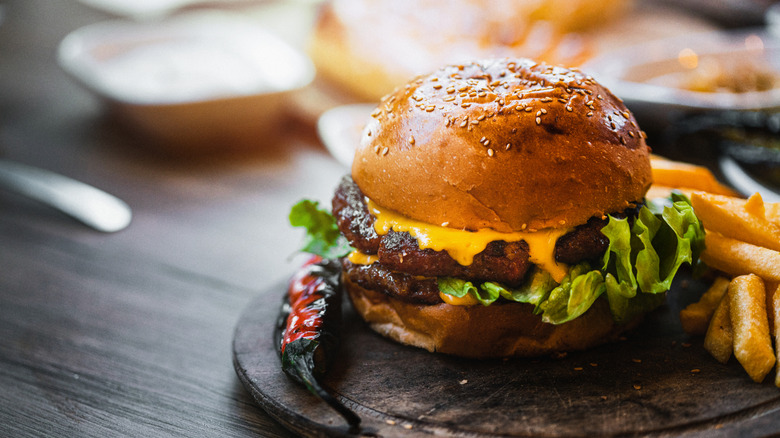
Everybody loves a burger, but a standard beef patty is hardly breaking news. To shake up burger night, there are plenty of unique ingredients you can add to your patties. Drawing inspiration from a classic bacon cheeseburger, take that combo a step further by swapping the bacon for guanciale and working it straight into the patty instead of piling it on top. It transforms both the texture and the flavor, and once you try it out for yourself, you'll never go back to plain old beef patties.
Bacon and guanciale are both cured pork products, but a few things set them firmly apart. Guanciale, a foundational ingredient in Roman pastas like carbonara and pasta alla gricia, is unsmoked, cured pork cheek (also known as jowl), while bacon is usually smoked pork belly. While guanciale may lack the smoky flavor we love in bacon, it more than makes up for it in fat. Where bacon tends to run leaner (40 to 50% fat), guanciale is made up of around 65% to 75% fat. Cook it, and that thick fat melts into a rich, fragrant oil while the meat turns golden and crisp at the edges, leaving behind an intensely savory, porky punch that'll completely level up the flavor (and texture) of your burger.
You'll find guanciale sold in several formats, from whole slabs to pre-sliced or cubed packs. For burgers, we recommend picking up a slab and cutting it into very small cubes, so it blends evenly into the patty. Go too big, and you risk the whole burger falling apart. Guanciale also needs time over heat to truly shine. For the crispiest results, rather than adding raw guanciale directly to your patties, render it out beforehand, and you'll be guaranteed to find little pockets of caramelized crunch running through each and every bite.
Things to think about when adding guanciale to your burgers
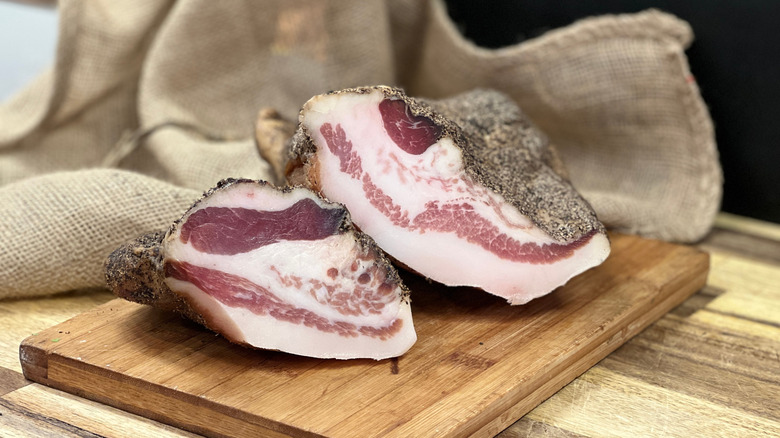
When adding guanciale to your burger patties, the end goal is a richly savory flavor and, even more importantly, a crunchy texture. Getting there, however, requires a specific method. Thin-cut bacon may see some success straight into a hot pan, but guanciale needs a gentler touch. Start the diced cubes in a cold pan over low-to-medium heat, which gives the dense fat time to render slowly before the meat even thinks about crisping up. Drop them into a hot pan instead, and the exterior scorches before the fat has had the chance to melt.
Another factor worth giving some thought is your beef's lean-to-fat ratio. Guanciale is very fatty, which comes with plenty of benefits, like keeping the meat flavorful and juicy during cooking. But stack it on top of an already fatty blend, and you risk a greasy burger. For the best results, go for a leaner blend, something like a 93/7, so the guanciale can do the heavy lifting on fat and flavor. With a leaner base, there's even room to work a spoonful of the rendered guanciale fat into the mix for extra richness. Better yet, fry the patties in whatever fat is left over in the pan. Compared to neutral oils, it's packed with flavor.
Last, but certainly not least, go easy on the salt. Guanciale is cured in the stuff, so those little cubes already bring plenty of seasoning to the mix, and a heavy hand can tip a perfectly seasoned burger into an inedible one. If you find the cooked patty to be too salty, don't toss it quite yet — try adding something dairy or creamy (a low-salt cheese or a dollop of mayo) or even a dash of something tangy, like a splash of vinegar or a squeeze of lemon or lime juice.