
Not Butter Or Canola Oil: The Fat Bobby Flay Recommends For Cooking Ribeye Steak

When making a steak, most of the attention goes to the marinade, whether it would benefit from a salt brine, or how long it needs to cook to reach the perfect doneness. Sure, all of these things matter when you're chasing after a beautifully cooked steak, but one area that rarely gets quite as much thought as it deserves is the cooking oil. Unsurprisingly, however, one person who doesn't leave this decision to chance is celebrity chef Bobby Flay, who has revealed that he likes to cook his ribeyes in avocado oil (via Today).
Most people don't think twice about what oil they cook their steak in. More often than not, it's butter or canola oil, simply because they're easy to find and likely already sitting in the pantry. Avocado oil might be a slightly more unconventional choice, but Flay isn't the type to steer us in the wrong direction. He told Food&Wine that he prefers to cook with it thanks to its neutral taste and the fact it won't scorch under high heat.
When deciding whether avocado oil or canola oil, or any cooking fat, is right for your steak, a good place to start is the smoke point. Simply put, this refers to the temperature at which oil begins to produce visible smoke. Since steak benefits from high heat to develop that flavorful crust, you want an oil that can handle the temperature without smoking excessively. Once an oil starts smoking heavily, it can break down and produce unpleasantly bitter flavors and compounds that you probably don't want anywhere near your steak. Refined avocado oil is a great fit for the job since its smoke point can reach up to 500 degrees Fahrenheit.
Why cooking oil matters when making a steak
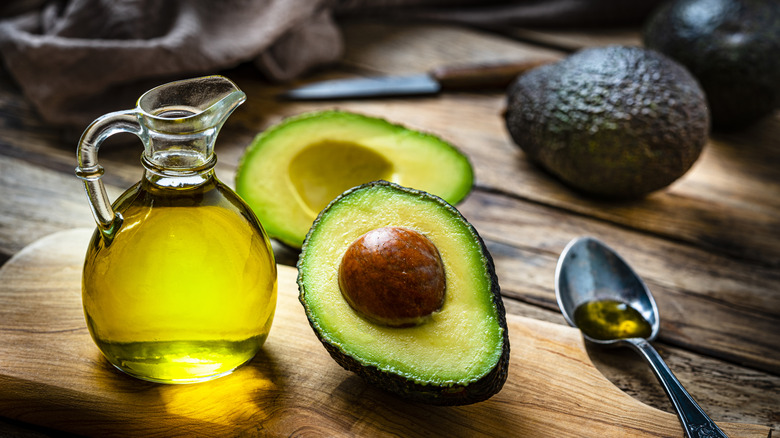
Some avocado oils are extracted from the fruit with relatively little processing, while others are more heavily refined, which involves processes such as bleaching and deodorizing. In the traditional sense, unrefined avocado oil is generally considered to be more "nutritious" than refined avocado oil as it retains more antioxidants, but this comes at the cost of a much lower smoke point, making these types of oils ill-suited to the intense heat needed for searing steak — for reference, its smoke point is around 400 degrees Fahrenheit, almost a 100-degree difference to its refined counterpart. As a general rule, cold-pressed oils are better suited to lower-heat cooking or finishing dishes, where you can make the most of their fresh, vibrant flavors, which refining strips.
Smoke point isn't the only thing to consider when choosing a cooking oil. It's especially important to consider when you're working with leaner cuts of steak, such as filet mignon or sirloin. These cuts contain relatively little intramuscular fat, so they don't have the same built-in lubrication as something like a ribeye. That's where the oil you add before cooking becomes more important. One trick used by steak pros is to oil the steak directly rather than pouring oil straight into the pan. This gives the meat an even coating, encouraging a uniform sear while simultaneously giving your seasonings something to cling to.