

The Packet In Your Takeout Bag Isn't Real Soy Sauce If You See This Brand Name
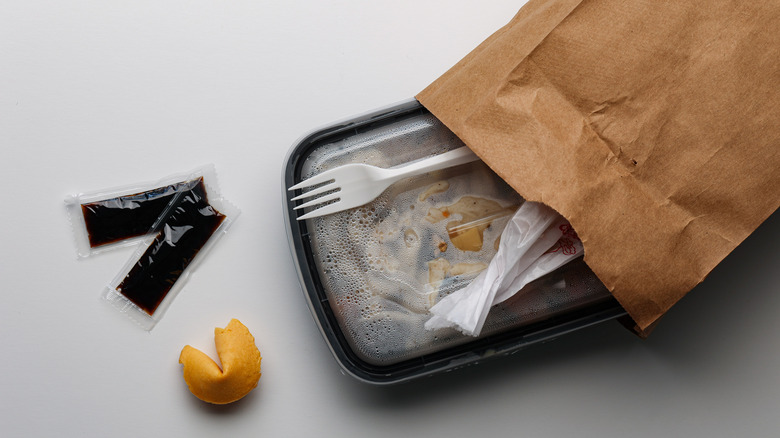
Is there any joy in this world like foregoing cooking dinner for a night and instead ordering Chinese takeout? Sure, you could buy all the ingredients and spend plenty of your precious time prepping and making your own at home, but if you don't have the right Chinese ingredients to elevate the dish, there is no way your homemade version can compare to the glorious, greasy delight that is takeout. Naturally, the restaurant from which you order will throw in a handful of condiment packets, including soy sauce. But you should be aware that if the brand on the individual packet of the Asian condiment reads Kari-Out, it's unfortunately not traditionally brewed soy sauce.
You see, soy sauce — real, traditionally brewed soy sauce — is made using a painstakingly long technique, which can take up to several years in some cases. Much of that time is spent fermenting the inky liquid, but "fake" soy sauce bypasses the fermentation process entirely, taking as little as a few days. Instead of a drawn-out fermentation, the fake stuff, like Kari-Out, is made with hydrolyzed soy protein, and other ingredients are added to create an approximation of the real thing.
To be honest, it's probably not a big deal if you receive Kari-Out when you're just eating it with takeout, which sometimes errs on the side of Americanized and can be nothing like what they actually eat in China. But if you were to create Chinese food at home or enjoy a meal while dining out, you would definitely want to enhance the experience by using the real deal.
You can identify real soy sauce by its ingredients and flavor
There are a few indicators you can watch out for when buying soy sauce in grocery stores to be sure you're picking up the real thing, aside from relying on customer-approved brands. For one, you can actually read the difference in the ingredients list. Traditionally brewed soy sauce (of which there are at least 13 varieties) will typically list salt, wheat, and soybeans, and perhaps most importantly, it will indicate that it was brewed on the label. This last bit is especially significant because it means the liquid within actually went through the fermentation process. On the other hand, chemically produced soy sauce contains things like hydrolyzed soy and corn protein, plus added color (Kari-Out contains caramel color).
If you're dining out and don't have access to the bottle the soy sauce came in, you ought to be able to tell based on the flavor. Chemically produced soy sauce typically tastes one-note, salty, and kind of artificial. Real soy sauce, in contrast, has complexity, a hint of sweetness, and a savory profile that doesn't hit your tongue as pure saltiness. The real stuff, too, isn't necessarily pitch-black but can appear rather transparent when held up to the light, and it may give off a reddish hue.