

McDonald's Vs Wendy's: The Burger Chain With A Healthier Classic Cheeseburger

When you're hungry for an all-American cheeseburger, McDonald's and Wendy's are two popular spots with plentiful options to feed those cravings. Among their offerings, each chain sells a standard, basic cheeseburger — the Jr. Cheeseburger at Wendy's and the Cheeseburger at McDonald's. The two burgers are very alike in terms of their composition and toppings. They both feature toasted buns, American cheese, pickles, onions, ketchup, mustard, and beef patties. Mickey D's meat is shipped to stores frozen (save for the beef for the Quarter Pounder), while Wendy's is among the chains that use always fresh and never frozen beef. One obvious difference between the sandwiches is the distinctive, square-shaped beef patty that is characteristic of all Wendy's burgers. But, looking beyond their appearances, which one is the more nutritious option?
Every person has a different idea of what is "healthy" and what isn't, so defining that factor really comes down to opinion. Nutritionally, though, a clear winner emerges when you crunch the numbers. Between the classic cheeseburgers offered at Mickey D's and Wendy's, McDonald's Cheeseburger rises to the top as the more nutritious contender, pulling ahead in key areas like protein and fiber content. There are also areas where the two burgers are dead even, as well, such as their vitamin, mineral, and fat content.
Come along with us as we take a deeper dive into the nutrition facts for these two competing cheeseburgers. If you're undecided as to which sandwich you should opt for when hunger strikes, a closer look beneath the buns may help settle the question.
McDonald's wins the day in key nutritional areas
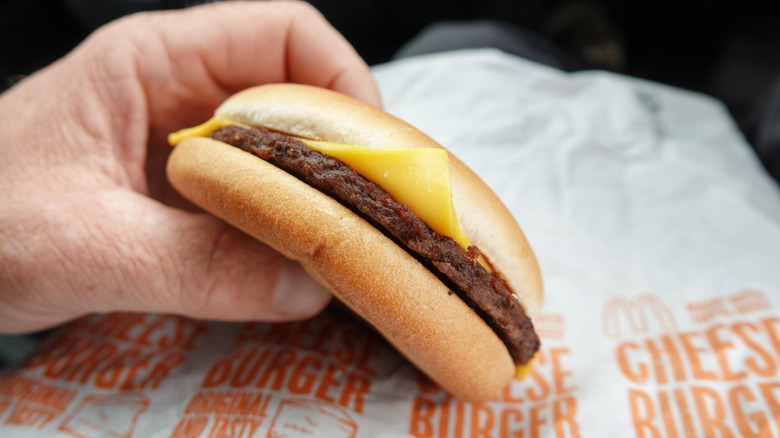
Over at the Golden Arches, you'll get 15 grams of protein and 2 grams of fiber in the basic cheeseburger, which is more than the Wendy's burger offers. The sandwich also serves up 90 milligrams of calcium, or 8% of the recommended daily value; 2.5 milligrams of iron, or 15% of the DV; and 210 milligrams of potassium, or 4% of the DV. These amounts are identical to those offered in the Wendy's burger.
There is one area in which McDonald's falls behind the Wendy's cheeseburger, and that's sodium content. McD's burger contains 720 milligrams of sodium, while the Wendy's sandwich has 660 milligrams. The FDA advises consuming under 2,300 milligrams daily, so neither cheeseburger is egregiously high, but if you're watching your sodium intake, that may sway you over to Wendy's.
Since Mickey D's burger patties are flash-frozen, you might assume this harms the beef nutritionally. While the general perception is that fresh meat is more nutritious, the opposite has actually been found to be true. Fresh, unfrozen beef, like the meat used at Wendy's, is prone to losing nutrients over time — the longer it's stored in refrigerators and held at room temperature, the more its vitamins, minerals, and proteins can degrade due to factors like fluctuating temperatures and air exposure. The flash freezing process, like McDonald's uses for its beef, can actually result in greater nutrient preservation.
Optional add-ons can turn up the nutrition factor in Wendy's Jr. Cheeseburger
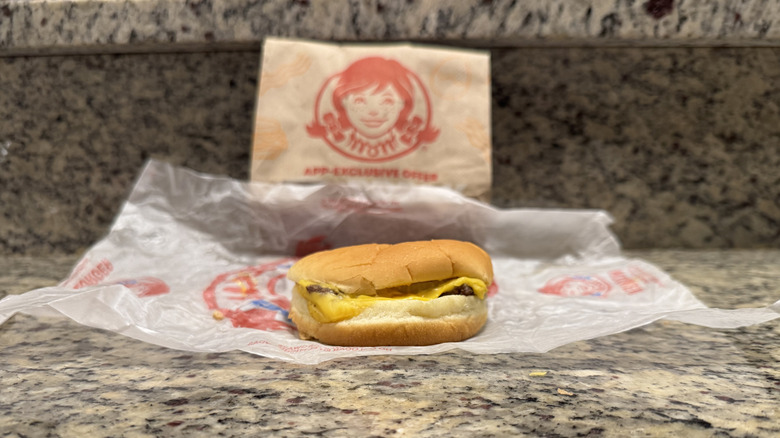
The Jr. Cheeseburger at Wendy's delivers 14 grams of protein, falling 1 gram behind the McDonald's sandwich. It also offers 1 gram of dietary fiber, which is similarly 1 gram behind Mickey D's. Like the McDonald's burger, it contains 8% DV of calcium, 15% DV of iron, and 4% DV of potassium.
If you're following the 2,000-calories-per-day general guideline prescribed by the FDA, your target consumption of fats should be between 44 and 78 grams per day, with no more than 22 grams coming from saturated fat. However, you should try to limit saturated fat and do your best to avoid artificial trans fats (as in, not found in nature, like those in meat and dairy) altogether. Both the Wendy's and McDonald's cheeseburgers contain 13 total fat grams. When you subtract out their 6 grams of saturated fat and 0.5 grams of trans fat, the burgers each deliver 6.5 total grams of unsaturated fats (also known as healthy fats).
The McD's sandwich contains 300 calories, while Wendy's weighs in just below that with 270 calories. If you're counting calories for dietary reasons, this puts the Wendy's burger as the favored option. Looking at it another way, though, containing higher calories and more fiber makes the McDonald's burger a more filling nosh.
If you want to increase the nutrition in your Jr. Cheeseburger, Wendy's offers customization options that are identical to those available for the McDonald's burger, including letting you add extra cheese slices, applewood smoked bacon, and additional veggies like tomato and lettuce. Opting for all of these extras will increase the calcium content, turn up the protein, and bring extra vitamins and minerals into play.