

Forget New York Strip: The Budget-Friendly Steak Cut That's Making A Comeback
We may receive a commission on purchases made from links.
According to Jacques Pépin, there's no better cut of steak out there than a New York strip thanks to its delicious marbling. Unfortunately, due to the high quality and high demand, you'll be paying a pretty penny for one — even a USDA Choice (not Prime) runs around $20 a pound, and that's at a retailer like Walmart. Fortunately, if you want something just as good but far less expensive, you can turn to the old-fashioned Delmonico cut.
This once-popular steak cut was named after one of America's first fine dining establishments, Delmonico's Restaurant. While it was originally harvested from just behind a cow's thirteenth rib, you may also find boneless ribeyes mimicking its signature intramuscular fat and two-inch thickness sold under the same name — but don't be deceived. A true Delmonico is quite affordable at roughly $13 a pound from retail, depending on your source, a big savings compared to the New York strip. However, keep in mind that ribeye may still cost upwards of $30 a pound, so a high-priced Delmonico could be an imposter.
While there are no strict labeling laws on what constitutes a "Delmonico," a true cut should combine the great qualities of a New York strip and a ribeye, as it's harvested near both of them. Fantastic marbling combined with the beefy chew you'd expect from a leaner cut creates a truly unique steak that can be difficult to find. Unfortunately, you can only source two from every cow, so this delicious yet affordable cut may be hard to find, but it is always worth it.
How to prepare a Delmonico steak
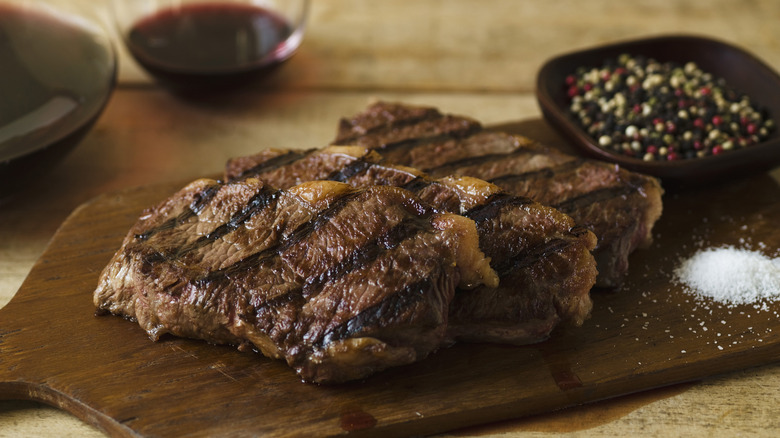
Even if you've never bought a Delmonico, don't feel too much apprehension about making it perfectly. As forgiving as it is delicious, the ideal way to cook this steak is to treat it like you would any other well-marbled slab of beef, which involves careful heat control, plenty of seasoning, and a way to sop up all those extra juices.
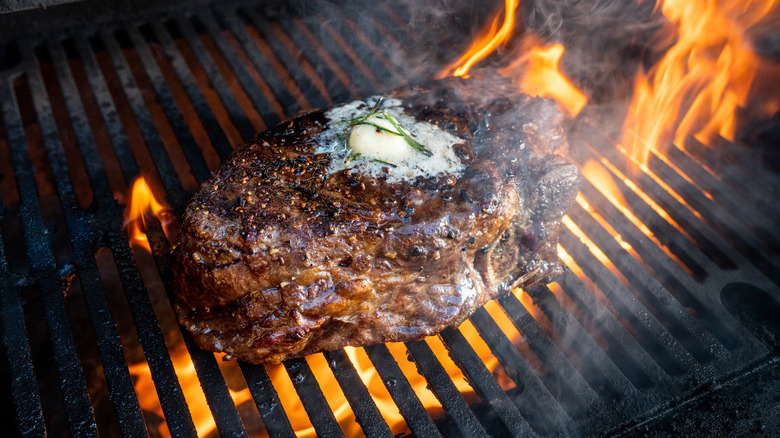
Lean meats tend to dry out easily, so short sears over high heat keep them from becoming boot leather. But cuts like the Delmonico, with rich intramuscular fat, benefit from longer cook times to render all that flavor into the meat. A reverse sear, where the steak is slowly brought to temperature then finished in a scorching hot pan to get that craveable crust, is a reliable way to bring out its full flavor. Still, a two-zone grill and careful attention can produce just as good a product and still let you get that flame-broiled, charred taste.
Guaranteeing a tender Delmonico is quite straightforward and doesn't require specialty tricks or knowledge. A generous application of salt, allowed to sit on the surface (while uncovered in the fridge) for at least an hour, draws out surface-level moisture for a better crust and helps tenderize muscle fibers. This also encourages the muscles to hold on to more liquid, making the end product juicier. Finishing it with a butter baste creates a silkier mouthfeel that makes it feel more tender without messing with the muscle.